Boiling water is one of the simplest things we do at home. Whether it is used for drinking, making tea, preparing coffee, cooking, or mixing powdered foods, many people assume that once water reaches a rolling boil, it is automatically safe.
Boiling is indeed an important way to kill many disease-causing microorganisms. But boiling does not remove every possible contaminant, and the way water is stored, reheated, or handled afterward can also matter.
Some common household habits may therefore create unnecessary risks or reduce the effectiveness of boiling as a safety measure.
Here are three mistakes worth knowing about.

1. Assuming Boiling Removes Every Contaminant
Perhaps the biggest misconception is that boiling water makes every type of contaminated water completely safe.
It does not.
Bringing water to a rolling boil is highly effective against many bacteria, viruses, and parasites. For situations where microbial contamination is suspected, public-health guidance commonly recommends bringing water to a rolling boil and maintaining the boil for an appropriate period.
But boiling does not reliably remove chemicals, heavy metals, salts, or many other dissolved contaminants.
For example, if water contains certain chemical pollutants, simply heating it may not make the water safe to drink.
In some circumstances, prolonged boiling can actually reduce the volume of water through evaporation while leaving nonvolatile dissolved substances behind, potentially increasing their concentration.
What should you do?
The first question should be:
Why are you boiling the water?
If the concern is microorganisms, boiling can be an effective treatment.
If the concern is chemical contamination, however, you need to know what contaminant is present and follow guidance from the local water authority or a qualified professional.
Boiling should not be treated as a universal solution for every water-quality problem.
2. Repeatedly Reboiling Water Without Considering Storage and Contamination
Another common habit is allowing boiled water to sit for a long time and then repeatedly reheating it.
You may hear claims online that reboiling water automatically turns it into a dangerous or poisonous substance.
That is an oversimplification.
For ordinary drinking water, there is no good basis for saying that simply boiling the same water twice makes it poisonous.
However, repeatedly boiling water can become problematic under certain circumstances because of evaporation and concentration.
Every time water evaporates, dissolved substances that do not evaporate with it remain behind. If the same water is repeatedly boiled down substantially, the concentration of some dissolved minerals or contaminants could increase.
This is particularly relevant if the original water source already contains undesirable substances.
Storage matters, too
Once water has been boiled, it can become contaminated again if it is stored improperly.
For example, repeatedly opening a container, touching the water or inside of the container, leaving it uncovered, or storing it at an unsuitable temperature can introduce microorganisms.
This means that boiling and storage should be considered together.
If you have boiled water for drinking, place it in a clean, covered container and handle it in a way that minimizes recontamination.
3. Boiling Water in an Unclean Kettle or Container
Sometimes the problem isn't the water itself.
It is what you're boiling it in.
Kettles, pots, thermos bottles, and storage containers can accumulate mineral deposits, residue, dust, or microbial contamination if they are not cleaned regularly.
You might boil water perfectly, but if the container is dirty afterward, the water can become contaminated again.
Look inside your kettle
If you notice a white or chalky layer inside your kettle, this is commonly limescale, which is largely composed of calcium carbonate and other mineral deposits.
Limescale is generally more of a maintenance and taste issue than evidence that the water is poisonous.
However, a dirty kettle can also contain accumulated residue and biofilm, particularly around the lid, spout, seals, or areas that remain damp.
That's why regular cleaning is important.
Don't forget the lid and spout
These areas are easy to overlook.
When cleaning your kettle or other water container, pay attention to:
-
The lid
-
Spout
-
Filter screen
-
Rubber seals
-
Interior surfaces
-
Areas where water tends to remain after use
Always follow the manufacturer's cleaning instructions, especially for electric kettles.
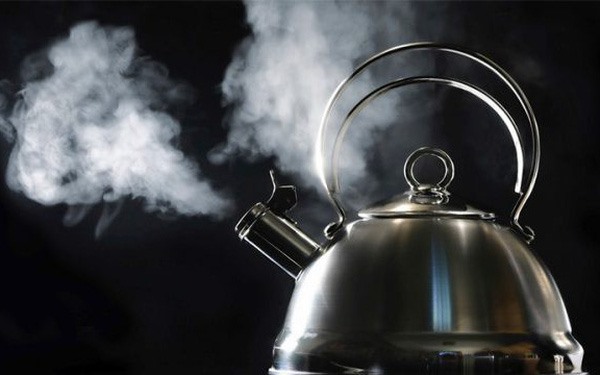
Does Boiling Water Remove Bacteria?
Yes, adequate boiling can kill many disease-causing microorganisms.
This is one of the major reasons boiling has long been used as a household water-treatment method.
However, effectiveness depends on proper heating.
Simply seeing a few bubbles does not necessarily mean the water has reached a sustained rolling boil.
For emergency treatment of water when microbial contamination is suspected, public-health authorities generally recommend bringing water to a rolling boil and maintaining it according to their guidance.
Afterward, the water should be allowed to cool in a clean, covered container.
The process is important:
Treat → cool safely → store safely → avoid recontamination.
What About Bottled or Tap Water?
The answer depends on the water source.
If your household receives properly treated municipal drinking water, routinely boiling every glass of water may not be necessary unless there is a specific advisory or reason to do so.
If your water comes from a private well, the safety situation can be different.
Well water may require periodic testing because contamination can occur from:
-
Agricultural runoff
-
Septic systems
-
Flooding
-
Naturally occurring minerals
-
Nearby industrial activity
In these circumstances, knowing what is actually in the water is much more useful than simply assuming boiling will solve every problem.
What About Nitrate Contamination?
Nitrates are an example of a contaminant for which boiling is not an appropriate treatment method.
If water contains excessive nitrate, boiling can reduce the amount of water through evaporation while leaving nitrate behind.
That means the nitrate concentration can potentially increase.
This is particularly important for households with infants because high nitrate levels in drinking water can pose serious health risks.
If there is a known nitrate problem, the appropriate solution is a water-treatment method specifically designed to remove nitrate, or another safe water source—not prolonged boiling.