The Alaska earthquake was a reminder that preparedness cannot begin after the ground starts moving.
It must be part of everyday life in regions exposed to seismic hazards.
Chapter 6: What the Alaska Earthquake Teaches the World About Tsunami Safety
The Alaska Peninsula earthquake was a powerful reminder that a tsunami emergency can begin far from the communities that eventually receive the warning.
It also demonstrated why the first reports after an earthquake must be interpreted carefully.
A headline may describe a powerful earthquake and a tsunami warning in the same sentence. Readers may understandably assume that a devastating wave has already struck a city.
But the sequence of events is more precise.
An earthquake occurs.
Scientists assess whether the movement could have displaced the ocean.
Warning centers issue alerts for potentially exposed coastlines.
Authorities monitor the sea and update their assessments.
Warnings may be expanded, downgraded, or canceled as evidence becomes available.
That sequence is the foundation of modern tsunami response.
Why the first minutes matter
When a strong earthquake occurs near the coast, people may have only a limited amount of time to respond.
In some locations, a tsunami can arrive within minutes. Waiting for an official announcement may not be the safest option if the shaking itself is strong or prolonged.
For this reason, people in tsunami-prone areas are often advised to recognize natural warning signs.
These may include:
-
Strong or long-lasting earthquake shaking.
-
A sudden and unusual rise or fall in sea level.
-
A loud roaring sound coming from the ocean.
-
Official tsunami warnings or evacuation instructions.
If strong shaking occurs near the coast, people should protect themselves during the earthquake and move to higher ground as soon as it is safe to do so, following local evacuation guidance.
They should not wait at the beach to see whether a wave appears.
They should not return to the shoreline simply because the water looks calm.
And they should not assume that the first wave will be the largest.
A tsunami is not necessarily a single breaking wave like those seen in ordinary coastal surf.
It may arrive as a rapid rise in water level, a powerful surge, or a series of waves and currents that continue for an extended period.
The danger can remain even after the most visible wave has passed.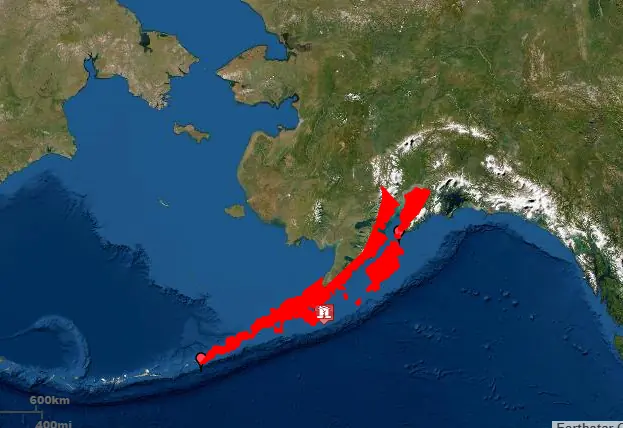
The importance of reliable information
During a major earthquake, social media can spread information faster than traditional news outlets.
That speed can be useful, but it can also create confusion.
Old footage may be presented as new.
A warning issued for one region may be described as applying to an entire country.
A preliminary earthquake magnitude may be repeated after scientists have revised it.
And a tsunami warning may be turned into a claim that a city has already been flooded.
The Alaska earthquake is a useful example of why readers should distinguish between a confirmed earthquake, a tsunami warning, and verified damage.
The confirmed event was a powerful magnitude 8.2 earthquake near the Alaska Peninsula in July 2021.
The warning was issued because officials were assessing the possibility of a tsunami.
The warning itself did not prove that a destructive tsunami had struck a city.
These are separate facts, and they should remain separate in responsible reporting.
For readers who encounter a headline about a magnitude 9.1 earthquake and a tsunami, the first questions should be straightforward:
Where did the earthquake occur?
When did it happen?
What magnitude was reported by the relevant scientific agency?
Was a tsunami warning issued?
Did officials confirm that a tsunami reached a populated area?
Were there verified reports of damage or casualties?
Those questions help prevent an alarming headline from becoming a misleading account of an actual event.
A warning is not a failure
There is another important lesson in the Alaska response.
When a tsunami warning is issued and no major wave causes widespread damage, some people may wonder whether the warning was unnecessary.
But emergency warnings are not designed to predict the future with absolute certainty.
They are designed to reduce the risk of death and injury when the consequences of waiting could be severe.
A warning system must balance the danger of issuing an alert that later proves unnecessary against the danger of failing to alert people before a destructive wave arrives.
In a tsunami emergency, the cost of waiting for perfect information can be catastrophic.
The Alaska warning gave authorities and residents an opportunity to take precautions while scientists assessed the threat.
That is precisely what a warning system is meant to do.
The Pacific's continuing earthquake risk
The Pacific Ocean is surrounded by regions where tectonic plates interact. Many of these areas are capable of producing powerful earthquakes and tsunamis.
Alaska, the Aleutian Islands, Japan, Indonesia, Chile, and other parts of the Pacific Rim have experienced major seismic events.
The 1964 Great Alaska Earthquake, which reached magnitude 9.2, remains the largest earthquake recorded in U.S. history. It generated a major tsunami that caused damage and casualties across parts of Alaska and other coastal areas.
U.S. Geological Survey
That historical event demonstrates why Alaska's earthquake warnings are taken seriously.
The region has the geological conditions needed to produce very large earthquakes.
But it is important not to confuse the 1964 magnitude 9.2 earthquake with the magnitude 8.2 earthquake near Perryville in 2021.
They were different events, separated by decades and associated with different earthquake ruptures.
The 2021 event triggered a serious warning and a broad assessment of tsunami risk. It did not become the same kind of catastrophe as the 1964 earthquake.
The distinction is not a reason to minimize the 2021 event.
It is a reason to report it accurately.
The final lesson
The most important story from the Alaska earthquake is not that a magnitude 9.1 earthquake destroyed a city.
The available reporting describes a magnitude 8.2 earthquake near the Alaska Peninsula that triggered tsunami warnings and emergency monitoring across the Pacific.
Sirens sounded in Kodiak.
Authorities activated emergency coordination.
Coastal communities were alerted.