The exact texture and thickness of a coat can vary depending on the individual animal, its age, the season, and its environment.
Young calves also change in appearance as they mature. Their body proportions become more adult-like, their coats develop, and their distinctive fringes may grow or change direction.
A calf that looks particularly round and fluffy in its early months may eventually develop a more elongated appearance as its body grows.
Even so, many Highland cattle retain the shaggy character that made them recognizable in the first place.
The little calf with the white curl seems to bring together everything people love about the breed.
It has the familiar fluffy coat, the distinctive forehead fringe, and the innocent appearance associated with young animals. Yet the bright white tuft introduces a surprising visual feature that makes its face especially memorable.
Imagine seeing several Highland calves together in a field. Their coats might range from reddish brown to black or pale cream. Their fringes might fall at different angles, and their faces might have slightly different shapes.
Among them, a calf with a cloud-like white curl would naturally draw the eye.
The marking does not need to be large to make a difference. Sometimes, the smallest contrast creates the strongest impression.
The Natural Beauty of a Highland Calf's Coat
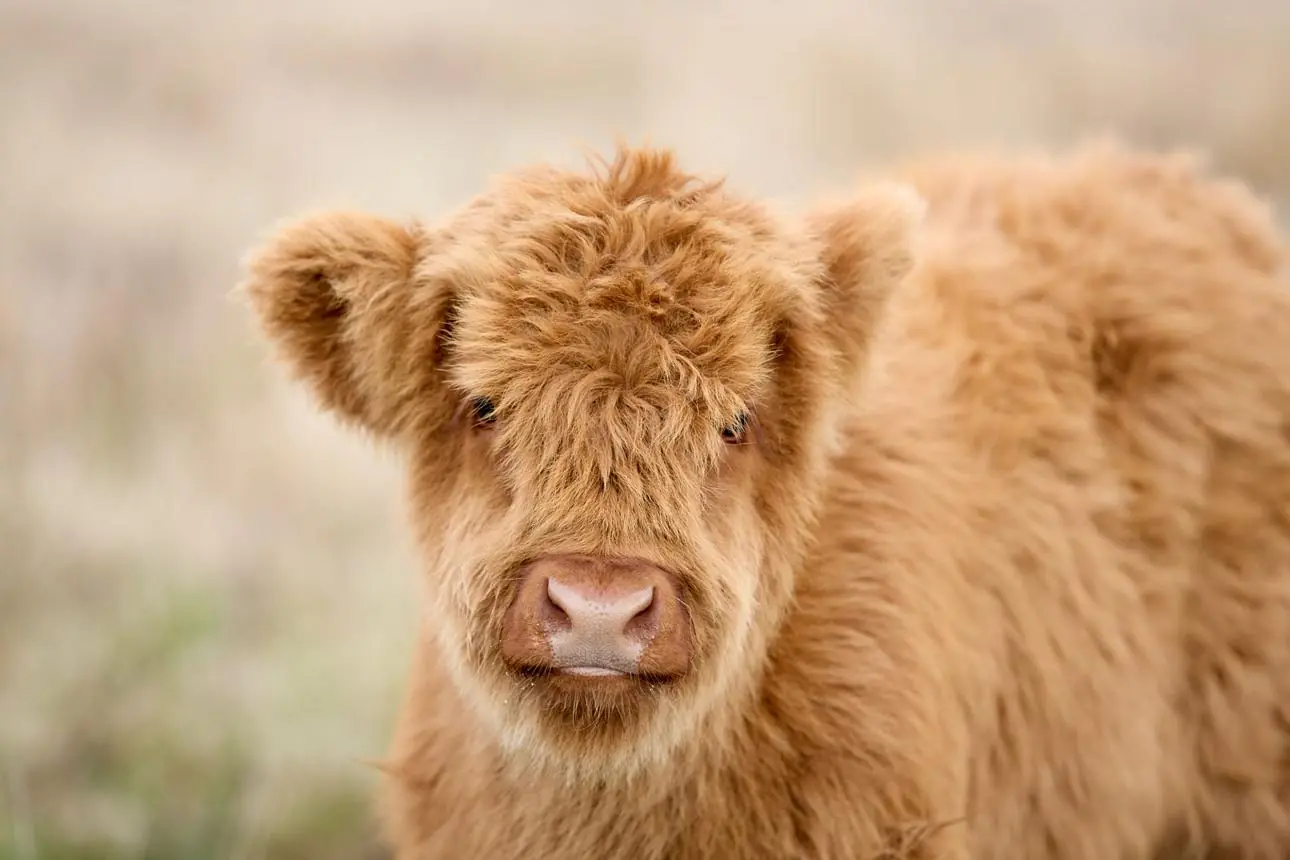
Animal coats are fascinating because they can display an enormous variety of colors, patterns, and textures.
Even within a single breed, individual animals may look remarkably different from one another.
Highland cattle are well known for their variety of coat colors. Red is perhaps the most widely recognized, especially in photographs of Scottish landscapes, but the breed also includes black, yellow, white, brindled, and other shades.
Some animals have deep reddish coats that appear coppery in sunlight. Others have dark brown or black hair that creates a dramatic silhouette against green grass. Pale cream and yellow coats can make individual cattle look almost golden when the light catches their fur.
These differences are part of the natural variation found within the breed.
Coat color is influenced by genetics, and different combinations of inherited traits can produce different shades and markings. Hair texture and the way individual strands grow also influence how a coat looks from one angle to another.
A shaggy coat can appear darker where the hair overlaps or lighter where sunlight illuminates the outer strands. Wet fur may look flatter and deeper in color, while dry fur can appear fuller and more textured.
The hair on an animal's forehead can be particularly expressive.
Because the strands grow in different directions, the fringe may form waves, curls, or small tufts. Some locks fall toward the eyes, while others angle sideways or stand slightly upward.
When a patch of hair differs in color from the surrounding coat, the contrast becomes even more noticeable.
That is what makes a white curl on a darker forehead so visually appealing.
The lighter hair catches the eye immediately, especially when the rest of the face is covered in brown or reddish fur. Its shape adds another layer of interest, turning a simple difference in pigmentation and hair direction into something that resembles a tiny decorative feature.
People naturally look for familiar shapes in the world around them. We recognize faces in clouds, hearts in leaves, and animal shapes in the patterns of stones or tree bark.
The same tendency helps explain why a white tuft of fur can look like a little cloud.
The calf's marking is real, but the cloud-like impression comes from the way people interpret its shape. Its softness, pale color, and rounded appearance all contribute to that resemblance.
There is no need to believe that nature deliberately created the marking to resemble a cloud. The charm lies in the unexpected result.
A combination of ordinary biological processes has produced something that feels wonderfully imaginative to human eyes.
That is one of the most enjoyable things about observing animals closely. Their appearance often contains small details that we might never notice if we only looked at them from a distance.
A tiny curl, a crooked ear, an unusual patch of fur, or a slightly uneven fringe can make an individual animal seem completely unique.
And once someone notices such a detail, it can become the first thing they remember about that animal.
For this Highland calf, the white curl may be the feature that makes its face instantly recognizable.
How Could a Calf Be Born With a White Curl?
The little cloud on this calf's forehead raises an interesting question: how can an animal develop such a distinctive patch of white hair?
The answer lies in the natural variation of coat pigmentation and hair growth.
Hair gets its color largely from pigments called melanins, which are produced by specialized cells during hair development. Differences in the amount and type of pigment influence whether hair appears black, brown, red, yellowish, or very pale.
White hair generally has little or no visible pigment.
The genetic processes that determine coat color are complex. Multiple genes can influence the distribution of pigment across an animal's body, and the exact pattern can vary even among individuals that share the same breed.
Some animals are born with relatively uniform coats. Others have contrasting patches, pale markings, or areas where the hair differs noticeably in color from the surrounding fur.
The distribution of hair itself can also influence how a marking appears.
Hair follicles do not necessarily produce strands that all point in the same direction. Around the forehead, hairs can grow in patterns that create whorls, waves, and curls.
These growth patterns can be especially visible in animals with long coats because the strands overlap and bend around one another.
When pale hair grows in a naturally curled section of a darker fringe, the result can look like a small white swirl sitting on the animal's head.
In other words, the calf's cloud-like hairstyle may reflect two separate characteristics: a difference in hair pigmentation and a particular arrangement of the hair.
Together, those characteristics create a striking visual effect.
Without detailed information about this individual calf, it would not be possible to determine the precise genetic explanation for its marking. Nor can a photograph alone establish whether the curl will remain exactly the same as the calf grows.
Its appearance could change as the hair lengthens, the coat develops, and the calf's body proportions change.
Nevertheless, naturally occurring markings are a familiar part of animal variation.
In cattle, horses, dogs, cats, and many other species, individual animals can have patterns that seem remarkably distinctive.
Some have white markings on their faces. Others have contrasting socks on their legs, spots across their bodies, or small patches that make them easy to recognize.
Occasionally, those markings resemble familiar objects or shapes.
A white spot might look like a star. A patch on a dog's chest might resemble a heart. A tuft of hair might form something that looks like a tiny flower or cloud.
These resemblances are usually interpretations rather than evidence that the markings have a specific symbolic meaning.
But they can still be delightful.
The white curl on this Highland calf demonstrates how a small natural variation can create a memorable appearance without requiring anything extraordinary to happen.
It also illustrates a broader truth about nature: biological variation does not always produce perfectly uniform results. Sometimes, the differences between individuals are precisely what make them fascinating.
No Two Highland Calves Look Exactly Alike
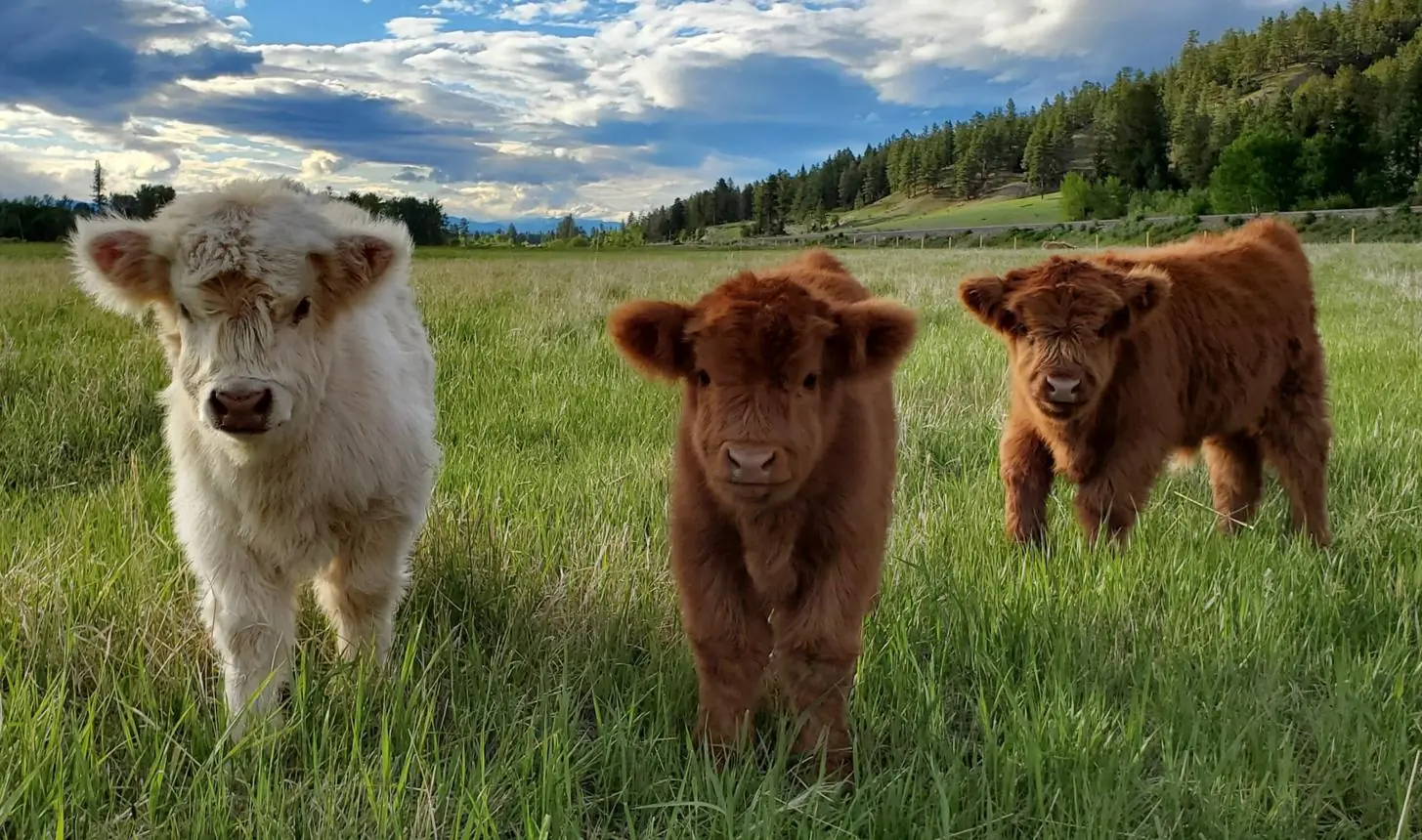 rivervalleyranch.ca
Spend enough time around Highland cattle, and one of the first things you may notice is how different individual animals can look.
Even when they belong to the same breed and live in the same pasture, their coats, faces, and overall appearances can vary considerably.
One calf might have a rich reddish-brown coat, while another has a lighter golden shade. A third might be black or pale cream. Some have particularly long fringes, while others have hair that sits differently across the forehead.
The shape of their horns also changes as they mature, although young calves may have little visible horn development at first.
Their faces have individual characteristics, too.
The spacing of their eyes, the shape of their muzzle, the arrangement of their fringe, and the way their ears sit can all contribute to a recognizable appearance.
Farmers who spend time with their animals often become familiar with these small differences. They may recognize individual cattle from a distance based on coat color, markings, body shape, or characteristic behavior.
A visitor might see a group of similar-looking animals, while someone who cares for them every day can distinguish one from another almost immediately.
The white curl on this calf could make identification especially easy.