Those pointed projections are one of the most recognizable features of the fruit.
They're also one of the reasons you shouldn't handle a large pile carelessly.
If the fruits are particularly sharp or have broken points, use caution when washing, moving, or opening them.
A towel or kitchen glove can provide additional protection while handling the hard shells.
How to Store Them
Fresh water caltrops should be handled similarly to other perishable plant foods.
If they are intended for consumption, keep them clean and appropriately refrigerated according to local food-safety guidance.
Avoid eating fruits that have:
-
A strong unpleasant odor
-
Visible mold
-
Slimy surfaces
-
Extensive decay
-
Unusual discoloration associated with spoilage
And don't assume that cooking will make spoiled food safe.
Cooking can reduce many microorganisms, but it doesn't magically reverse spoilage or eliminate every food-safety hazard.
What If You Don't Know Where They Came From?
This is especially important in the situation shown in the photograph.
The caption says:
"My neighbor gave me a bag of these. Anyone know what they are? How do you eat them?"
That's a perfectly reasonable question.
But before eating them, the person should ideally ask the neighbor:
Where were they harvested?
If the neighbor bought them from a market or food supplier, that's useful information.
If they came from a pond, lake, or wild waterway, additional caution is warranted.
If they were collected from an unknown body of water, it's better to establish their identity and food-safety status before consuming them.
Could They Be Something Else?
This is another important consideration.
The photograph strongly resembles water caltrops, but photographs aren't always enough for definitive botanical identification.
There are multiple species and varieties, and common names can vary dramatically between regions.
If someone plans to eat a wild or unfamiliar plant, identification should ideally be confirmed using:
-
A local agricultural extension service
-
A qualified botanist
-
A knowledgeable local forager
-
A reputable field guide
-
A trusted food market or supplier
Never rely solely on a social-media comment saying, "Yes, that's edible."
Why People Are So Fascinated by These Fruits
Part of the fascination comes from their appearance.
Modern supermarkets have made many foods look predictable.
Apples look like apples.
Bananas look like bananas.
Oranges look like oranges.
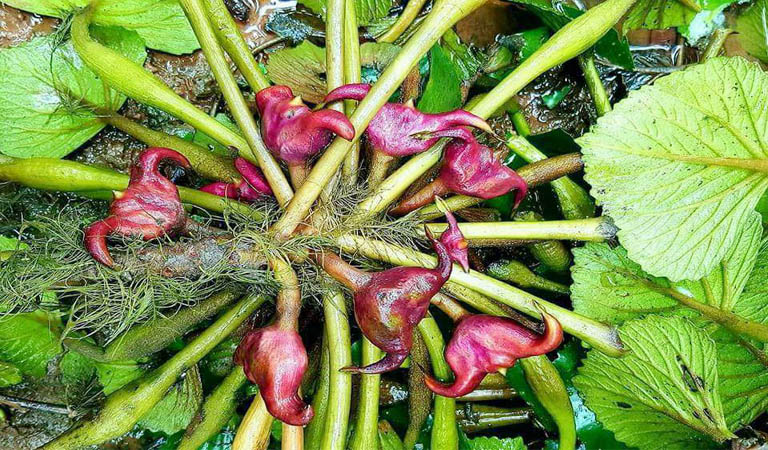
But water caltrops look almost prehistoric.
Their dark shells and curved horns make them look more like objects from a fantasy movie than something you'd find in the produce section.
And yet, inside is a perfectly ordinary edible plant food that has been part of traditional diets for generations.
Nature's Strange Designs Often Have a Purpose
The shape of the water caltrop is a great example of how unusual natural structures can have biological functions.
The hard exterior protects the seed.
The distinctive shape is connected to how the fruit interacts with its environment.
And the tough shell allows the seed inside to survive until conditions are favorable.
From our perspective, the fruit looks bizarre.
From the plant's perspective, the design has a purpose.
What Makes Them Different From Regular Chestnuts?
It's easy to confuse them because of the name.
Traditional chestnuts grow on trees and have a completely different structure.
Water caltrops grow in aquatic environments.
Chestnuts have a brown, rounded appearance.
Water caltrops have dark, angular shells with distinctive projections.
Their growing environments are also completely different.
So if you've ever heard someone refer to these as "water chestnuts," remember that they're not the same food as the familiar tree-grown chestnut.
A Food That Has Traveled Through Generations
One of the most interesting things about water caltrops is their history.
People have harvested and eaten them for centuries.
In some regions, they were important seasonal foods.
In others, they became ingredients in traditional flour and dishes.
Modern consumers may discover them through social media and wonder what they are.
But for families who have grown up eating them, there may be nothing mysterious about them at all.
They're simply a familiar food from the water.
Could You Grow Them at Home?
Water caltrops are aquatic plants, so growing them isn't as simple as planting a seed in ordinary garden soil.
They require suitable aquatic conditions.
In addition, growing certain species may be regulated or restricted in some regions because some Trapa species can become invasive.
That's an important environmental consideration.
Before intentionally cultivating or releasing aquatic plants, check local regulations and guidance.
Never release unfamiliar aquatic plants into natural waterways.
An Important Environmental Issue
Some water caltrop species have become invasive in parts of the world.
They can spread rapidly under favorable conditions and form dense mats across the surface of waterways.
Those dense growths can interfere with:
-
Boating
-
Fishing
-
Recreation
-
Light penetration
-
Native aquatic plants
-
Water movement
So while water caltrops are traditional foods in some places, they can also be considered problematic invasive plants elsewhere.
The species and location matter enormously.
So, How Should You Prepare Them?
If you have positively identified the fruit as an edible water caltrop and know that it came from a reliable food source, a traditional preparation is straightforward.
Step 1: Clean them
Rinse the exterior thoroughly under clean running water.
Because the fruits come from aquatic environments, don't skip this step.
Step 2: Cook them thoroughly
Boiling or steaming is commonly used.
Follow a trusted recipe for your specific species and size rather than relying on an arbitrary cooking time.
Step 3: Let them cool
The shells can become hot and difficult to handle.
Allow them to cool enough to work with safely.
Step 4: Remove the shell
Carefully crack or cut away the hard exterior.
Avoid the pointed projections.
Step 5: Eat the cooked kernel
The pale interior can be eaten as a simple snack or incorporated into other recipes.
What Should You Not Do?
Don't:
Eat an unidentified wild fruit simply because it looks like something you've seen online.
Don't:
Assume that every water caltrop from every region is equally safe.
Don't:
Eat aquatic plant material raw without understanding the food-safety risks.
Don't:
Consume fruits that appear spoiled or contaminated.
And don't:
Release leftover live plants or seeds into local waterways.
These precautions are simple, but they're important.
The Most Interesting Part Is What's Hidden Inside
Perhaps that's what makes the fruit so fascinating.
From the outside, it looks almost impossible to eat.
The dark shell is rough.
The horns make it look intimidating.
The shape is completely unlike most familiar fruits.
But inside is a pale, starchy kernel that has been used as food for generations.
It's a reminder that appearance doesn't always tell us much about what something is.
Final Thoughts
If you came across the strange horned fruits shown in the photograph and wondered what they were, they appear to be water caltrops from the genus Trapa, sometimes called water chestnuts, buffalo nuts, bat nuts, or singhara depending on the region.
They are aquatic fruits with a hard, distinctive shell surrounding a starchy edible kernel.
Traditionally, they are cooked before the shell is removed and the interior is eaten. They can be enjoyed as a snack or incorporated into various dishes, and their edible portion provides carbohydrates and several nutrients.
But there is one point worth remembering above everything else:
Don't eat an unfamiliar freshwater plant simply because someone identifies it from a photograph.
If these were given to you by a neighbor, ask where they came from and how they were harvested. Confirm the identification, and if they're intended for food, use a reliable preparation method that involves thorough cooking.
Once properly prepared, however, these bizarre-looking fruits can become a fascinating example of how traditional foods can look completely unfamiliar while having a long culinary history.
What looks like a strange black object covered in horns may actually be a traditional freshwater food hiding a surprisingly mild, starchy center.
Sometimes, the weirdest-looking foods in nature have the most interesting stories behind them.