No single measure can prevent every collision. However, reducing dangerous driving and improving protection for pedestrians can lower the likelihood that a mistake or loss of control will result in multiple deaths.
The Manhattan incident is a reminder that the consequences of a vehicle leaving the roadway can be severe, especially in places where people gather close to traffic.
A person walking on a sidewalk has little ability to escape a rapidly approaching vehicle. Even a short period of lost control can leave pedestrians with almost no time to react.
That is why pedestrian safety must be treated as a central part of urban transportation planning, not as a secondary concern.
The Wider Importance of Pedestrian Safety in New York City
New York City streets are used by millions of people, including drivers, passengers, cyclists and pedestrians. The same roads that carry vehicles also provide access to shops, homes, schools, workplaces and public transportation.
In a dense city, pedestrians are constantly close to moving traffic. They cross at intersections, wait at bus stops, walk past parked cars and move along narrow sidewalks.
The Manhattan crash highlighted the vulnerability of people who are outside vehicles when a driver loses control.
A vehicle offers some protection to its occupants, although serious crashes can still be fatal for drivers and passengers. Pedestrians have no comparable physical barrier. Their safety depends heavily on the behavior of motorists and the design of the street.
The city has pursued a range of road-safety measures over the years, including speed management, intersection improvements, pedestrian islands and enforcement initiatives. The effectiveness of any specific measure depends on the location and the circumstances.
A crash like this can lead residents to question whether the street offers enough protection. It may also encourage officials to examine whether there are recurring problems at the intersection.
However, a single incident does not automatically establish that a particular road design is unsafe. A careful review would need to consider the physical layout, traffic volumes, visibility, vehicle speeds and other relevant information.
The broader lesson is that pedestrian safety requires constant attention. Even streets that appear familiar and ordinary can become dangerous when drivers fail to maintain control or when vehicles enter spaces intended for people on foot.
The tragedy also demonstrates why public awareness of impaired driving remains important. Operating a vehicle while intoxicated can endanger not only the driver but also passengers, pedestrians and people in nearby vehicles.
The consequences can extend far beyond the moment of impact. Families may lose loved ones, survivors may face lasting injuries and communities may carry the emotional effects for years.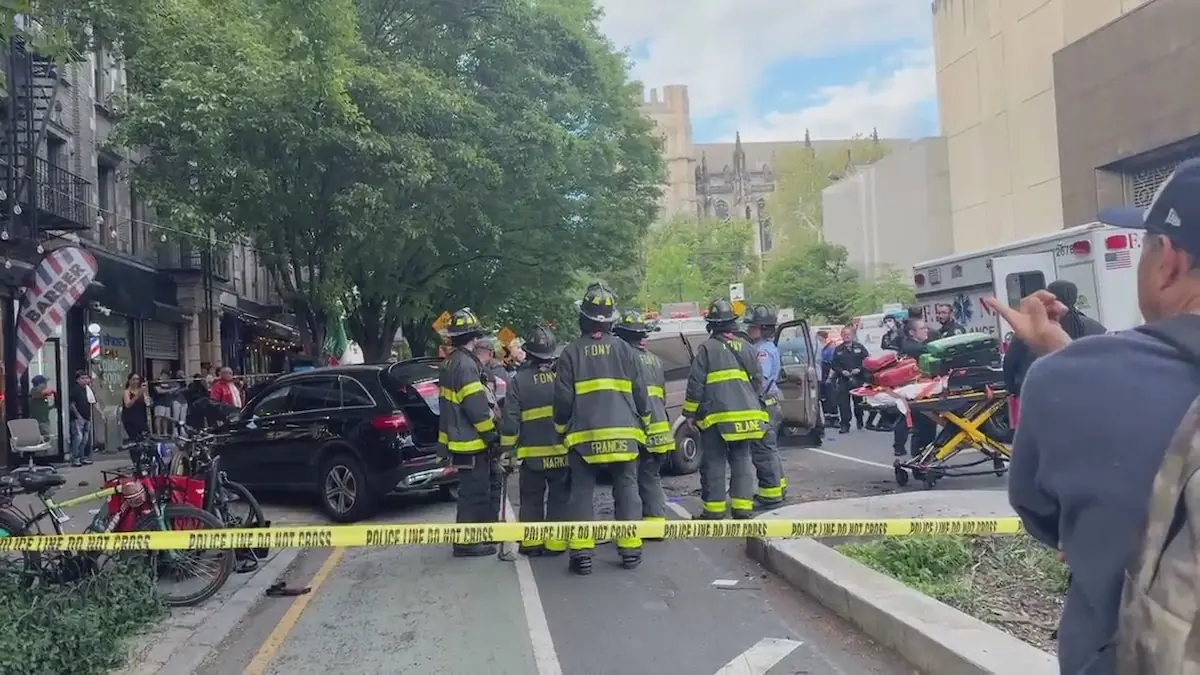
What Is Known—and What Remains Unanswered
The available reporting establishes several important facts about the Manhattan crash.
The collision occurred around 6 p.m. on Friday, May 15, 2026, near Amsterdam Avenue and West 109th Street on the Upper West Side.
A 61-year-old man was driving a Mercedes-Benz GLC 300 northbound on Amsterdam Avenue. Police said the SUV struck a parked Volkswagen Jetta, continued through the area, crossed a pedestrian island and struck pedestrians.
The vehicle then collided with a parked Chevrolet Astro van occupied by a 51-year-old man. The impact pushed the van into other parked vehicles.
Two pedestrians, Jason Negron, 46, and Michael Saint-Hilaire, 35, died. Three other pedestrians were seriously injured and taken to hospital.
The driver, identified as Elvin Suarez, was arrested and faced charges including manslaughter-related offenses, vehicular assault and driving while intoxicated.
The NYPD's Highway District Collision Investigation Squad was involved in the investigation.
Those facts provide a clear outline of the incident. But several questions require the evidence and legal process to establish a complete answer.
The exact circumstances leading to the first collision must be assessed. Investigators must determine the vehicle's movements and the reasons it continued after striking the parked car. The evidence relating to possible intoxication must be considered through the legal process. The precise medical outcomes for the injured victims also require confirmed updates.
The public reports do not justify inventing a mechanical failure, a medical emergency or a specific moment when the driver lost control. Nor do they establish that a particular road feature caused the collision.
It is equally important to avoid treating every early description as a final conclusion. Initial reports may be updated as police release additional information and as investigators clarify the sequence.
The image accompanying the original article also needs to be treated cautiously. It shows a severely damaged red pickup truck on a rural road beside a lake, not the documented Manhattan scene. It does not match the vehicle or urban setting described in the reports. The actual incident involved a Mercedes-Benz SUV on Amsterdam Avenue. The unrelated pickup-truck photograph should therefore not be presented as an authentic image of this crash.
There is also a date discrepancy in the screenshot: it displays November 3, 2026, while the matching, independently reported Manhattan collision occurred on May 15, 2026. The article text appears to describe the May incident, but its displayed publication date does not match the date of the verified event.
These distinctions matter because a dramatic photograph or headline can easily lead readers to associate the wrong scene with a real tragedy. Accurate reporting requires the text, date, location and photographs to correspond.
A Tragedy That Leaves More Than Wreckage Behind
After the emergency vehicles leave and the damaged cars are removed, the street will gradually return to its familiar appearance. Traffic will move again along Amsterdam Avenue. People will walk past the intersection, visit nearby businesses and continue their routines.
But for the families of Jason Negron and Michael Saint-Hilaire, life will not simply return to normal.
Two people who had been part of their community are gone. Three other pedestrians have had to face serious injuries. Witnesses and residents who saw the aftermath may continue to remember the scene long after the physical evidence has been cleared.
The arrest of the driver and the criminal charges that followed are important developments. They create a path for the legal system to examine responsibility and determine what the evidence supports.
Yet legal proceedings cannot reverse the consequences of the crash. They cannot restore the lives lost or immediately remove the uncertainty faced by injured survivors and their families.
The tragedy also raises a broader question about the safety of people who walk through New York City every day. Pedestrians should be able to stand outside a neighborhood business, wait at an intersection or walk along a sidewalk without fearing that a vehicle will suddenly enter their space.
The investigation must establish exactly how the collision happened and what factors contributed to it. The court process must address the charges against the driver. The community, meanwhile, must find a way to support the families and residents affected.
For now, the most important facts remain stark: two men were killed, three others were seriously injured, and a 61-year-old driver was arrested after an SUV left its intended path and struck pedestrians on Manhattan's Upper West Side.
A routine evening became a tragedy in seconds. The damaged vehicles may eventually disappear from the street, but the loss experienced by the families and the neighborhood will remain long after the road has reopened.