Chapter 1: When an Ordinary Sore Throat Becomes a Serious Medical Concern
A sore throat is one of the most familiar health complaints. Almost everyone experiences it at some point, whether because of a common cold, seasonal flu, allergies, or irritation caused by dry air. In most cases, the discomfort is temporary and improves within several days without requiring complicated treatment.
However, not every sore throat follows the same course. Occasionally, an infection can become more serious, spreading beyond the surface tissues of the throat or causing swelling that interferes with breathing and swallowing.
This is why medical professionals encourage people to pay attention to symptoms that seem unusual, severe, or rapidly worsening.
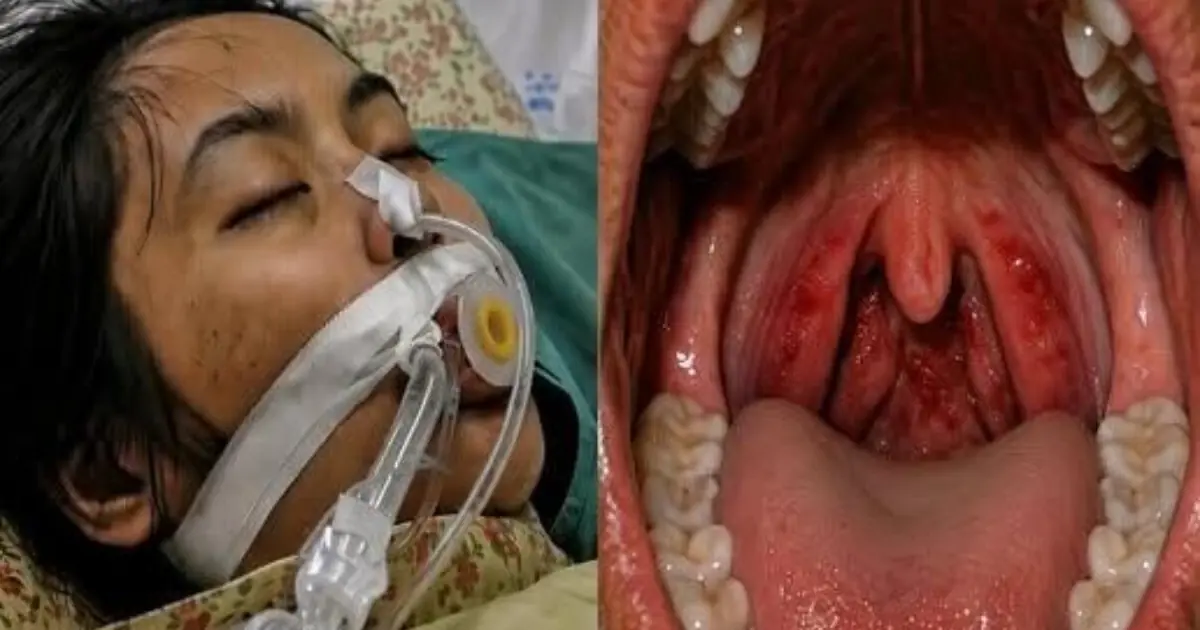
The image accompanying this article shows a young woman receiving respiratory support in a hospital alongside a close-up photograph of an inflamed throat. Although the image carries a dramatic warning about a 22-year-old woman who allegedly died five days after developing a sore throat, the photograph alone cannot establish her diagnosis or cause of death.
Nevertheless, the medical concern behind the headline deserves attention.
The throat contains several important structures, including the tonsils, pharynx, larynx, and epiglottis. These structures work together to help people breathe, swallow, and speak.
An infection affecting this area can produce pain, swelling, redness, and difficulty swallowing. In ordinary cases, these symptoms are caused by viruses that also produce colds and influenza.
According to the Centers for Disease Control and Prevention, viruses are responsible for most sore throats. Many people recover within approximately one week.
Bacterial infections are another possible cause. One of the best-known examples is strep throat, which is caused by group A Streptococcus bacteria.
Strep throat can produce a sudden sore throat, fever, painful swallowing, swollen tonsils, and enlarged lymph nodes around the neck. Some patients also develop white patches or streaks of pus on their tonsils.
Although most cases respond well to appropriate treatment, complications can occasionally develop.
One example is a peritonsillar abscess, which occurs when infected material collects in the tissue surrounding a tonsil. This condition can cause severe pain, swelling, difficulty opening the mouth, and problems swallowing.
Another uncommon but dangerous condition is epiglottitis. This involves inflammation of the epiglottis, a small flap of tissue that helps protect the airway during swallowing.
If the epiglottis becomes significantly swollen, it can obstruct airflow and create a life-threatening emergency.
These conditions explain why a sore throat should not always be dismissed when symptoms become severe.
The important distinction is between ordinary discomfort and signs that suggest a potentially serious complication.
A scratchy throat accompanied by a mild runny nose is generally very different from a rapidly worsening sore throat accompanied by difficulty breathing or an inability to swallow saliva.
People should also remember that serious infections do not always begin with dramatic symptoms. Sometimes, the early signs resemble an ordinary respiratory illness.
Recognizing changes in the patient's condition is therefore essential.
The following chapters examine five warning signs that deserve particular attention, explain why they occur, and discuss when medical assistance should be sought.
Chapter 2: Warning Sign Number One and Two – Difficulty Breathing and Inability to Swallow
Among all the symptoms associated with a severe throat infection, difficulty breathing is one of the most urgent.
Breathing depends on an open pathway that allows air to travel through the nose or mouth, down the throat, and into the lungs.
When tissues around the airway become severely inflamed, swelling can reduce the available space for air to pass.
This is particularly concerning in conditions such as epiglottitis and severe infections involving deeper tissues of the neck.
A person experiencing airway obstruction may notice that breathing becomes unusually difficult or noisy.
One important symptom is stridor, a high-pitched sound that occurs when air moves through a narrowed upper airway.
Other possible warning signs include rapid breathing, an inability to speak normally, and a sensation that the throat is closing.
The person may also appear extremely anxious or struggle to find a comfortable breathing position.
In some cases, the lips or skin may develop a blue or grey appearance because the body is not receiving enough oxygen.
These symptoms require immediate emergency medical attention.
Someone experiencing severe breathing difficulty should not wait to see whether the symptoms disappear naturally.
Emergency services should be contacted immediately.
A second important warning sign is an inability to swallow.
A mild sore throat can make swallowing uncomfortable, but being unable to swallow liquids or even one's own saliva is a different situation.
When swallowing becomes severely impaired, saliva may accumulate in the mouth and begin to spill out.
This is known as drooling.
In adults, unexpected drooling associated with severe throat pain can indicate significant swelling, an abscess, or another condition affecting the throat.
One possible explanation is a peritonsillar abscess.
This complication commonly develops following tonsillitis or another infection involving the throat.
As infected material collects around a tonsil, the surrounding tissues become swollen and painful.
The pain may be especially severe on one side of the throat.
Some patients experience difficulty opening their mouths, a muffled voice, ear pain on the affected side, or visible swelling around the jaw and neck.
If the infection spreads into deeper tissues, it may threaten the airway.