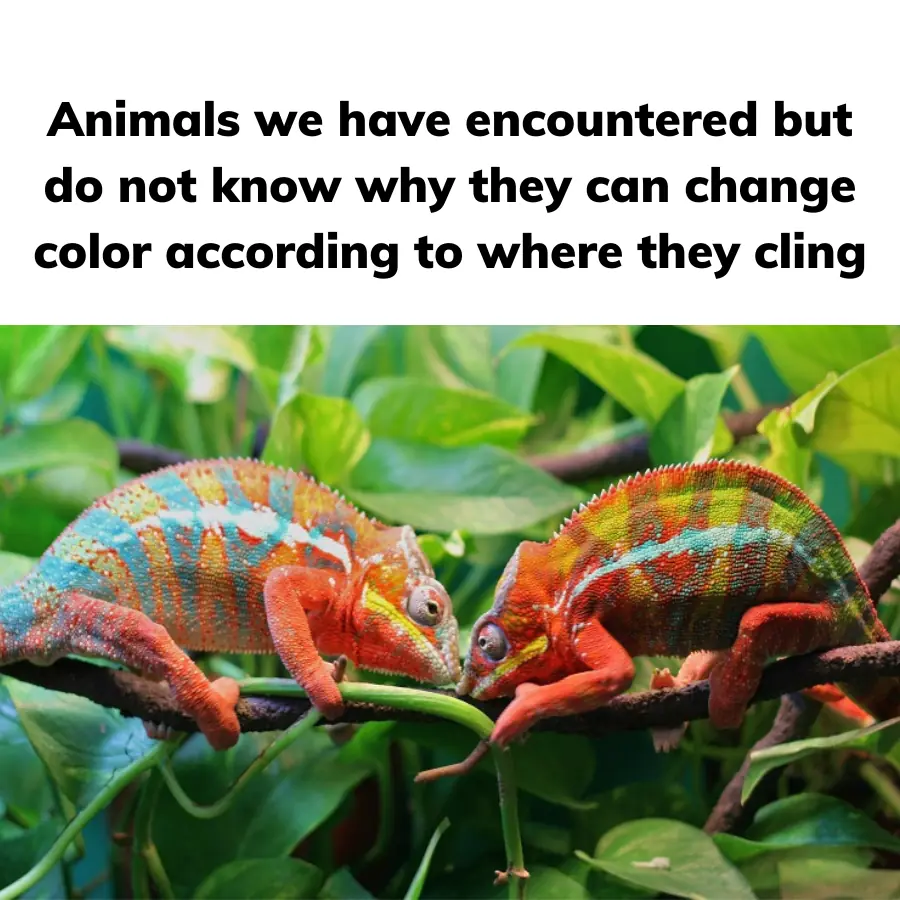
Chameleons are reptiles famous for their ability to change color. When their living environment such as light, temperature, humidity changes or due to fear, the pigment cells in their skin will shift, leading to changes in color.
Between the epidermis and dermis of chameleons, there are scattered pigment cells, controlled by nerves and hormones, showing different shades of color.
In the black pigment cells, there are cell nuclei and small black-brown granules. Pigment granules can move in the cells, when they expand, the skin shows a fairly dark color. Black pigment cells can also move and extend pseudopods like a metamorphic insect, when the pseudopods contract, the body color fades. White pigment cells under light of different intensities, on the skin shine gray-brown or blue-gray. Yellow pigment cells can make the skin turn yellow or green. The expansion and contraction of the pink pigment cells can regulate the level and distribution of pink.
Some people have done a series of experiments, when the chameleon is exposed to strong light, the body color is very light, when it is in a dark environment, the body color is dark. Some people also believe that when the temperature increases, the pigments narrow, the skin color becomes light. When the temperature decreases, the skin pigment expands, the skin color darkens, when dry, the skin color becomes pale. In addition, being affected by chemicals can also cause animals to change color.