Chapter 1 — The Mysterious Prediction That Has Returned in 2026
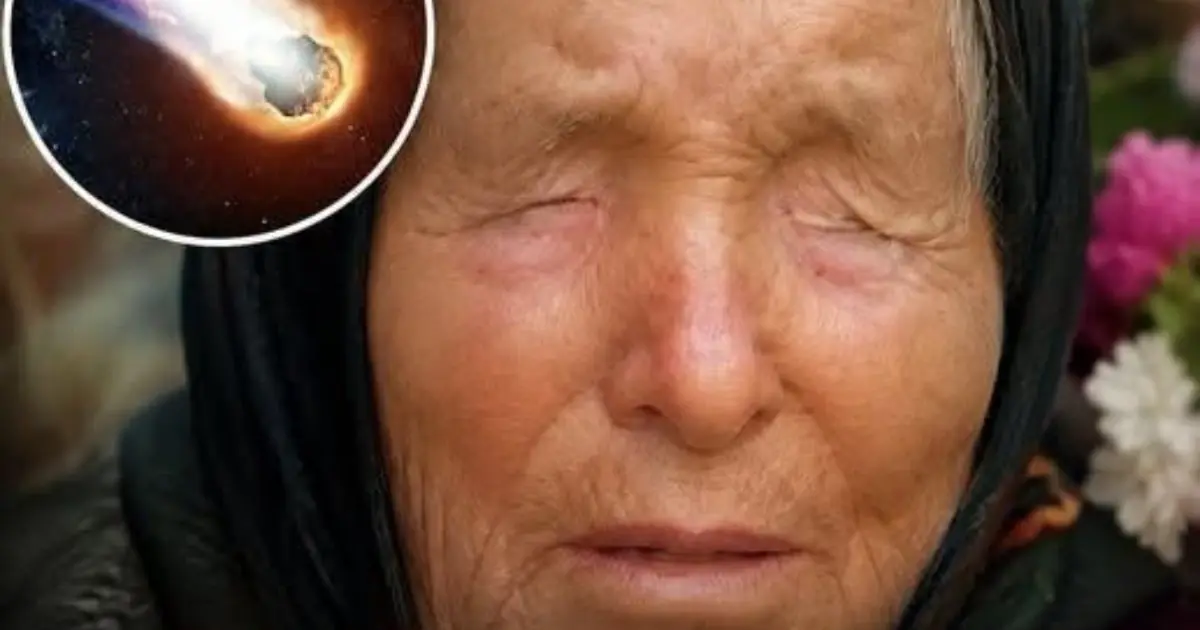
As the final weeks of 2026 approach, the name Baba Vanga has once again appeared in dramatic online headlines. One particular claim has captured attention: an eerie prediction supposedly made by the Bulgarian mystic that could come true before the year ends.
The image accompanying the story shows an elderly woman with her eyes closed, surrounded by a mysterious atmosphere. A bright celestial object appears in a circular inset, suggesting that the prediction may involve something extraordinary happening in the sky.
The headline asks readers to fear what could happen during the final days of the year. But the image does not provide the original words of the prediction, the date when it was supposedly made, or the person who recorded it.
That missing information is important.
Baba Vanga, whose birth name was Vangeliya Pandeva Gushterova, was born in 1911 and became widely known in Bulgaria for her reputation as a clairvoyant. She died in 1996, but her name continues to appear in stories about future wars, natural disasters, technological changes, and mysterious events.
Many people believe she possessed extraordinary abilities. Others regard her reputation as a mixture of folklore, personal testimony, and stories that became increasingly dramatic after her death.
The renewed interest in her supposed 2026 predictions reflects a familiar pattern. As a new year approaches, websites and social media accounts publish lists of events that a famous prophet allegedly foresaw decades earlier.
Some lists describe a major conflict between powerful nations. Others mention an unusual object approaching Earth, a possible encounter with extraterrestrial life, or a dramatic change in the world's political balance.
The claims often sound specific enough to create excitement, yet their original sources are difficult to locate.
In the case of the prediction featured in the image, the phrase “final days of the year” creates a sense of urgency. It encourages readers to watch the calendar and wonder whether an extraordinary event is about to unfold.
However, urgency is not evidence.
A prediction should ideally have a clear original statement, a reliable date, and a record showing that the words were spoken before the event being described.
Without those details, it is impossible to determine whether the claim represents an authentic prediction, a later interpretation, or a headline created to attract attention.
The story also raises an interesting question about why people remain fascinated by prophecies.
Human beings have always been curious about the future. People want to know whether the coming months will bring peace, prosperity, danger, or unexpected change.
When the world feels uncertain, a prediction that appears to explain the future can become especially appealing.
Baba Vanga's name has become closely connected with that desire. Her reputation allows modern stories to combine historical mystery with current concerns.
Yet the most responsible way to approach the 2026 headline is to separate the legend from the evidence.
The image may be striking, and the prediction may sound frightening, but neither establishes that a specific event is destined to happen.
The real story is how an old mystic's reputation continues to influence conversations about the future, even decades after her death.
Chapter 2 — Who Was Baba Vanga, and Why Does Her Name Still Matter?
Baba Vanga remains one of the most recognizable figures in modern prophecy. Her reputation spread far beyond Bulgaria, attracting visitors who believed she could offer insight into personal problems, family matters, illness, and the future.
She was born in 1911 in Strumica, a town that was then part of the Ottoman Empire and is now in North Macedonia. Accounts of her early life describe a difficult childhood and a severe loss of eyesight following an incident during a storm.
As she grew older, people began visiting her for advice. Some believed she could sense events that had not yet happened. Others came because they wanted comfort, guidance, or an explanation for difficult experiences.
Over time, stories about her abilities became part of popular culture.
Her followers have credited her with predicting major historical events, including political upheavals, disasters, and changes in international relations. Some claims have become so widely repeated that they are now treated as established parts of her legend.
However, historians and researchers have raised questions about the reliability of many predictions attributed to her.
One major difficulty is that Baba Vanga did not leave a comprehensive, authenticated collection of written prophecies. Many statements circulated through relatives, visitors, journalists, and books published after particular events had already occurred.
This creates a problem for anyone trying to establish exactly what she said.
A prediction may be described as having been made decades earlier, but the original wording might not be available. In some cases, different versions of the same prediction appear in different publications.
That makes it difficult to determine whether a statement was genuinely recorded in advance or later adapted to fit a historical event.
The Bulgarian mystic's reputation also grew through repetition. When a dramatic claim appears in one publication, other websites may repeat it without checking its original source. Over time, the claim can become familiar enough that readers assume it must be authentic.
The internet has accelerated this process.
Every year, new lists of Baba Vanga's alleged predictions appear online. Some focus on the coming year, while others describe events supposedly scheduled many decades into the future.
The 2026 predictions have followed the same pattern.
Online discussions have linked her name to global conflict, environmental disasters, artificial intelligence, political changes, and possible contact with extraterrestrial life.
The variety of these claims shows how flexible the legend has become.
A single vague statement can be interpreted in many different ways. If an event occurs that seems remotely similar, supporters may connect the two afterward.