16 Killed and 14 Injured in Devastating Bus Collision Near Gold Mine Along the Arizona–Mexico Border
The early morning darkness had barely begun to lift when a devastating collision brought an ordinary workday to a horrifying end. Two buses carrying mine workers collided head-on near a gold mine in the Mexican state of Sonora, leaving 16 people dead and 14 others injured. What should have been a routine journey to or from work suddenly became one of the most tragic road accidents reported in the region that year.
The crash occurred near the entrance to the Noche Buena gold mine, south of the Arizona–Mexico border. Emergency responders were confronted with a devastating scene: two damaged buses blocking a narrow two-lane highway, families waiting for news, and survivors requiring urgent medical attention.
But behind the shocking death toll was another heartbreaking reality. Every person aboard those buses had been travelling as part of an ordinary working day. They were workers with families, responsibilities, personal plans and people expecting them to return home.
As investigators began examining the wreckage, important questions emerged about how the collision happened, why the smaller bus suffered such devastating consequences, and what was known about the workers involved.
The tragedy was reported on April 6, 2021, and the details released by Sonora authorities revealed that the accident involved a passenger bus operated by Movimex and a passenger van operated by Transportes Ejecutivos Premier (TEPSA). The 16 people who died were travelling in the van, while 14 people aboard the bus were injured. This distinction is important because some early reports described the vehicles differently as information was still emerging.
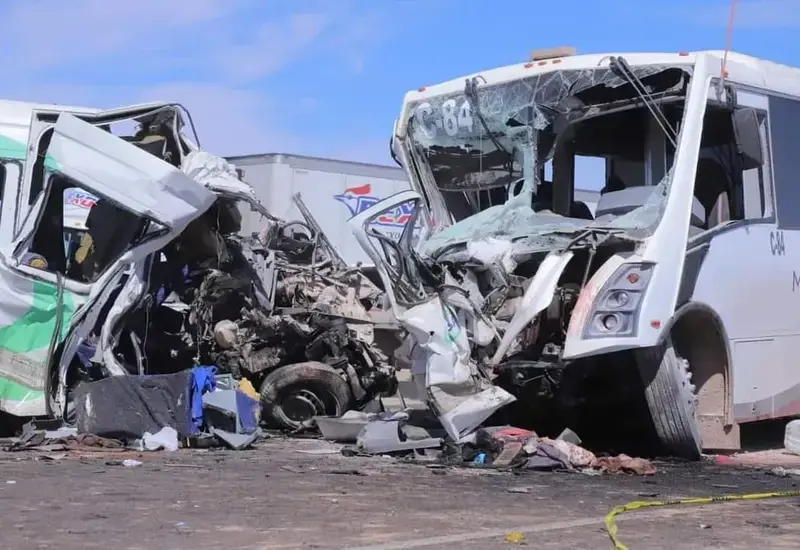
The Collision That Turned a Quiet Highway Into a Disaster
The accident happened at approximately 3:36 a.m. on Tuesday, April 6, 2021, near kilometer 156 of International Highway 2, along the Caborca–Sonoyta route in Sonora, Mexico.
The location was close to the entrance of the Noche Buena gold mine, a mining operation situated south of the Arizona–Mexico border. The highway connects communities across a region where long-distance travel, commercial transportation and industrial activity are important parts of everyday life.
At that hour, most people in nearby communities would have been asleep. The workers travelling in the company transportation vehicles were part of a routine that many employees in remote industrial locations understand well: travelling considerable distances between their accommodation, workplaces and surrounding communities.
Then came the collision.
According to the Sonora State Attorney General's Office, the emergency was reported at 3:36 a.m. The two vehicles had collided near the mine entrance, leaving a devastating scene that required an immediate response from emergency personnel.
The first reports established that 16 people had died and 14 others had sustained injuries.
The location was particularly significant. The collision occurred on a major highway rather than inside the mine itself. Although the accident was closely connected to transportation serving the mining operation, it was a road disaster that required the intervention of highway authorities, forensic specialists and medical emergency teams.
The distinction also helps explain why the incident attracted attention beyond the immediate mining community.
A tragedy involving 30 people travelling on a regional road raised questions about passenger transportation, vehicle safety and the risks faced by workers who depend on organized transport to reach remote workplaces.
The accident was not simply a story about two damaged vehicles. It was a tragedy involving families, livelihoods and an entire community suddenly confronted with an overwhelming loss.
Two Vehicles, 30 People and a Devastating Outcome
The vehicles involved were identified in reports as a Movimex passenger bus, bearing fleet number C84, and a passenger van operated by Transportes Ejecutivos Premier, commonly referred to as TEPSA.
The Movimex vehicle was transporting personnel associated with the Noche Buena mining operation. The other vehicle was carrying 16 passengers.
The collision proved fatal for everyone travelling in the van.
The 14 people aboard the Movimex bus survived the initial impact but suffered injuries serious enough to require medical attention. They were transported to hospitals in the nearby city of Caborca.
This difference between the two vehicles became one of the most important details in the official account.
The death toll was especially devastating because the smaller vehicle's occupants were unable to survive the collision. Reports described the van as suffering extensive damage, while photographs from the scene showed severe destruction to the vehicles involved.
For investigators, the condition of the vehicles would become an important part of reconstructing what had happened.
A collision between two passenger vehicles can involve several factors, including vehicle speed, road position, visibility, driver reaction, mechanical condition and the amount of time available to avoid impact.
However, photographs alone cannot establish which of those factors caused this particular accident.
That responsibility belongs to investigators examining the available evidence.
The initial reports established the location, the vehicles and the number of people affected. They did not provide a definitive explanation of the sequence of events leading to the collision.
That distinction is essential when discussing a tragedy of this scale.
The public naturally wants to know why it happened. Families want answers, survivors deserve clarity, and communities need confidence that the circumstances have been examined properly.
But an accurate account must distinguish confirmed information from speculation.
The most certain fact was already heartbreaking enough: 16 people had lost their lives, and 14 others were injured in a single collision near a mining operation.
Emergency Responders Arrived Before Sunrise
Once the accident was reported, emergency personnel were sent to the highway.
The National Guard's highway division was among the first authorities involved in responding to the scene. Their responsibilities included securing the road, managing traffic and coordinating the initial response.
Red Cross personnel and other emergency services also took part in the operation.
The timing made the response particularly challenging. The collision occurred in the early hours of the morning, when visibility was limited and the surrounding area was still dark.
Rescue workers had to approach a scene involving severely damaged passenger vehicles and numerous casualties.
In major road accidents, the first minutes are especially important.
Emergency teams must determine how many people are involved, identify those who require immediate medical assistance, establish whether anyone remains trapped and organize transportation to suitable medical facilities.
At the same time, highway personnel must protect the scene from additional traffic accidents.
The presence of damaged vehicles on a two-lane highway can create a secondary danger. Drivers approaching the scene may not immediately understand what has happened, especially when the accident occurs at night or before sunrise.
Traffic management therefore becomes an essential part of the emergency response.
In this incident, the injured passengers were taken to medical facilities in Caborca.