Emirates Flight EK521: The Terrifying Dubai Runway Crash That All 300 Passengers and Crew Survived — But Cost a Firefighter His Life
On August 3, 2016, a routine international flight from southern India to the United Arab Emirates ended in one of the most dramatic aviation emergencies in the history of Dubai International Airport. An Emirates Boeing 777 carrying 300 people struck the runway during an attempted go-around, skidded across the pavement, and was eventually engulfed in flames. Within minutes, passengers and crew were forced to abandon the aircraft as emergency responders raced toward the wreckage.
What followed was a remarkable story of survival, professional determination, and devastating sacrifice.
Every one of the 282 passengers and 18 crew members aboard Emirates Flight EK521 survived. Yet the emergency also claimed the life of a firefighter who was responding to the burning aircraft. The contrast between the successful evacuation and the loss suffered by the rescue services became one of the defining elements of the disaster.
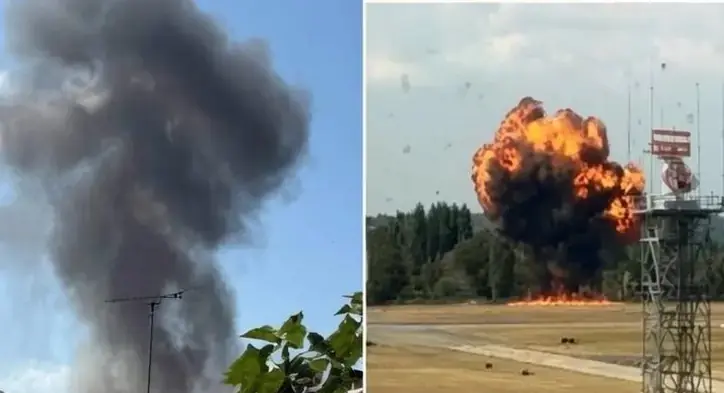
Photographs of thick black smoke rising above the airport quickly spread around the world. Images showed the damaged Emirates aircraft resting on the runway as firefighting vehicles surrounded it. For travelers watching from inside airport terminals and people following the unfolding emergency on television, the scene was deeply alarming.
The aircraft had been operating a scheduled flight from Thiruvananthapuram, also known as Trivandrum, in the Indian state of Kerala, to Dubai. It was a journey familiar to thousands of travelers who regularly moved between India and the Gulf region for employment, family visits, business, and tourism.
There had been no reason for the people boarding the flight that morning to expect their journey would become an internationally reported aviation accident.
Yet as the aircraft approached Dubai, circumstances changed rapidly.
The final moments of the flight involved difficult landing conditions, an attempted maneuver to discontinue the landing, and a sequence of events that investigators would later examine in extraordinary detail.
Although the initial reports focused on the successful evacuation and the visible destruction of the aircraft, subsequent investigations revealed a more complicated story involving flight procedures, aircraft automation, crew awareness, weather information, and emergency response.
Years after the accident, Flight EK521 remains an important case study in commercial aviation safety. It illustrates how an emergency can develop during the final seconds of a flight, why evacuation training matters, and how the survival of hundreds of people can coexist with a profound human tragedy.
A Routine Flight Between India and Dubai
Emirates Flight EK521 began its journey at Trivandrum International Airport in Thiruvananthapuram, a major city in southern India.
Kerala has long maintained extensive economic, cultural, and family connections with the Gulf countries. Many residents have traveled to the United Arab Emirates and neighboring nations for work, while others make frequent journeys to visit relatives or return home.
For these travelers, flights between Kerala and Dubai are an essential link between communities separated by thousands of kilometers.
On that Wednesday morning, passengers boarded an Emirates Boeing 777-300, registration A6-EMW. The aircraft was powered by two Rolls-Royce engines and had been delivered to the airline in March 2003.
Although the aircraft had been in service for more than a decade, its age alone did not indicate that it was unsafe. Commercial airliners undergo scheduled maintenance, inspections, and operational checks throughout their service lives.
The Boeing 777 is a wide-body passenger aircraft designed for international operations. Known for its long-range capability and substantial passenger capacity, it had become a major part of Emirates' expanding global fleet.
Flight EK521 carried 282 passengers and 18 crew members, including two pilots and 16 cabin crew members.
The flight departed India at approximately 5:06 a.m. Coordinated Universal Time, corresponding to 10:36 a.m. local time in India. Its scheduled journey to Dubai was approximately three and a half hours.
For most people aboard, the flight represented an ordinary part of travel.
Some passengers were returning to the United Arab Emirates after visiting family members in India. Others were beginning vacations, traveling for professional reasons, or connecting through Dubai to destinations farther away.
Dubai's position as an international aviation hub meant that the passengers were not all traveling for the same purpose or to the same final destination.
Many would have expected to leave the aircraft, collect their belongings, and continue their journeys without interruption.
During the flight, the cabin crew would have carried out the familiar duties associated with commercial air travel: monitoring passenger safety, providing assistance, and preparing the cabin for arrival.
The pilots, meanwhile, were responsible for managing the aircraft's navigation, flight performance, communications, and approach to Dubai.
According to Emirates, both pilots had accumulated more than 7,000 flight hours each.
Their experience reflected the extensive training and qualifications required to operate a large commercial aircraft.
Nevertheless, even experienced crews can encounter situations in which environmental conditions, operational decisions, and technical systems interact in unexpected ways.
The danger that eventually confronted Flight EK521 emerged during the most critical stage of the journey: the approach and attempted landing.
Dubai International Airport: A Major Global Aviation Hub
Dubai International Airport is among the world's most significant international aviation centers.
Located in the United Arab Emirates, it connects cities across Asia, Europe, Africa, the Americas, and the Middle East.
By 2015, the airport had handled approximately 78 million passengers, highlighting its importance to the region's transportation network and the wider global economy.
Emirates, founded in 1985, had developed into a major international carrier with Dubai serving as the center of its operations.
The airline's distinctive aircraft, featuring the colors of the United Arab Emirates on their tails, had become familiar sights at airports around the world.
For Emirates, Dubai International was more than a destination. It was the operational heart of an extensive route network.
Aircraft arrived from one part of the world and departed for another, carrying passengers who often relied on carefully coordinated connections.
This concentration of activity made the airport highly efficient, but it also meant that any major disruption could have consequences extending far beyond Dubai.
An emergency involving an aircraft on an active runway could affect departing flights, incoming traffic, connecting passengers, airline schedules, and ground operations throughout the airport.
When Flight EK521 approached Dubai on August 3, the airport was preparing to receive another scheduled international arrival.