Chapter 1: The Breast Changes You Should Never Ignore
Breast cancer is one of the most widely discussed health conditions affecting women, yet many people remain uncertain about the changes that should prompt a medical appointment.
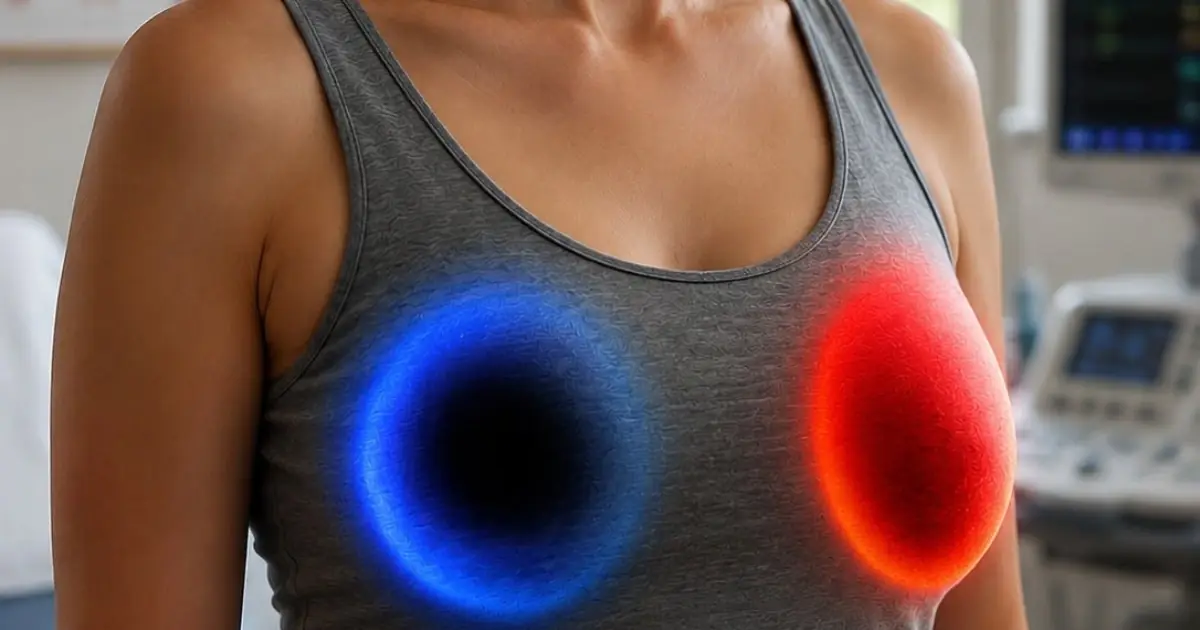
The image accompanying this article highlights the breast area, but it is important to understand that a red or blue mark on a medical illustration does not represent a reliable prediction of cancer. Breast cancer cannot be diagnosed simply by looking at the outside of the body.
Instead, doctors pay attention to changes in the breast's appearance, texture, shape, and surrounding areas. These changes may develop gradually or become noticeable over a relatively short period.
One of the most important possible warning signs is a new lump.
A lump may appear in the breast itself, near the chest wall, or in the underarm area. It may feel firm, soft, round, irregular, or different from the surrounding tissue.
Some breast cancers produce a painless lump, which is why waiting for pain before seeking medical advice can be a mistake.
However, finding a lump does not automatically mean that a person has cancer. Breast cysts, hormonal changes, and other noncancerous conditions can also cause lumps or areas of thickening.
The important point is to have a new or unusual change evaluated rather than trying to determine its cause at home.
Another possible sign is a change in the size or shape of one breast.
Breasts are naturally different from one another. Slight asymmetry is common and usually does not indicate a problem.
What deserves attention is a noticeable change that is new for the individual. One breast may appear larger, swollen, heavier, or differently shaped than it was previously.
A change in the skin can also be significant.
Some people notice dimpling, puckering, or an area where the skin appears to be pulled inward. In certain cases, the surface may resemble the texture of an orange peel.
These changes can occur when underlying tissue affects the skin's normal structure. They are not proof of cancer, but they should not be ignored if they persist or appear unexpectedly.
The nipple is another area worth observing.
A nipple that previously pointed outward may begin turning inward. The skin around the nipple may become irritated, flaky, or unusually thick.
Unexplained discharge is another possible warning sign, particularly if it occurs without squeezing, comes from one breast, or contains blood.
According to major cancer organizations, possible breast cancer symptoms include a new lump, swelling, skin changes, nipple changes, and unusual discharge. Some people may have no noticeable symptoms at all.
CDC+1
This is why the idea that every person's body gives a clear warning exactly one year before cancer develops is misleading.
There is no universal timetable for breast cancer symptoms. Some cancers grow slowly, while others develop more quickly. Some are discovered during routine screening before a person notices anything unusual.
The safest approach is to become familiar with your own body and report new changes promptly.
A medical appointment does not mean that cancer has been diagnosed. It is simply the first step toward understanding what is happening.
Chapter 2: Changes Around the Nipple and Underarm May Also Matter
Many people focus only on the center of the breast when checking for changes.
However, breast tissue extends toward the underarm, and nearby lymph nodes may also become enlarged for several reasons.
A new lump or swelling in the armpit should therefore be evaluated, especially when it occurs alongside a breast change.
The underarm area can be difficult to examine because normal structures, including lymph nodes, may sometimes be felt beneath the skin.
A swollen lymph node can result from infection, inflammation, or other conditions. It does not automatically indicate cancer.
Nevertheless, an unexplained swelling that persists or grows deserves medical attention.
The nipple and areola can also develop changes that are easy to overlook.
Some people notice that the nipple looks flatter than before. Others may observe a new inward direction, unusual crusting, or a rash that does not improve.
Skin irritation is common and may be caused by clothing, sweating, allergies, or eczema.
But a persistent rash affecting the nipple or surrounding area should not simply be treated repeatedly with creams without seeking advice, particularly if it is accompanied by other breast changes.
Another possible symptom is discharge from the nipple.
Discharge can occur for several reasons, including hormonal changes, certain medications, and benign breast conditions.
The characteristics of the discharge can help a healthcare professional decide whether further testing is needed.
Blood-stained discharge, discharge occurring spontaneously, or discharge from only one nipple should be assessed.
It is also important to understand that breast cancer can occur in men.
Although it is much less common than breast cancer in women, men may notice a lump beneath or near the nipple, nipple retraction, skin changes, or discharge.
Anyone experiencing an unusual breast or chest change should seek medical evaluation, regardless of sex.
A further concern is persistent breast swelling.
Sometimes the entire breast appears swollen even when no distinct lump can be felt. The skin may look red, darker than usual, or feel unusually warm.
These changes may have several possible explanations, including infection. Inflammatory breast cancer is an uncommon form of breast cancer that can cause swelling, redness, and skin changes without producing a typical lump.
Because its symptoms can resemble other conditions, persistent or rapidly developing changes should be assessed promptly.
People with darker skin tones may not always notice redness in the same way that it appears on lighter skin.
The affected area may look darker, purple, or simply different from the surrounding skin. Changes in texture, swelling, or warmth may be more noticeable than color alone.
The key is to recognize what is unusual for your own body.
A symptom does not need to be dramatic to deserve attention. Equally, a dramatic-looking symptom does not necessarily mean cancer.
Medical examination and appropriate testing are needed to determine the cause.
The National Cancer Institute emphasizes that breast changes can include lumps, thickening, nipple abnormalities, discharge, and changes in the skin. It also notes that early breast cancer may have no symptoms, making screening an important part of early detection.
Chapter 3: Why Some Breast Cancers Are Found Before Symptoms Appear
One of the most important facts about breast cancer is that symptoms are not always present during its earliest stages.
A person may feel completely healthy and notice no unusual changes in the breast.
This does not mean that the body has failed to provide a warning. It means that some cancers are too small or located in a way that does not produce noticeable symptoms.
This is where screening becomes important.
A mammogram is an imaging test that uses low-dose X-rays to examine breast tissue.
It can sometimes detect an abnormal area before it becomes large enough to feel as a lump.
Screening mammograms are generally intended for people who do not have breast symptoms. Diagnostic imaging may be used when a person has a symptom or when a screening result requires further investigation.