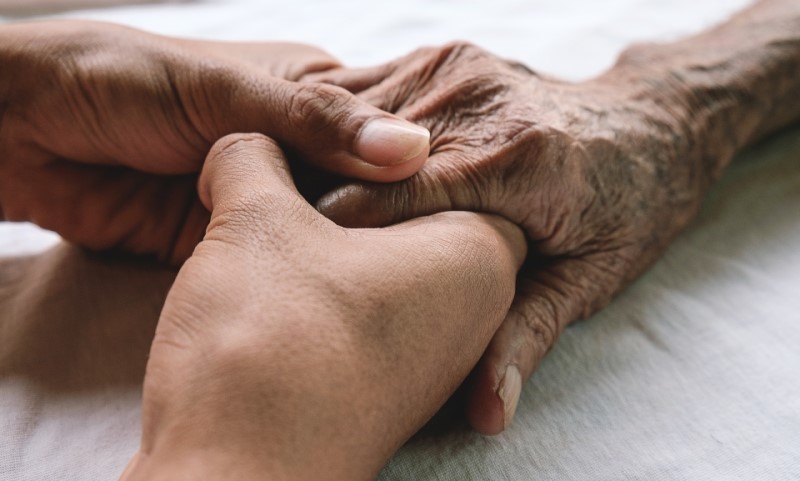
When someone you love is approaching the end of life, physical affection can become incredibly meaningful. Holding their hand, touching their forehead, hugging them, or giving them one final kiss may provide comfort during an emotionally difficult moment.
But a question sometimes arises: Can kissing someone who is dying put your own health at risk?
The short answer is that being near death itself is not contagious. In most situations, simply kissing a dying loved one does not suddenly expose you to something dangerous.
However, the answer changes if the person has a communicable infection, if there is contact with blood or bodily fluids, or if the person giving the kiss is particularly vulnerable to infection.
The actual risk therefore depends not on how close someone is to death, but primarily on what illness they have, how that illness spreads, and the type of contact involved.
Here’s what families should understand.

Why People Worry About Kissing Someone Near Death
As a person approaches death, their body can undergo noticeable changes.
They may experience:
-
Irregular or noisy breathing
-
Increased respiratory secretions
-
Dry mouth or lips
-
Reduced ability to swallow
-
Changes in skin temperature or color
-
Decreased consciousness
-
Loss of bladder or bowel control
These changes can understandably make relatives wonder whether touching or kissing the person is safe.
In most cases, however, these end-of-life changes aren't infectious.
Cancer, heart failure, dementia, stroke, kidney failure, and many other common causes of death cannot be transmitted through kissing.
The relevant question isn't:
“Is this person dying?”
It is:
“Does this person have an infection that can spread through close contact?”
1. Most Terminal Illnesses Cannot Be Spread by Kissing
This is perhaps the most reassuring fact.
Many illnesses that bring people to hospice or end-of-life care are noncommunicable diseases.
For example, you cannot “catch” cancer by kissing someone.
The same applies to conditions such as:
-
Alzheimer's disease
-
Most other forms of dementia
-
Heart failure
-
Stroke
-
Parkinson's disease
-
Chronic kidney disease
-
Amyotrophic lateral sclerosis (ALS)
Cancer cells do not normally pass from one person to another through ordinary physical contact.
You don't need to avoid affection simply because someone has advanced cancer.
2. Respiratory Infections Are a Different Story
If the dying person has an infectious respiratory illness, very close face-to-face contact can potentially expose another person.
Depending on the infection, transmission may occur through respiratory particles or secretions.
Examples include:
-
Influenza
-
COVID-19
-
Respiratory syncytial virus (RSV)
-
Tuberculosis in relevant circumstances
-
Other contagious respiratory infections
Kissing naturally places two people's faces extremely close together.
It may also involve contact with saliva.
That means the risk can be higher than simply standing farther away in the room.
Who Should Be Particularly Careful?
Extra precautions may be appropriate for people who:
-
Have weakened immune systems
-
Are receiving chemotherapy or other immunosuppressive treatments
-
Have undergone an organ or stem-cell transplant
-
Take certain immune-suppressing medications
-
Have serious chronic illnesses
-
Are medically fragile
The person's healthcare team can advise relatives about appropriate precautions for the specific infection.
3. Saliva Can Transmit Certain Infections
Saliva isn't inherently dangerous, but some infectious organisms can spread through saliva or close oral contact.
One well-known example is Epstein-Barr virus (EBV), which can cause infectious mononucleosis.
Other infections can also potentially spread during intimate oral contact.
For this reason, kissing directly on the mouth may carry a different risk profile from kissing someone's forehead or holding their hand.
If an infectious disease is known or suspected, ask the healthcare team what kind of physical contact is considered safe.
4. What About Herpes?
Herpes simplex virus type 1 (HSV-1) commonly causes oral cold sores.
The virus can spread through close contact, including kissing, particularly when an active cold sore is present.
Visible signs can include:
-
Blisters around the lips
-
Open sores
-
Crusting
-
Tingling or burning before lesions appear
Transmission can sometimes occur even without an obvious sore, although active lesions generally raise concern.
This risk has nothing specifically to do with the person being near death.
It's the same biological transmission issue that can occur between otherwise healthy people.
5. Can You Catch Cancer From a Dying Person?
No, ordinary contact with someone who has cancer does not transmit cancer.
You cannot catch cancer through:
-
Kissing
-
Hugging
-
Holding hands
-
Sharing the same room
-
Touching someone's skin
This is important because fear of cancer transmission can unnecessarily isolate patients at a time when emotional and physical connection may matter greatly.
Cancer isn't a contagious disease in ordinary human interaction.
6. What About HIV?
This is another area where misconceptions persist.
HIV is not transmitted through ordinary kissing.
It also isn't spread through:
-
Hugging
-
Holding hands
-
Sharing dishes
-
Casual touching
-
Sharing a room
HIV transmission requires specific types of exposure to infectious bodily fluids.
Ordinary saliva isn't considered a route of HIV transmission.
The theoretical concern would be a highly unusual situation involving substantial blood exposure, such as both people having significant actively bleeding wounds in the mouth.
Normal goodbye kisses aren't considered a typical HIV transmission risk.
7. What About Hepatitis?
The answer depends on the type.
Hepatitis viruses don't all spread in the same way.
For example, hepatitis B and hepatitis C are primarily associated with exposure to infected blood and particular bodily fluids, rather than ordinary casual kissing.
Hepatitis A, meanwhile, spreads primarily through the fecal-oral route.
So simply hearing that someone has “hepatitis” isn't enough information to determine what precautions are necessary.
Healthcare professionals can explain transmission precautions based on the exact diagnosis.
8. Blood Exposure Changes the Situation
Ordinary intact skin provides an excellent protective barrier.
But contact with blood deserves greater caution.
For example, extra care is appropriate if the patient has:
-
Bleeding gums
-
Blood around the mouth
-
Open facial wounds
-
Significant oral lesions
and the visitor also has:
-
Open cuts
-
Cracked or bleeding lips
-
Mouth ulcers
-
Recent dental wounds
The risk still depends on the underlying infection, but avoiding direct blood-to-blood contact is a sensible universal precaution.
Healthcare workers use gloves and other protective equipment when exposure to blood or bodily fluids is possible for precisely this reason.
9. What Happens to the Mouth Near the End of Life?
People approaching death frequently eat and drink less.
They may also breathe through their mouths or become unable to swallow normally.
As a result, the mouth and lips may become:
-
Dry
-
Cracked
-
Coated
-
Sore
Secretions may accumulate because swallowing becomes weaker.
This doesn't automatically mean the person's mouth has become “toxic” or unusually infectious.
Good mouth care is often an important part of hospice and palliative care.
Caregivers may moisten the mouth and lips to improve comfort according to the healthcare team's instructions.
10. What Is the “Death Rattle”?
One end-of-life change that can be particularly distressing to families is sometimes called the death rattle.
As consciousness decreases and swallowing becomes weaker, saliva and respiratory secretions can collect in the throat or upper airways.
Air passing through these secretions may create a wet, rattling sound.
The sound can be upsetting for relatives.
However, it doesn't mean the patient's breath has suddenly become poisonous or that simply being nearby is dangerous.
Whether infection precautions are needed depends on the person's actual medical diagnosis—not the presence of noisy breathing itself.
11. What About Bacteria in the Mouth?
Every human mouth contains enormous communities of microorganisms.
That's true whether someone is healthy, seriously ill, or dying.
Kissing can exchange oral microorganisms between people.
In everyday life, this usually isn't dangerous for healthy adults.
Risk may become more relevant when one person has:
-
An active transmissible infection
-
Open mouth sores
-
Significant bleeding
or when the other person has severe immune suppression.
Again, context matters more than the fact that someone is dying.
12. Should You Kiss Someone Who Has Pneumonia?
“Pneumonia” describes inflammation or infection in the lungs, but it doesn't identify one specific organism.
Pneumonia can result from different:
-
Viruses
-
Bacteria
-
Fungi
-
Aspiration-related processes
Some underlying infections are contagious; others aren't readily transmitted through ordinary contact.
Therefore, you can't determine whether kissing is safe based solely on the word “pneumonia.”
Ask what caused the pneumonia and whether isolation precautions are in place.
13. What If the Patient Is in Isolation?
This is one situation where family members should pay close attention to medical instructions.
Hospitals may use different precautions depending on how an infection spreads.
Visitors may be asked to use:
-
Masks
-
Gloves
-
Gowns
-
Eye protection
or follow other infection-control procedures.
If a patient's room has an isolation notice, don't remove protective equipment or ignore precautions simply because you want physical contact.
Instead, ask the nurse:
“What is the safest way for me to say goodbye while still being close to them?”
The staff can usually explain what contact is appropriate.
14. A Kiss on the Forehead May Be Different From a Kiss on the Mouth
If there is concern about saliva transmission, kissing intact skin on the forehead may involve less direct exposure than kissing on the lips.
Other forms of affection can include:
-
Holding hands
-
Touching the shoulder
-
Stroking the hair
-
Sitting beside the bed
-
Speaking softly
-
Reading something meaningful
-
Playing familiar music
The safest option depends on the patient's condition and any infection-control restrictions.
15. Can You Get Sick From Touching a Dying Person?
Usually, ordinary skin contact isn't dangerous.
Touching someone's hand, arm, or forehead is generally low risk when the skin is intact.
The basic hygiene principle is simple:
Wash your hands appropriately before and after contact.
This is especially important in healthcare environments because surfaces and hands can transmit some infectious organisms.
Avoid touching your:
-
Eyes
-
Nose
-
Mouth
with unwashed hands.
16. Hand Hygiene Is One of the Simplest Protective Measures
You don't need an elaborate “detox” after visiting someone who is seriously ill.
Good hand hygiene is far more useful.
Wash your hands with soap and water, particularly:
-
After contact with bodily fluids
-
Before eating
-
After using the bathroom
-
When hands are visibly dirty
Alcohol-based hand sanitizer is useful in many healthcare situations, although soap and water is preferred in certain circumstances.
Follow the facility's instructions when visiting a hospital or hospice.
17. What About Children Saying Goodbye?
Children may also want physical contact with a dying parent, grandparent, or other loved one.
Whether close contact is appropriate depends on:
-
The patient's infection status
-
The child's health
-
The child's age
-
Hospital policies
-
The nature of any isolation precautions
If there is a contagious illness, ask the medical team before allowing close face-to-face contact.
If there isn't an infectious risk, there may be no medical reason to prevent ordinary affection.
The emotional needs of the child should also be handled thoughtfully and age-appropriately.
18. Pregnant Visitors May Need Specific Advice
Pregnancy doesn't automatically mean a person cannot visit or kiss a dying relative.
However, certain infections are more significant during pregnancy.
If the patient has a known contagious disease, a pregnant visitor should ask the healthcare team whether special precautions are recommended.
The answer depends on the organism involved, the visitor's immunity or vaccination status, and the type of exposure.
19. Immunocompromised Visitors Should Be More Cautious
Someone with a severely weakened immune system may be more vulnerable to infections that would cause only mild illness in another person.
This can include people receiving certain:
-
Chemotherapy treatments
-
Transplant medications
-
Immunosuppressive therapies
as well as people with specific medical conditions.
For these individuals, close contact with someone who has an active infection may require additional precautions.
A mask, avoiding mouth-to-mouth kissing, or postponing certain contact may sometimes be advised.
20. What Happens Immediately After Death?
Another common question is whether touching or kissing someone becomes dangerous immediately after they die.
Death itself doesn't suddenly make a person's body hazardous.
A person who dies from a noninfectious condition doesn't instantly become contagious.
Family members may often be allowed to:
-
Hold the person's hand
-
Touch them
-
Sit beside them
-
Say goodbye
depending on hospital or hospice policies.
However, certain infectious diseases require continued precautions after death because the pathogen can remain present in bodily fluids or tissues.
In those cases, healthcare professionals will provide specific instructions.
Can Diseases Survive After a Person Dies?
Some infectious organisms can remain viable for a period after death.
How long depends heavily on:
-
The organism
-
Temperature
-
Environment
-
Body fluid involved
-
Storage conditions
This is one reason healthcare workers and funeral professionals use standard infection-control procedures when handling bodies.
But this shouldn't be interpreted as meaning every deceased person poses a significant infection risk to their family.
Most ordinary farewell contact isn't equivalent to occupational handling of blood, tissues, or bodily fluids.
What About Kissing Someone Who Died From Cancer?
If cancer was the cause of death and there isn't a separate transmissible infection requiring precautions, cancer itself doesn't make kissing the person's forehead or touching their hand dangerous.
Cancer cannot be transferred to another person through a goodbye kiss.
Families shouldn't feel that they must physically distance themselves simply because the patient had advanced cancer.
Should You Wear a Mask?
A mask may be appropriate when the person has a respiratory infection or when healthcare staff recommend one.
It may also be useful if you have respiratory symptoms and need to be near a medically vulnerable patient.
Hospitals may have specific policies depending on circulating respiratory illnesses and the patient's condition.
Follow the healthcare team's instructions rather than guessing based on the severity of the patient's appearance.
What If You Have a Cold?
This flips the situation around.
Sometimes the dying patient is actually more vulnerable to infection than the visitor.
If you have:
-
Fever
-
Cough
-
Sore throat
-
Vomiting
-
Diarrhea
-
Another potentially contagious illness
tell the healthcare team before visiting.
They can advise whether you should:
-
Wear a mask
-
Limit close contact
-
Postpone the visit
-
Use additional precautions
Even during end-of-life care, infection prevention can help maintain patient comfort.
Don't Rely on Appearance to Judge Infectiousness
Someone can look extremely ill without being contagious.
Another person can look relatively well while carrying a transmissible infection.
Therefore, appearance isn't a reliable guide.
A person dying from metastatic cancer may pose essentially no infection risk from ordinary contact.
Meanwhile, someone with a respiratory virus may still be contagious despite appearing reasonably comfortable.
Diagnosis and transmission route matter—not how sick someone looks.
A Simple Risk Checklist
Before close physical contact, consider four questions.
1. Does the person have a known contagious infection?
If not, ordinary affection may be perfectly reasonable.
2. Is the patient under isolation precautions?
If yes, follow them.
3. Is there visible blood or another bodily fluid involved?
Avoid unprotected exposure.
4. Are you especially vulnerable to infection?
If you're severely immunocompromised or have another significant medical concern, ask the healthcare team for individualized advice.
These questions are far more useful than simply asking whether someone is “near death.”

Common Myths About Kissing Someone Near Death
Myth: A dying person's breath becomes toxic.
There is no general medical phenomenon in which approaching death makes someone's breath poisonous.
Myth: You can catch cancer from a goodbye kiss.
Cancer isn't transmitted through ordinary kissing.
Myth: Every dying person becomes highly infectious.
False. Infectiousness depends on the underlying disease.
Myth: You should never touch a deceased person.
Not necessarily. Ordinary contact may be permitted unless specific infection-control precautions apply.
Myth: The closer someone is to death, the more dangerous their germs become.
This isn't a general biological rule.
When You Should Ask Before Kissing
It's particularly sensible to ask the medical team when:
-
The patient has tuberculosis or another known transmissible infection.
-
The patient is in an isolation room.
-
There is visible blood around the mouth.
-
You are severely immunocompromised.
-
You're pregnant and the patient has a known infection of concern.
-
You're unsure why staff are wearing protective equipment.
A nurse can often answer this question very quickly.
What If You're Afraid to Ask?
There is nothing strange about asking.
Healthcare teams routinely answer infection-control questions.
You can simply say:
“I want to kiss them goodbye. Is that safe, or should I avoid contact with their face?”
That gives the medical team exactly the information they need to advise you.
The Emotional Side Matters Too
Medical safety isn't the only consideration at the end of life.
Physical affection can carry enormous emotional meaning.
A kiss on the forehead, holding someone's hand, or simply sitting beside them may provide comfort to both the patient and family.
When infection-control precautions are necessary, the goal shouldn't automatically be complete emotional isolation.
Instead, healthcare professionals can often help families find safer ways to maintain closeness.
Even when direct kissing isn't advisable, you may still be able to:
-
Hold a hand while wearing appropriate protection
-
Speak to the person
-
Sit nearby
-
Play familiar music
-
Read aloud
-
Express love verbally
Medical precautions and meaningful connection don't always have to be mutually exclusive.
When Is a Goodbye Kiss Generally Low Risk?
For most healthy people, a brief kiss on intact skin is generally low risk when:
-
The patient doesn't have a known contagious infection requiring precautions.
-
There is no visible blood or open wound at the contact site.
-
The visitor isn't severely immunocompromised.
-
Hospital staff haven't advised against the contact.
But individual circumstances can change that assessment.
When you're in a healthcare setting, the patient's nurse or physician is the best source of situation-specific guidance.
The Bottom Line
Kissing someone simply because they are near death does not inherently put your health at risk.
The medical issue isn't death itself.
It's whether there is an infectious disease that can spread through close contact, saliva, respiratory particles, blood, or other bodily fluids.
For someone dying from a noncommunicable illness such as advanced cancer, dementia, heart failure, or many neurological diseases, ordinary affectionate contact generally doesn't transmit the underlying condition.
Extra caution becomes appropriate when there is:
-
A known contagious respiratory infection
-
Active oral lesions associated with transmissible infection
-
Visible blood exposure
-
Isolation precautions
-
Severe immune suppression in the visitor
In those circumstances, ask the healthcare team what type of contact is safe.
Final Thoughts
Few moments are more personal than saying goodbye to someone you love.
Online warnings can sometimes make ordinary end-of-life affection sound much more dangerous than it actually is. There is no general rule that says kissing someone becomes unsafe simply because that person is close to death.
Cancer isn't contagious. Heart failure isn't contagious. Dementia isn't contagious. Dying itself isn't contagious.
What matters is the presence—or absence—of a specific transmissible infection and how that infection spreads.
If no special infection precautions are required, a kiss on the forehead, a gentle touch, or holding someone's hand may be entirely appropriate.
If there is a known infectious disease, don't guess. Ask the nurse or doctor what precautions are necessary and whether kissing should be avoided.
That way, you can protect your health without allowing unnecessary fear to take away an important final moment with someone you care about.