Can You Solve This Without a Calculator? Put Your Brain to the Test!
This Simple Math Problem Is Surprisingly Easy to Get Wrong
⏱️ 1 min read 08/08/2026 11:47
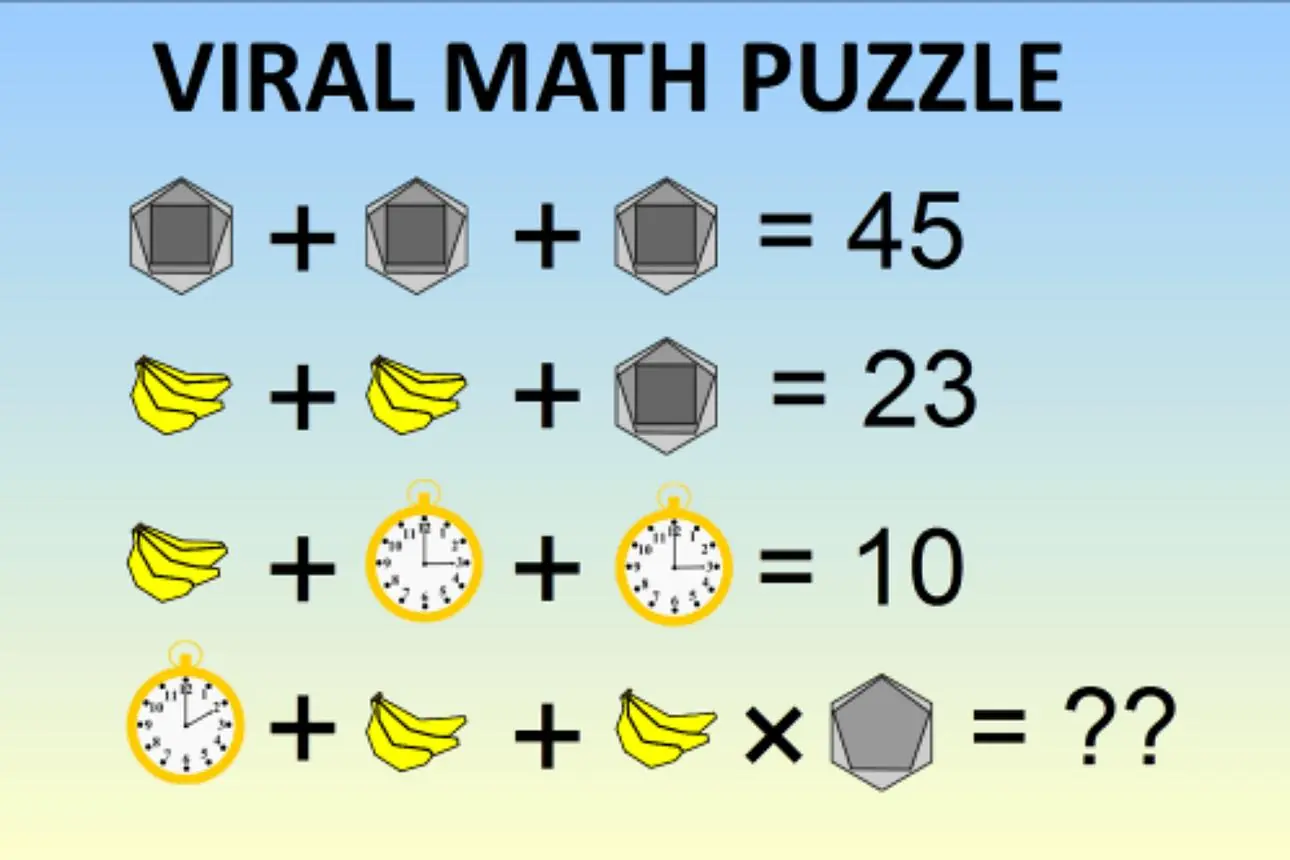
At first glance, this puzzle looks almost too easy to be challenging. You see a few familiar objects, some simple equations, and a final expression that seems like it should take only a few seconds to solve.
But that's exactly what makes this type of puzzle so effective.
The mathematics itself is not particularly difficult. The real challenge is paying close attention to the details. Some of the objects change between equations, and the final line requires you to apply the correct order of operations.
So, before jumping to the answer, let's work through the puzzle carefully and see where the hidden tricks are.
The first line shows three identical pairs of earbuds adding up to 30.
We can write the equation as:
Earbuds + Earbuds + Earbuds = 30
Since all three pairs are identical, divide 30 by 3:
30 ÷ 3 = 10
Therefore:
This seems straightforward, but remember that the value of 10 represents a pair, not a single earbud.
That distinction becomes extremely important later.
The second equation introduces a person:
Person + Person + Earbuds = 20
From the first equation, we already know:
Earbuds pair = 10
Substitute that value into the second equation:
Person + Person + 10 = 20
Subtract 10 from both sides:
Person + Person = 10
Since the two people are identical:
Person = 5
So now we have:
At this point, the puzzle still appears very simple. We know two values:
Pair of earbuds = 10
Person = 5
But we're not finished yet.
The third equation introduces another object: a pair of watches.
The equation is:
Watch pair + Watch pair + Person = 13
We already know that:
Person = 5
So substitute it:
Watch pair + Watch pair + 5 = 13
Subtract 5:
Watch pair + Watch pair = 8
There are two identical watch pairs, so:
8 ÷ 2 = 4
Therefore:
Since each pair contains two watches:
4 ÷ 2 = 2
So:
Now we have established three important values:
Pair of earbuds = 10
Person = 5
One watch = 2
Everything seems ready for the final question.
But this is where the puzzle gets interesting.
The final expression may look almost identical to the objects shown in the previous equations.
However, don't assume that every object is still the same.
This is the part that catches most people.
The final line contains:
Single earbud + Person × Single watch
There are several details that need to be checked before calculating.
Earlier, we were given a pair of earbuds worth 10.
But the final line shows only one earbud.
Therefore:
10 ÷ 2 = 5
So:
The person shown in the final equation may contain a visual difference compared with the person used in the earlier equation.
This is a classic trick in visual math puzzles.
Before using the value of 5, carefully compare the final figure with the original figure.
If the final person is missing an accessory or holding an additional object, that change needs to be accounted for separately.
This is why these puzzles aren't simply about solving equations. They require you to compare every image carefully.
The earlier equation used a pair of watches, which was worth 4.
But the final equation shows only one watch.
Therefore:
One watch = 2
This is another easy detail to overlook.
Once you've identified the individual values, the final expression becomes:
5 + 5 × 2
At this point, there's another common mistake.
Some people calculate from left to right:
5 + 5 = 10
Then:
10 × 2 = 20
But that's not how standard mathematical order works.
Multiplication must be performed before addition.
So first:
5 × 2 = 10
Then:
5 + 10 = 15
Therefore, based on the values shown and assuming the final person is identical to the earlier person:
The calculations themselves are simple.
The difficulty comes from the fact that your brain naturally tries to recognize patterns.
Once you've seen an object several times, your brain tends to automatically assign it the same value without checking whether its appearance has changed.
That's exactly what the puzzle is designed to exploit.
There are several common traps.
The first equation gives you a pair of earbuds worth 10.
The final equation uses one earbud.
Therefore, you cannot simply use 10.
You have to divide the pair's value by two.
The third equation gives you:
Two watches = 4
Therefore:
One watch = 2
Using 4 instead of 2 in the final equation changes the answer completely.
Visual math puzzles frequently alter small details in the final line.
An accessory may disappear.
An object may be added.
A pair may become a single object.
Or an object may be held by the character in the final equation.
These differences can completely change the final calculation.
Even after identifying all the correct values, you can still get the answer wrong by calculating from left to right.
Remember:
Multiplication and division come before addition and subtraction.
So:
5 + 5 × 2
is:
5 + 10 = 15
not:
(5 + 5) × 2 = 20
These puzzles aren't really about advanced mathematics.
A child who understands basic addition, subtraction, multiplication, and division can solve one.
What they actually test is visual attention, logical consistency, and careful observation.
You have to resist the urge to rush.
Instead of thinking:
"I've already seen this object, so I know its value."
you need to think:
"Is this exactly the same object as before?"
That tiny difference in thinking can completely change the result.
Our brains are designed to recognize patterns quickly.
That's useful in everyday life because we don't need to consciously analyze every familiar object we encounter.
But in a puzzle like this, that automatic pattern recognition becomes a disadvantage.
Once your brain learns:
Earbuds = 10
it wants to keep using 10.
It doesn't naturally stop to ask:
"Wait—are these still a pair?"
That's why these puzzles can feel surprisingly difficult despite using very simple mathematics.
The next time you encounter one of these challenges, don't immediately start calculating.
Instead, follow a simple process.
Write down what appears in each equation.
Is it one item, two items, or a pair?
Look for changes in:
Number of objects
Accessories
Clothing
Items being held
Object size or shape
Pairs versus individual objects
Solve the equations step by step.
This makes hidden changes much easier to spot.
Remember multiplication and division come before addition and subtraction.
A final review can catch the smallest visual difference.
The most interesting part of this challenge isn't actually the number 15.
It's the thinking process required to reach it.
A puzzle like this demonstrates why careful observation is often more valuable than rushing toward an answer.
The problem looks simple, so your brain expects a simple solution.
That's when it's easiest to make assumptions.
But good problem-solving requires you to slow down, question what you're seeing, and verify every detail before committing to an answer.
If you arrived at 15, congratulations—you successfully handled the arithmetic and noticed the important changes in the final expression.
If you got a different answer, don't worry.
These puzzles are specifically designed to exploit quick assumptions and visual shortcuts. Getting one wrong doesn't mean you're bad at math.
In fact, the mistake can tell you exactly what to improve:
Slow down. Compare. Verify. Then calculate.
That's a useful skill far beyond a simple internet puzzle.
This brain teaser may use nothing more than a few earbuds, a person, some watches, and basic arithmetic, but it demonstrates an important principle:
The equations are easy.
The real challenge is attention to detail.
So next time you see a puzzle like this, don't let familiar images trick you into switching to autopilot. Check every object, count every item, look for subtle changes, and only then solve the equation.
Because in visual puzzles, one tiny detail can be the difference between the wrong answer and the right one.
This Simple Math Problem Is Surprisingly Easy to Get Wrong
A Mind-Bending Math Puzzle That Will Challenge Your Critical Thinking
Your Sleeping Position Might Be More Interesting Than You Think
Choose Your Favorite Shoe and See What It Might Reveal About Your Character
Can Your Feet Reveal Hidden Aspects of Your Character? A Look at the Popular Foot Personality Theory
Put Your Brain to the Test: What Number Belongs in the Empty Spot?
Pick One Raw Food: Your Choice Could Reveal Surprising Things About Your Personality
When You Change Your Perspective, New Solutions Often Come Into Focus
This Math Challenge Looks Easy, But Most People Get Different Answers
Which Couple Seems Most Happy? Your Answer May Reflect Your View of Relationships
Pick a Sapphire Ring and Uncover the Trait That Defines You Most
Put Your IQ to the Test with This Tricky Flower Math Challenge
What Does Your Favorite Nail Shape Say About Your Hidden Personality?
This Puzzle Seems Simple at First - But It Tricks Almost Everyone
Only the Most Observant People Can Find Every Dog Here!
The way you sit could secretly say a lot about who you are
Most people miss several animals in this illusion - how many do you see?
Which drink would you give up forever? Your answer may reveal your true personality
The First 3 Colors That Catch Your Eye Reflect What You’re Carrying Inside
niors should be cautious - this sleeping position may elevate str.oke risk
A Japanese woman shares 10 reasons why women in Japan live longer and stay fit
Stool color explained: what it may indicate about your health
The science of cloves: benefits, uses, and how they work
6 reasons you may feel pain on the right side of your body
This Simple Math Problem Is Surprisingly Easy to Get Wrong
Your Stool May Reveal More About Your Health Than You Think
8 Cooking Habits to Watch Out For That May Increase the Formation of Potentially Harmful Compounds
The Chairman Recognized His Son by a Scar
Purple Garlic vs. White Garlic: Key Differences Explained
THEY JUDGED THE WRONG MAN
What Looked Like an Ordinary Allergy Turned Out to Require Medical Attention
The Potential Benefits of Cloves Every Woman Should Know
The Day My Father Went Bankrupt
Why Experts Want You to Check Your Palms and Soles Today
This nutrient-rich vegetable may support blood sugar and heart health.
Your veins are suddenly visible? The reason may surprise you.
Hard-boiled eggs are nutritious, versatile, and full of surprising facts.