Have you ever wondered whether the way you sleep says something about your personality?
A viral image making the rounds online claims that your sleeping position can determine how lazy you are, showing eight different ways a person might sleep. From lying perfectly straight to curling up on one side, each position is presented as if it reveals something about a person's habits or personality.
It's an entertaining idea—and definitely the kind of personality quiz people love sharing with friends.
But there's an important distinction between a fun personality interpretation and established science.
There is currently no reliable scientific evidence showing that sleeping position can determine whether someone is lazy, hardworking, ambitious, or productive. Your preferred sleep position is influenced by many factors, including comfort, habit, body structure, pain, temperature, mattress quality, pregnancy, and even breathing patterns.
Still, the way you sleep can provide interesting clues about your comfort preferences, sleep quality, and physical health.
So let's take a closer look at the eight positions shown in the image and separate the fun interpretation from what we actually know about sleep.
1. Sleeping Flat on Your Back
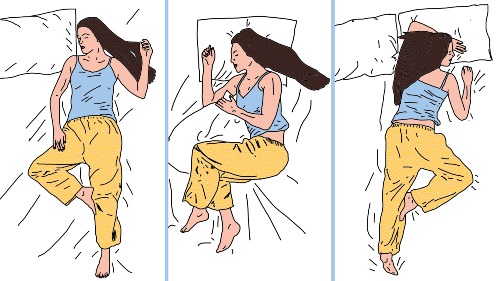
The first position shows a person lying flat on her back with her arms positioned near her head.
This is commonly called the supine position.
For some people, sleeping on the back feels natural because it allows the body to remain relatively straight. A properly supportive mattress and pillow can help keep the spine in a neutral position.
The fun personality interpretation
In popular personality quizzes, people who sleep on their backs are sometimes described as confident, organized, independent, or disciplined.
Some versions of these quizzes may even label them as less "lazy" because the position looks neat and controlled.
However, these personality claims aren't established scientific conclusions.
What science actually tells us
Back sleeping can be comfortable for some people, but it isn't ideal for everyone.
For people who snore or have obstructive sleep apnea, lying on the back may allow the tongue and other soft tissues to move backward and narrow the airway.
If you frequently wake up gasping, snore loudly, or feel excessively sleepy during the day, your sleeping position may be worth discussing with a healthcare professional.
2. Sleeping Straight With Your Arms Down
The second illustration shows a person lying on her back with her arms resting alongside her body.
It looks simple and symmetrical.
The personality myth
Online sleep-position quizzes sometimes associate this position with people who are calm, reserved, or structured.
Some may describe these sleepers as responsible people who prefer routines and don't like unnecessary complications.
Again, that's personality entertainment—not a diagnostic tool.
There is no reliable evidence that placing your arms beside your body during sleep tells researchers whether you're hardworking or lazy.
The practical side
What matters more is whether you wake up feeling rested.
If your neck, shoulders, or lower back hurt in the morning, your pillow and mattress may be more important than the exact position itself.
3. Sleeping With Arms and Legs Spread Out
The third position is much more open.
The sleeper lies on her back with both arms and legs extended outward.
It almost resembles someone making a star shape on the mattress.
What the viral image might suggest
Personality quizzes often describe this type of sleeper as relaxed, carefree, or comfortable taking up space.
Some might interpret it as a sign of confidence or a laid-back attitude.
That can make for a fun conversation:
"Which one are you?"
But it doesn't prove anything about your personality.
You might sleep this way simply because you like having plenty of room.
A more important consideration
People naturally change positions during the night.
You may start in one position and wake up in another.
So even if you identify strongly with one illustration, it may not represent how you spend the entire night.
4. The Curled-Up Side Sleeping Position
The fourth position shows the person lying on her side with her knees bent toward her chest.
This is commonly associated with a fetal-like sleeping position.
Side sleeping is extremely common.
The personality interpretation
Popular sleep quizzes sometimes associate curled-up sleepers with sensitivity, caution, emotional depth, or a desire for security.
The claim is often that these people may appear tough on the outside but be more sensitive underneath.
Again, there's no strong scientific evidence that the position itself reveals those traits.
The health perspective
Side sleeping can be comfortable and beneficial for many people.
It can also be particularly useful during pregnancy, when side sleeping is commonly recommended, although individual medical advice should come from a healthcare professional.
For some people, placing a pillow between the knees can also make side sleeping more comfortable by supporting the hips and legs.
5. Sleeping on Your Side With One Leg Straight
The fifth position shows a person sleeping on her side with one leg extended and the other positioned differently.
This kind of position is sometimes described online as the posture of someone who is decisive or comfortable with change.
The reality
There is no established scientific formula that connects a specific leg position with a personality trait.
People move their legs during sleep because their bodies are constantly making small adjustments.
The goal is often simply to find a position that feels comfortable.
What might actually matter
If you regularly wake up with hip or lower-back discomfort, experimenting with pillow placement or mattress support may help.
Sometimes a small change in alignment can make a surprisingly big difference in morning comfort.
6. Sleeping With Arms Above the Head
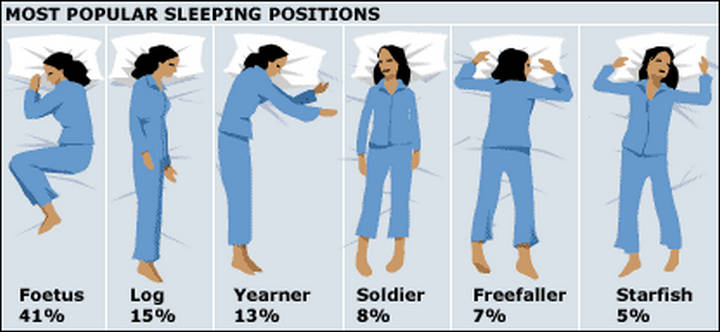
The sixth illustration shows the sleeper lying on her back or slightly turned, with her arms extended above her head.
This can look like someone reaching toward the top of the bed.
The personality myth
Some popular interpretations call this the position of a relaxed, friendly, or independent person.
Others suggest that people who sleep this way are more open-minded or easygoing.
But once again, there is no scientific basis for using arm position to determine laziness or character.
Your arms may simply end up there because that's where they feel comfortable.
Could it affect your body?
For some people, keeping the arms overhead for extended periods may contribute to shoulder discomfort, particularly if they already have shoulder problems.
If you consistently wake up with numbness, tingling, or shoulder pain, changing your position may be worth trying.
7. Hugging a Pillow While Sleeping
The seventh illustration shows a person sleeping on her side while holding a pillow.
This is incredibly common.
Some people can't imagine sleeping without something to hug.
The personality interpretation
Online quizzes often associate pillow-hugging sleepers with affectionate, caring, or emotionally warm personalities.
Others suggest that these people value close relationships and comfort.
It's a cute interpretation—but it shouldn't be treated as psychological fact.
Why does hugging a pillow feel so comfortable?
There may be a straightforward physical explanation.
Holding a pillow can provide additional support for the arms and shoulders.
For side sleepers, a pillow can also help create a more comfortable position for the upper body.
So what looks like a personality clue may simply be a comfort strategy.
8. Sleeping With Hands Near or Above the Head
The final position shows the sleeper lying on her back with her arms raised around the pillow.
This is another position that many people naturally adopt.
The viral interpretation
Personality quizzes may associate this posture with confidence, openness, independence, or a strong sense of self.
The original image takes a much more playful approach by suggesting that different sleeping positions somehow reveal how "lazy" a person is.
But it's important not to take that literally.
Sleeping position cannot tell you whether someone is lazy.
A person can sleep in almost any position and still be highly disciplined, ambitious, energetic, or productive.
So, Can Sleeping Position Really Predict Laziness?
This is the biggest question raised by the image.
The answer is:
No—not reliably.
There is no established scientific test in which researchers observe someone's sleeping position and determine that person is lazy.
"Laziness" itself is also far more complicated than a personality label.
Someone who appears unmotivated might actually be experiencing:
-
Poor sleep
-
Chronic stress
-
Burnout
-
Depression
-
Anxiety
-
Physical discomfort
-
An exhausting schedule
-
Sleep deprivation
-
An underlying health problem
That's why judging someone's character based on how they sleep can be misleading.
Your Sleep Position Can Still Tell You Something Important
Even though it can't reveal laziness, your sleeping position may provide useful information about your physical comfort and sleep habits.
For example, if you always sleep on your side because lying on your back makes breathing uncomfortable, that may be worth discussing with a healthcare professional.
Likewise, if you repeatedly wake up with:
-
Neck pain
-
Shoulder pain
-
Hip pain
-
Back stiffness
-
Numbness
-
Tingling
your sleep setup may need attention.
The position itself may not be the problem. Your pillow, mattress, posture, or an underlying condition could be contributing.
Why Do We Have Favorite Sleeping Positions?
Sleep position is influenced by a surprisingly large number of factors.
Habit
Once your body becomes accustomed to a particular position, you may naturally return to it every night.
Comfort
People tend to settle into positions that feel physically comfortable.
Pain
Someone with back, hip, or shoulder discomfort may unconsciously change positions to avoid pressure.
Breathing
Some people breathe more comfortably in certain positions.
Pregnancy
Pregnancy can significantly change which positions feel comfortable.
Mattress and Pillow
A mattress that is too firm or too soft can influence how you position your body.
Temperature
People may unconsciously spread out when hot or curl up when cold.
Your Body Moves While You Sleep
One reason these viral quizzes should be taken lightly is that humans don't necessarily remain in one position all night.
During normal sleep, people can shift positions many times.
You might fall asleep on your back, roll onto your side, stretch your legs, move your arms, and eventually wake up in a completely different posture.
So asking:
"Which position do you sleep in?"
can be surprisingly difficult to answer accurately.
Your favorite position when falling asleep may not be your dominant position throughout the night.
Sleep Quality Matters More Than Sleep Position
Rather than worrying about whether your sleeping position makes you look lazy, focus on the things that actually influence your well-being.
Ask yourself:
Do I get enough sleep?
Do I wake up feeling refreshed?
Do I regularly wake during the night?
Do I snore loudly?
Do I wake up gasping or choking?
Am I excessively sleepy during the day?
Do I experience persistent pain in the morning?
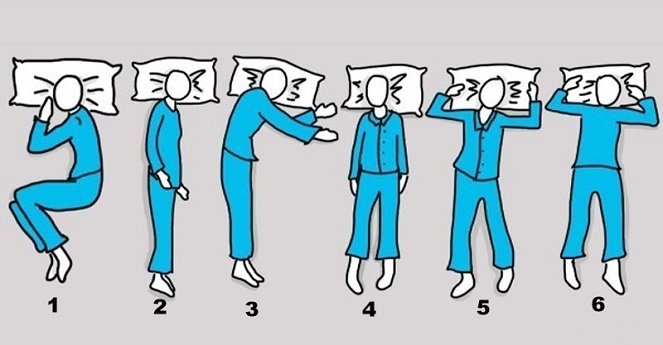
These questions tell you much more about your sleep health than whether you sleep in position 1, 4, or 8.
What Your Sleep Position Might Say About Comfort
Instead of saying that a position reveals your personality, it's more accurate to think of it as a reflection of your body's preferences.
A person who hugs a pillow may simply like the sensation of pressure and support.
A person who sleeps spread out may simply prefer more room.
Someone who curls up tightly may find that position physically comforting.
Someone who sleeps completely straight may simply have developed that habit over many years.
There's nothing mysterious about it.
And that's actually more interesting than the viral claim.
When Should You Pay Attention to Your Sleeping Position?
Your sleeping position becomes more important when it's connected to symptoms.
For example, if you regularly wake up with severe pain, numbness, headaches, or breathing problems, don't dismiss those symptoms as simply "sleeping wrong."
Persistent symptoms deserve attention.
In particular, loud chronic snoring, witnessed pauses in breathing, gasping during sleep, and significant daytime sleepiness can be signs of a sleep disorder such as obstructive sleep apnea.
A healthcare professional can help determine whether further evaluation is appropriate.
Don't Let a Personality Quiz Define You
The image is clearly designed to be fun.
It's the kind of content that makes people immediately look at the eight options and think:
"Wait… that's literally how I sleep."
Then comes the inevitable question:
"So what does that say about me?"
That's where it's useful to separate entertainment from science.
A personality quiz can be a conversation starter.
It can make you laugh.
It can even encourage you to think about your habits.
But it shouldn't be treated as a psychological assessment.
Your personality is shaped by countless factors—not the position your body happens to take while you're unconscious.
The Real Takeaway
Your sleeping position probably can't tell you whether you're lazy.
But it may tell you something about comfort, habits, physical alignment, and potentially sleep quality.
And that's a much more useful way to think about the subject.
So if you looked at the image and immediately picked one of the eight positions, go ahead and enjoy the personality interpretation.
Just don't let a viral graphic convince you that your sleeping posture defines your character.
Being productive isn't determined by whether you sleep curled up, stretched out, on your side, or with your arms above your head.
What matters far more is whether you're getting enough quality sleep and waking up ready to function during the day.
So, which one looks most like you?
1, 2, 3, 4, 5, 6, 7, or 8?
Pick your number for fun—but remember: your sleep position may reveal your comfort preference, not your level of laziness.