That is one of the unusual powers of live performance.
The same song can mean something entirely different when performed at a different moment in an artist's life.
The Stage Was Kept Relatively Simple
The production reportedly avoided overwhelming the singer with excessive spectacle.
Instead, the stage design placed the emphasis on Dion herself.
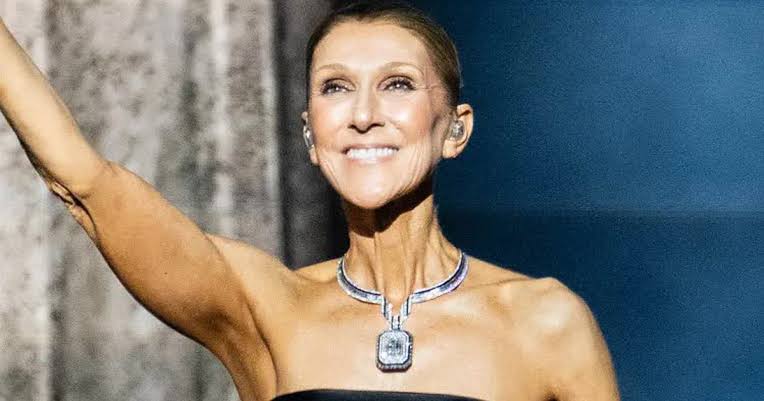
She appeared in understated black gowns, allowing the music and the emotional significance of the evening to remain at the center of the performance.
That simplicity was particularly appropriate for a comeback built around the question of whether she could once again carry an entire concert.
There was no need for the production to compete with the story unfolding onstage.
The audience had come to see Céline Dion.
And that was exactly what they received.
She Spoke to the Audience With Gratitude
Throughout the evening, Dion addressed the audience primarily in French while also speaking in English.
Her comments centered on gratitude, her connection with the people in the arena and the promise she had made to return.
After such a long absence, those words carried considerable emotional weight.
For years, fans had purchased albums, listened to her music and followed updates about her condition without knowing exactly when they would see her perform a full concert again.
Now thousands of them were standing in the same room with her.
The relationship between performer and audience had survived the years apart.
The Audience Became Part of the Comeback
Perhaps the most moving part of the opening night was the way the audience responded when Dion began to cry.
A performer is normally expected to control the rhythm of a concert.
There is a setlist.
There are rehearsals.
There are lights, musicians and production cues.
But emotion doesn't always follow a schedule.
When Dion paused during the opening song, the audience did something remarkable.
They waited.
Then they applauded.
The applause continued long enough to become a form of reassurance.
Instead of treating the interruption as something that needed to be hidden, the crowd embraced the moment.
For those few minutes, the usual relationship between performer and audience seemed to reverse.
Dion had spent her career giving audiences music.
Now the audience gave something back.
This Was Not a Claim That Her Illness Had Disappeared
It is important to understand what the concert did—and did not—represent.
Returning to the stage does not mean that stiff-person syndrome has been cured.
Dion continues to live with a medical condition that requires ongoing management.
Her performance demonstrated that she was able to complete this particular concert, not that every future performance will necessarily be easy or identical.
That distinction matters when discussing chronic or neurological illness.
Recovery and adaptation are rarely perfectly linear.
A successful performance can be deeply meaningful without suggesting that the underlying medical condition has disappeared.
For Dion, the achievement was being able to perform despite the challenges that had previously kept her away.
A Residency Rather Than a Traditional World Tour
The September performance also marked the beginning of a broader engagement at the arena.
Rather than immediately returning to the demanding schedule of a conventional worldwide tour, Dion's comeback was structured around a limited residency.
The plan described in the supplied account includes 26 performances across 2026 and additional dates in May 2027, with further performances added after strong demand.
This format could provide a different working environment from a traditional tour.
Instead of constantly traveling between cities, a residency allows an artist to remain in one location for multiple performances.
Even so, the physical demands remain substantial.
Performing repeatedly requires endurance and careful preparation, particularly for someone managing a chronic neurological condition.
Why This Comeback Feels Different
There have been countless celebrity comebacks throughout entertainment history.
But Dion's return carries a particular emotional dimension because the obstacle was not simply a change in musical trends, a long break or a decision to step away from the spotlight.
Her health had directly affected her ability to perform.
For years, one of the defining parts of her identity—the stage—was something she could not simply assume would always be available to her.
That uncertainty changed the meaning of returning.
Every song became part of a larger story.
Every minute onstage represented time that she had spent working toward this possibility.
And every cheer from the audience reflected years of waiting.
The Meaning of Beginning Again
There is something powerful about watching an experienced performer begin again.
Dion does not need to prove that she can become the singer she was decades ago.
Her career has already established that.
The challenge now is different.
It is about determining how she can continue making music while respecting the realities of her health.
That may mean adjusting songs.
It may mean changing movement.
It may mean carefully managing the length and frequency of performances.
And it may mean accepting that the future cannot always be predicted.
But none of those adaptations diminish the meaning of returning.
They are part of what returning actually looks like.
Six Years Later, the Music Continued
When Céline Dion stepped onto the stage in Nanterre, she wasn't simply opening another concert.
She was closing one chapter of uncertainty and beginning another.
The tears during “On ne change pas” captured the emotion of the night better than any carefully prepared speech could have.
There was relief in those tears.
There was gratitude.
There was the weight of everything that had happened since her last full concert.
And there was the unmistakable reality of finally standing in front of thousands of people again.
Then she continued singing.
Twenty-five songs followed.
For approximately two hours, the stage once again became part of her world.
The illness remained.
The years away remained.
The challenges ahead remained.
But so did the music.
And perhaps that is what made the night so meaningful.
Céline Dion's return was not about pretending that nothing had changed. It was about showing that even after life forces you to change, there can still be a way to begin again.
After more than six years away from a complete concert, she walked back onto the stage.
And when the music started, she was no longer waiting for her return.
She was living it.