COVID-19 Vaccinated Individuals May Be Ill: What a Stanford Study Really Reveals About Rare Heart Inflammation
Meta description: A Stanford-linked study investigates rare myocarditis after mRNA COVID-19 vaccination, identifying immune signals that may help explain the reaction.
A discovery about COVID-19 vaccines is drawing attention for a reason that deserves a closer look: researchers have identified two immune-system signals that may help explain why a very small number of people—particularly young males—develop inflammation of the heart after receiving an mRNA COVID-19 vaccine.
The finding sounds alarming when reduced to a headline suggesting that vaccinated individuals may become ill. But the scientific story is more specific, and understanding that distinction is essential. The research does not show that everyone who received a COVID-19 vaccine is at risk of heart disease. It does not establish that vaccinated people generally have hidden heart damage. Instead, it investigates a rare adverse reaction known as myocarditis and explores the biological processes that may contribute to it.
The study, led by researchers associated with Stanford Medicine and published in Science Translational Medicine in December 2025, focused on two signaling proteins: CXCL10 and interferon-gamma, commonly written as IFN-γ. These molecules are part of the body's immune communication system. In laboratory experiments and preclinical models, researchers found that their interaction could contribute to inflammation and injury in heart tissue.
The most intriguing part was what happened when scientists blocked those signals in experimental settings: markers of heart injury fell, while important aspects of the immune response remained largely preserved. The team also investigated genistein, a naturally occurring compound found in soy, as a possible way to reduce inflammatory effects in laboratory models.
But there is an important difference between discovering a possible mechanism in cells and animals and proving a safe preventive treatment for people. The findings are promising for research, but they do not mean that people should take supplements, stop vaccination or assume that unexplained symptoms are caused by a previous dose.
To understand what this discovery actually means, we need to look at the rare condition at its center, the two immune signals identified by the researchers, and the limits of what the experiments can tell us. Those details reveal a more balanced—and much more useful—picture than the alarming headline alone.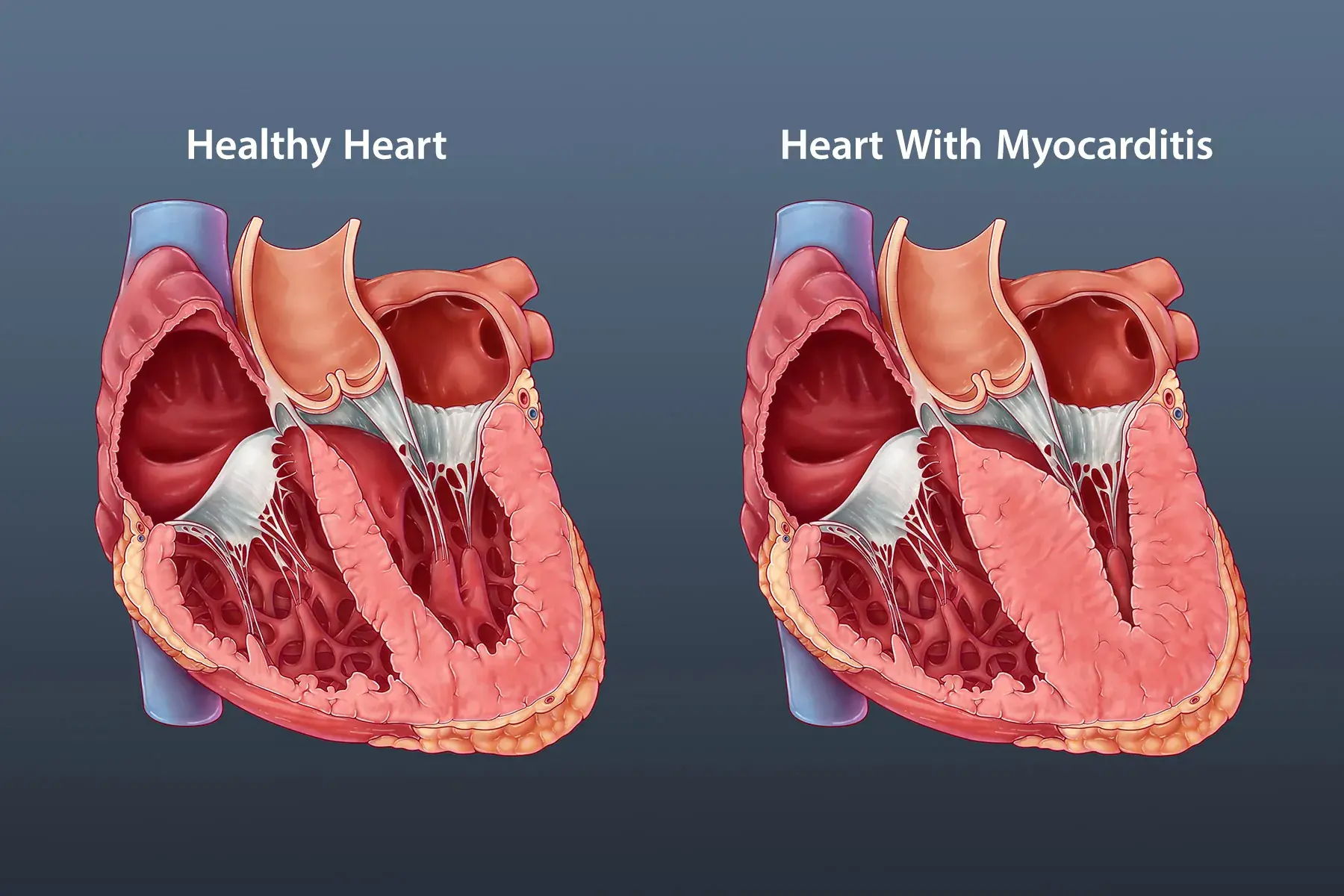
1. What the Stanford research actually discovered
The research behind the headline was published on December 10, 2025, in the scientific journal Science Translational Medicine. Its title was “Inhibition of CXCL10 and IFN-γ ameliorates myocarditis in preclinical models of SARS-CoV-2 mRNA vaccination.”
The title itself contains an important qualification: the work investigated myocarditis in preclinical models. That means the researchers used laboratory systems, including human cells grown in the laboratory, engineered heart-like tissue and animals, to study the biological process. It was not a clinical trial demonstrating that a new treatment prevents myocarditis in vaccinated people.
The research team included scientists affiliated with Stanford University School of Medicine and other institutions. They examined why a rare form of heart inflammation can occur after mRNA COVID-19 vaccination, particularly in young males. Their goal was to understand the immune signals involved and investigate whether those signals could eventually offer a way to reduce the risk of injury.
The investigators focused on two molecules:
-
CXCL10, a chemokine that helps direct immune cells towards areas where inflammatory activity is occurring.
-
Interferon-gamma (IFN-γ), a signaling protein involved in coordinating immune responses, particularly those involving T cells.
Both molecules belong to a broad group of substances called cytokines. Cytokines allow cells to communicate with one another. They help the immune system recognize threats, recruit defensive cells and coordinate responses to infections and other challenges.
That communication is normally essential. Without it, the body would struggle to organize an effective defense against pathogens. But immune signaling must be carefully regulated. A response that is too intense, prolonged or directed at the wrong tissue can contribute to inflammation and damage.
The Stanford team's findings suggest that CXCL10 and IFN-γ may work together in a sequence that helps explain how heart inflammation develops in some experimental models after mRNA vaccination.
This is a significant scientific lead, but it should not be confused with evidence that the vaccine causes widespread heart disease. The researchers were investigating a rare complication, not describing the typical experience of vaccinated people. Their work also does not establish that every case of myocarditis after vaccination follows exactly the same biological pathway.
The distinction between a possible mechanism and a general health risk will become especially important when considering the results in the next sections.
2. Understanding myocarditis: the condition at the center of the study
Myocarditis is inflammation of the heart muscle, the tissue responsible for contracting and pumping blood throughout the body.
The heart is not simply a mechanical pump. It is a living organ made of specialized cells that work together in a carefully coordinated rhythm. These cells depend on a stable supply of oxygen and nutrients, a functioning electrical system and a supportive network of blood vessels.
When the heart muscle becomes inflamed, several parts of this system can be affected. The inflammation may interfere with the ability of heart cells to contract normally. It can also disturb electrical signaling, potentially causing an irregular heartbeat.
The severity of myocarditis varies considerably. Some people experience relatively mild symptoms and recover with appropriate medical care. Others may develop more serious complications that require hospital treatment and specialist monitoring.
Possible symptoms include chest pain, shortness of breath, unusual tiredness, a racing or irregular heartbeat and reduced ability to exercise. In some cases, symptoms may be less obvious, which is one reason medical evaluation matters when a person develops concerning signs.
Myocarditis can have several causes. Viral infections are an important cause, but inflammation may also be associated with other infections, immune-system disorders, certain medicines and other triggers. The condition is therefore not unique to COVID-19 vaccines.
It is also important to distinguish myocarditis from pericarditis. Myocarditis affects the heart muscle itself, while pericarditis affects the thin sac surrounding the heart. The two conditions can occur together, which is sometimes described as myopericarditis.
The Stanford study focused on myocarditis and the inflammatory processes that may contribute to heart-muscle injury. It did not establish that every person with chest discomfort after vaccination has myocarditis. Chest pain can have many possible causes, some of which require urgent attention.
The wider medical evidence recognizes that myocarditis and pericarditis have been observed rarely after mRNA COVID-19 vaccination. Cases have most frequently been reported in adolescent and young adult males, particularly within seven days after the second dose, although cases have also occurred in females, other age groups and after other doses.
This is the specific health issue that the research is trying to explain—not a claim that all vaccinated individuals are becoming ill.
3. Why researchers focused on young males
One of the most important details in the vaccine-safety evidence is that the risk of myocarditis after mRNA COVID-19 vaccination has not been distributed equally across all groups.
Reports and monitoring systems have consistently identified adolescent boys and young adult men as the groups in which the association has been most noticeable. The risk has also been observed more often after the second dose in the original two-dose mRNA schedules.
This pattern raises important scientific questions. Why does the reaction appear more frequently in younger males? What biological differences may contribute? Why do most people mount an immune response without developing heart inflammation, while a small number experience this complication?