We can’t read dogs’ minds—and, unlike humans, dogs can’t use spoken language to tell us how they feel. But if, like many other dog people, you detect the green-eyed monster behind your dog’s barks when you pet another pooch, there is research to support your intuition: Dogs in potentially jealousy-inducing situations have shown brain activity and behavior that researchers believe reflects jealousy or something like it. Some scientists have criticized those studies, been unable to replicate them, or taken issue with labeling dogs’ feelings in the experiments as “jealousy”—but we know that dogs have emotions, and that they react when rivals get what they want.
Evidence that dogs get jealous
Scientists have shown that dogs seem to get jealous by watching how they behave in certain situations, and by monitoring their brain activity in fMRI scanners. This doesn’t irrefutably prove that dogs get jealous, because there is more than one explanation for how a certain dog acts or which parts of their brain are getting more oxygenated blood. But they can offer clues about how the dogs in question might be feeling.
In a 2014 University of California–San Diego study, Dr. Christine Harris and Caroline Prouvost found that their 36 canine subjects were much more likely to exhibit behaviors like pushing their owners or an object when said owners petted and baby-talked to a fake dog that could bark and wag its tail than when the humans did the same to a pail shaped like jack-o-lantern or read aloud from a book. The vast majority of participating dogs sniffed the fake dog’s rear, indicating to researchers that they believed it was, in fact, a dog—and none of the few dogs who skipped the sniff displayed “jealous” behaviors. This would seem to support the idea that going without the person’s attention wasn’t as bad for most participating dogs as seeing another dog enjoy it.
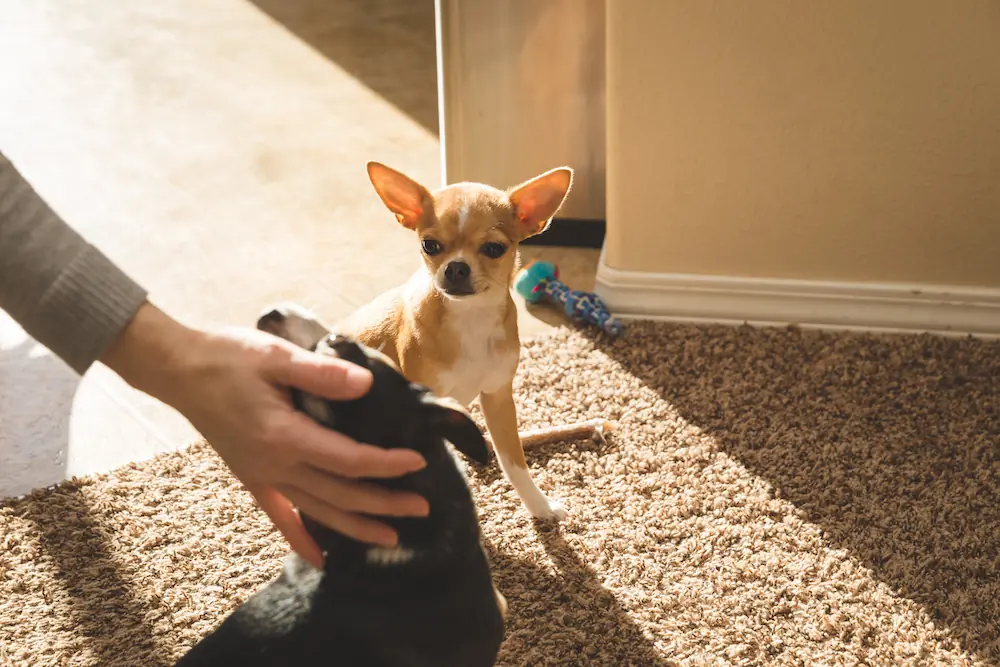
In 2017, Dr. Stanley Coren wrote about a study by Dr. Friederike Range at the University of Vienna in which dogs refused to do tricks if another dog was “unfairly” rewarded for the same task.
A 2018 paper in Animal Sentience by Dr. Peter Cook and his colleagues described evidence from brain imaging of 13 dogs who experienced the following scenarios: they got a treat, the treat was dropped into a bucket, or a realistic-looking fake dog received the treat. Using the Canine Behavioral Assessment and Research Questionnaire (CBARQ), the researchers identified 6 of those dogs as more aggressive than the rest. This doesn’t mean that the dogs were highly aggressive—none of them scored higher than a 1.75 on the CBARQ’s 4-point scale for any type of aggression. The researchers found that, when the fake dog got the treat, they saw more activity in more-aggressive dogs’ amygdalae—an area of their brains they’d expect to light up if they were feeling jealous.
Dr. Cook, an Associate Professor of Psychology and Neuroscience at the New College of Florida, would not go so far as to label his research proof of jealousy. “I would say that the clear assignment of jealousy as opposed to some other complex social emotion involving arousal is pretty tough to pin down in a dog,” he says. “My gut feeling is it’s actually something more like envy.”
His paper also acknowledges that, “from both human and non-human studies, activation in the amygdala has been linked with a range of affective states, including anxiety, anger, fear, and even jealousy. As such, amygdala activation should not be equated with specific emotions; it should be more broadly interpreted as a neurobiological indicator of high arousal.”
Why some researchers aren’t convinced
Some other scientists expressed reservations about the above research. This isn’t to say that they don’t think dogs don’t or can’t feel jealous—just that they’re questioning what these experiments show.
In 2018, Dr. Alexanda Horowitz of Barnard’s Dog Cognition Lab and two of her colleagues responded to Dr. Cook’s research in their own Animal Sentience article. They warned against drawing too many conclusions from it, writing: “Our particular concerns are as follows: (1) The relationship between jealousy and the selected context is unclear, and (2) the relationship between jealousy and the selected outcome (i.e., blood flow to the amygdala) is also unclear.” Dr. Horowitz and her colleagues did not eliminate jealousy as a possible explanation for the results of the experiment, but listed a number of other reasons more oxygenated blood could have flowed to the dogs’ amygdalae.
Also in 2018—as mentioned in the aforementioned Horowitz article—Dr. Emanuela Prato Previde and her colleagues at the University of Milano were unable to replicate the results of the 2014 study by Harris and Prouvost. They wrote about this in another Animal Sentience article, which also included their own response to Dr. Cook’s research.
Whatever you call them, your dog has feelings
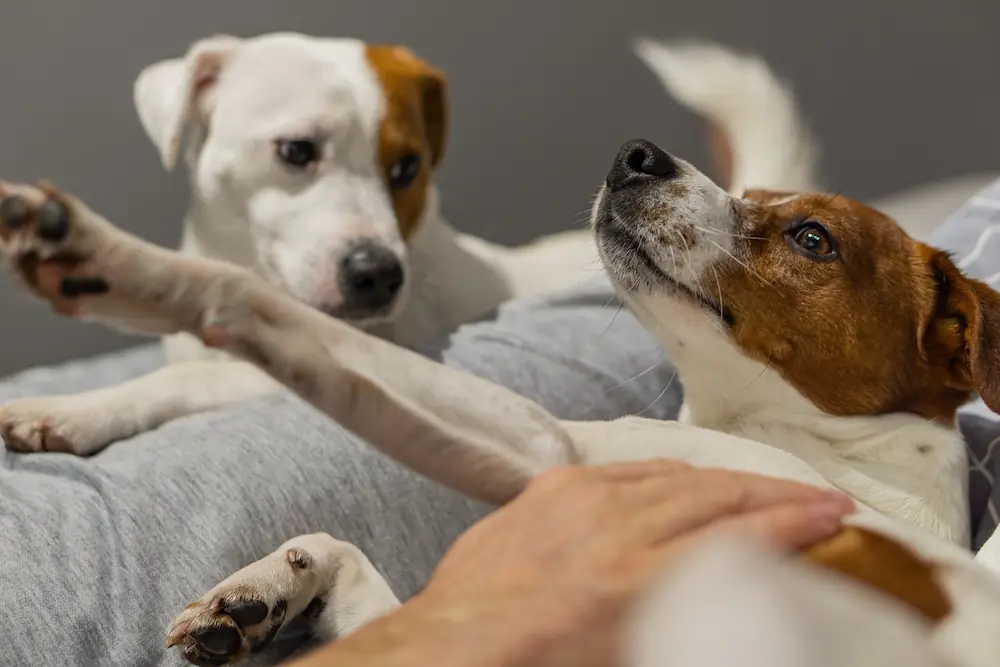
Despite the challenges of defining what jealousy would mean for dogs, and of proving that they truly feel it, some professionals who’ve spent years studying them are convinced that it’s part of their lives.
Ethologist Dr. Marc Bekoff, author of The Emotional Lives of Animals, says: “Combining the [Harris] study with detailed observations of dogs and other animals, I am of the opinion that they do indeed feel jealousy, and we need to figure out how to demonstrate this as unambiguously as possible.”
Dogs bond closely to their people, and depend on us for the things they need—like food, shelter, mental stimulation, and even love. They’re smart, too, able to figure out and remember more than some people give them credit for. They also seem to experience many emotions similar to our own, including happiness, sadness, excitement, and fear. Putting all of this together, it’s reasonable to think that it would be unpleasant for a dog to see someone else—whether another animal or a person—get what they want from us while they are deprived of it.
Whatever each study’s results mean—and however different scientists interpret dogs’ behavior, or their brain activity in certain situations—it’s clear that dogs do have emotions. So it’s worth treating them kindly and trying to make them happy. Recognizing this doesn’t require believing that they experience jealousy in the exact same way you do.
“We should be a little bit on guard against anthropomorphizing too much,” says Dr. Cook. “But, at the same time: the more evidence we gather, the more it looks like in most major ways—at least if you squint—there are very strong parallels between dog emotion and human emotion, and they often are expressed in similar ways in similar contexts.”