At first glance, the tiny creature in this image may look like a small insect, a seed, or even a harmless speck of dirt. But a closer look reveals something quite different.
The creature appears to be a tick, a tiny blood-feeding arachnid that can attach itself to humans and animals. Its rounded body, small head area, and multiple legs are consistent with the general appearance of a tick.
Ticks are easy to overlook because some species can be extremely small. A person may not notice one attached to the skin until hours or even days later. That's why understanding what ticks look like—and what to do after finding one—is important, especially for people who spend time outdoors.
What Is the Tiny Creature in the Image?
The animal shown appears to have a compact, oval-shaped body with several thin legs extending from the front portion.
That body shape is characteristic of a tick.
Ticks aren't insects. They belong to the arachnid group, which also includes spiders and mites. Adult ticks generally have eight legs, while younger tick stages can have fewer.
They are specialized parasites that feed on the blood of mammals, birds, reptiles, and sometimes humans.
The particular species cannot be reliably identified from this photograph alone, especially because the image is very close-up and doesn't show enough detail for a definitive identification.
However, the appearance is certainly consistent with a tick rather than an ordinary household insect.
Why Are Ticks So Small?
One of the reasons ticks can be difficult to detect is their size.
Depending on the species and life stage, ticks can range from extremely tiny to several millimeters across.
Some immature ticks, called nymphs, can be particularly difficult to notice.
A nymph may be smaller than a sesame seed, meaning that a person can spend time outdoors and unknowingly bring one home.
Adult ticks are easier to see, but even they can be surprisingly small.
After feeding, however, a tick can become much larger because its body expands as it takes in blood.
How Do Ticks Get Onto People?
Ticks don't typically fly or jump.
Instead, many species wait on vegetation such as grasses, shrubs, and low-growing plants.
When a person or animal brushes against the vegetation, the tick can attach itself to the passing host.
This behavior is sometimes called questing.
A tick positions itself on vegetation and extends its legs outward, waiting for contact with a potential host.
Once it reaches the host, it may crawl around before finding a suitable place to attach.
This is why simply walking through tall grass or brushing against bushes can potentially expose someone to ticks.
Where Do Ticks Usually Attach?
Ticks can attach to almost any part of the body.
However, they may favor areas that are warm, protected, or difficult to see.
Common locations include:
-
Behind the knees
-
Around the waist
-
In the groin
-
Around the ankles
-
Under the arms
-
Behind the ears
-
Along the hairline
-
On the scalp
-
Between the toes
Children may be particularly difficult to check because ticks can hide in the hair or around the neck.
After spending time outdoors, checking the entire body can be useful.
Are All Ticks Dangerous?
No.
Finding a tick does not automatically mean you will become sick.
Ticks can carry different microorganisms depending on their species and geographic location.
Some ticks transmit bacteria, parasites, or viruses that can cause disease, while others may not transmit any significant human pathogen.
The risk therefore depends on several factors, including:
The tick species: Different species carry different pathogens.
Where you live or traveled: Tick-borne diseases vary substantially by region.
How long the tick was attached: For some infections, the likelihood of transmission increases with prolonged attachment.
Whether the tick was infected: Not every tick carries a disease-causing organism.
This is why finding a tick should prompt appropriate action, but not automatic panic.
What Diseases Can Ticks Transmit?
Ticks can transmit a number of diseases.
One of the best-known is Lyme disease, which is caused by certain species of Borrelia bacteria and transmitted by infected ticks in regions where the disease occurs.
Possible early symptoms can include:
-
Fever
-
Chills
-
Fatigue
-
Headache
-
Muscle aches
-
Joint aches
-
Swollen lymph nodes
-
A skin rash in some cases
The characteristic expanding rash associated with Lyme disease is commonly called erythema migrans.
However, not everyone with Lyme disease develops the classic rash, and the rash can vary in appearance.
Other tick-borne illnesses include various forms of spotted fever, ehrlichiosis, anaplasmosis, babesiosis, tick-borne encephalitis, and others depending on geographic region.
This is why location matters when assessing a tick bite.
What Should You Do If You Find a Tick Attached to Your Skin?
If the creature is actually attached to the skin, the most important step is prompt and proper removal.
For a typical attached tick, the recommended approach is to use fine-tipped tweezers.
Grasp the tick as close to the skin as possible.
Then pull upward with steady, even pressure.
Avoid twisting or jerking the tick if possible.
After removing it, clean the bite area and your hands with soap and water or an appropriate antiseptic.
If a small portion of the mouthparts remains embedded, don't repeatedly dig into the skin trying to remove it. The skin can often expel the remaining material naturally, but if there is concern or significant inflammation, medical advice can help.
Don't Try to Burn the Tick
One dangerous myth involves using a match, cigarette, or heated object to make an attached tick release.
This is not recommended.
Applying heat can burn the skin and doesn't provide a safe or reliable removal method.
The same applies to attempting to smother the tick with substances such as petroleum jelly, nail polish, alcohol, or oils while it remains attached.
The safest approach is usually mechanical removal with fine-tipped tweezers.
Should You Keep the Tick?
If practical, you may want to preserve the tick after removal, particularly if you're in an area where tick-borne diseases are common.
Place it in a small sealed container or bag.
Avoid handling it unnecessarily.
A healthcare professional may be able to identify the tick based on its appearance, although routine testing of individual ticks isn't always recommended or available.
A photograph can also be useful, especially if the tick has been removed and discarded.
What If the Tick Is Very Small?
Don't assume that a tiny tick is harmless.
A tick's size does not determine whether it can transmit disease.
In some regions, nymphs are particularly important because they are small enough to go unnoticed and can still transmit pathogens.
If you find a very small eight-legged creature attached to your skin after outdoor exposure, it's worth treating it as a possible tick until properly identified.
What About the Red Legs and Gray Body?
The image shows a small creature with a relatively dark or grayish body and reddish-brown legs.
Color can vary considerably between tick species, developmental stages, and feeding states.
A tick's appearance may also change after feeding.
Because of this, color alone isn't enough to identify a tick species.
Species identification usually requires a more detailed examination of characteristics such as body shape, markings, mouthparts, leg structure, and other anatomical features.
So while the photograph strongly resembles a tick, it would be inappropriate to claim a specific species solely from this image.
What Symptoms Should You Watch For After a Tick Bite?
Most tick bites don't lead to serious illness.
However, monitor your health after finding an attached tick, particularly if you live in or recently visited an area where tick-borne disease occurs.
Seek medical advice if you develop symptoms such as:
-
Fever
-
Chills
-
Unusual fatigue
-
Headache
-
Muscle or joint aches
-
Enlarged lymph nodes
-
A spreading rash
-
Facial weakness
-
Severe headache
-
Confusion
-
Significant weakness
-
Breathing difficulties
Symptoms may appear days or, depending on the disease, longer after the bite.
That's why remembering the exposure can be useful.
If you develop unexplained symptoms after a tick bite, tell your healthcare professional that you recently found a tick.
Not Every Red Mark Is Lyme Disease
After removing a tick, it's common to see a small area of redness or irritation around the bite.
This can simply be a local reaction to the bite or to minor skin trauma.
A small spot that appears soon after the bite doesn't automatically indicate Lyme disease.
However, a rash that expands over time, particularly when accompanied by flu-like symptoms, deserves medical evaluation in regions where Lyme disease occurs.
Don't try to diagnose a tick-borne illness based on a photograph alone.
How Can You Prevent Tick Bites?
Prevention is much easier than dealing with a tick bite later.
When hiking, camping, gardening, or walking through areas with tall grass and vegetation, consider wearing:
-
Long pants
-
Long sleeves
-
Closed shoes
-
Socks that cover the lower legs
Light-colored clothing can make crawling ticks easier to spot.
In areas where ticks are common, use an appropriate EPA-registered insect repellent according to the product's instructions.
For clothing and outdoor gear, certain products containing permethrin are specifically designed to repel or kill ticks when used according to their labeling.
Check Yourself After Being Outdoors
One of the simplest habits is a tick check.
After spending time in a potentially tick-infested area, inspect your body carefully.
Pay particular attention to:
-
Hair and scalp
-
Behind the ears
-
Neck
-
Armpits
-
Waist
-
Groin
-
Behind the knees
-
Ankles
-
Between the toes
Don't forget children and pets.
Ticks can be brought indoors on clothing, equipment, or animals.
Showering after outdoor exposure and checking the body can help identify ticks before they remain attached for an extended period.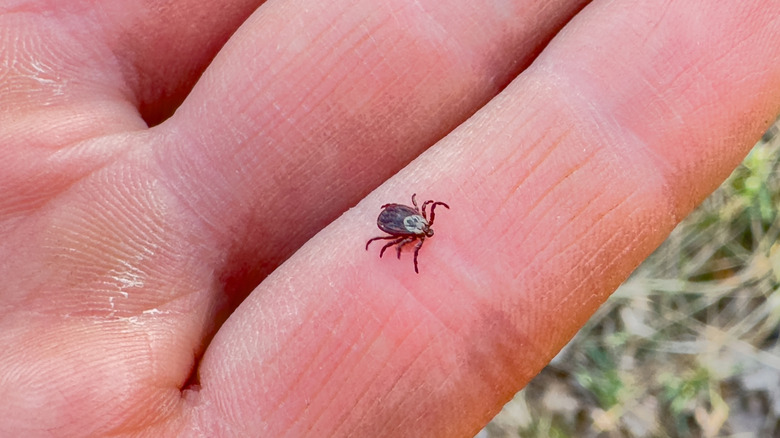
Don't Forget Your Pets
Dogs and cats can also carry ticks into the home.
Regularly check pets after outdoor activities, particularly around the ears, neck, legs, and between the toes.
Veterinarians can recommend appropriate tick-prevention products based on your pet's species, age, health, and local disease risks.
Never use a tick product intended for dogs on a cat unless the product specifically states that it is safe for cats.
Some ingredients can be toxic to cats.
When Should You Contact a Doctor?
Not every tick bite requires emergency treatment.
However, medical advice may be appropriate if:
-
The tick was attached for an unknown or prolonged period
-
You live in an area with significant tick-borne disease risk
-
You cannot remove the tick completely
-
The bite becomes increasingly red, painful, swollen, or produces pus
-
You develop fever or flu-like symptoms
-
You develop a spreading rash
-
You experience neurological symptoms
-
You are pregnant or immunocompromised and are concerned about exposure
In some circumstances, healthcare professionals may consider preventive treatment depending on the type of tick, geographic location, duration of attachment, and other factors.
Don't take antibiotics or antiparasitic medication on your own.
The Tiny Creature Is a Reminder to Pay Attention
The image is a good example of how easily ticks can go unnoticed.
Something this small can sit on the skin without immediately attracting attention.
That doesn't mean every tick bite will cause illness.
It simply means that early detection and proper removal are useful precautions.
If you spend time outdoors, especially in areas known for ticks, make tick checks part of your routine.
The Bottom Line
The tiny creature shown in the photograph appears to be a tick, although the exact species cannot be confirmed from the image alone.
Ticks are small arachnids that feed on blood and can transmit a range of diseases depending on the species and location.
Finding one does not mean you are infected.
The most important steps are to remove an attached tick promptly using fine-tipped tweezers, clean the bite area, monitor for unusual symptoms, and seek medical advice when appropriate.
Don't burn, crush, or coat an attached tick with household chemicals in an attempt to remove it.
And don't let fear keep you from enjoying the outdoors.
A few simple habits—wearing appropriate clothing, using tick protection, checking your body and pets, and removing ticks promptly—can significantly reduce the potential risks.
Sometimes the smallest creatures are the easiest to overlook. When it comes to ticks, taking a few minutes to check your skin after being outdoors can be well worth it.