Seeing a dog suddenly sprint after a stranger can be startling. One moment, the dog may appear calm and uninterested. The next, it is running toward someone walking past the house, a cyclist passing on the street, or a person approaching its owner.
To an observer, the behavior can seem completely random.
But dogs rarely chase people for no reason.
Chasing is a natural canine behavior that can be triggered by movement, excitement, fear, territorial instincts, frustration, or learned associations. Understanding what is happening behind the behavior can help owners respond more safely and prevent the situation from becoming a serious problem.
The important thing to remember is that a dog chasing someone does not automatically mean the animal is aggressive. The motivation behind the chase matters.
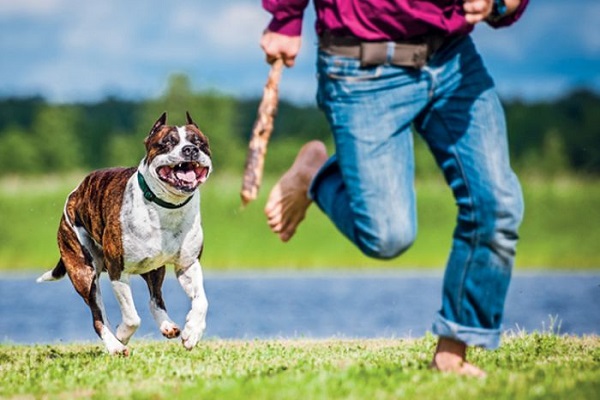
Why Do Dogs Chase Strangers?
Dogs experience the world differently from humans. They rely heavily on movement, scent, body language, and environmental cues to decide whether something is interesting, threatening, or worth investigating.
A stranger walking quickly past the house may therefore attract a dog's attention in a way that a person standing still does not.
The movement itself can become the trigger.
A dog may think:
"Something is moving. I should follow it."
That response can be particularly strong when the person is running, cycling, skating, or making sudden movements.
What looks like aggression from a distance may sometimes be excitement, curiosity, or an instinctive response to movement.
1. The Chase Instinct Can Be Powerful
One of the most obvious explanations is the dog's natural tendency to chase moving objects.
Dogs are predators by nature, and many breeds have been selectively developed to notice and respond to movement.
Herding dogs, hunting dogs, terriers, and other working breeds may have particularly strong responses to movement, although any dog can develop chasing behavior.
A running person can accidentally activate this instinct.
The dog may not understand that the person is simply exercising or trying to get somewhere.
To the dog, the sudden movement may be something worth pursuing.
This is one reason a person running away from a dog can sometimes make the situation worse.
The movement may encourage the dog to continue following.
2. Territorial Behavior Can Play a Role
Dogs are naturally attentive to their surroundings.
A dog living in a house with a yard may develop a strong sense that certain areas belong to its family.
When an unfamiliar person approaches the property, the dog may interpret the person's presence as something that needs to be investigated.
This can lead to:
-
Barking
-
Growling
-
Running toward the fence
-
Following someone along the property line
-
Charging toward a gate
-
Chasing someone who leaves the area
From the dog's perspective, the person may be an unfamiliar presence entering its perceived territory.
This doesn't necessarily mean the dog intends to attack.
However, territorial behavior can escalate, particularly if the dog has learned that barking or chasing makes strangers leave.
3. The Dog May Have Learned That Chasing "Works"
This is one of the most interesting explanations.
Imagine a dog runs toward a person walking past the house.
The person continues walking and eventually disappears around the corner.
The dog may interpret the sequence very differently from the human observer.
The dog could learn:
"I chased the person, and the person left."
From the dog's perspective, the behavior produced a successful result.
If this happens repeatedly, chasing can become reinforced.
The dog doesn't need to understand human intentions.
It simply learns that a particular action is followed by a particular outcome.
This is why allowing a dog to repeatedly chase pedestrians, cyclists, or delivery workers can make the behavior increasingly difficult to manage.
4. Fear Can Look Like Aggression
Not every dog that rushes toward a stranger is confident.
Some dogs actually chase because they are afraid.
This can seem contradictory.
Why would a frightened dog move toward something it fears?
Because dogs can respond to fear in different ways.
Some retreat.
Some freeze.
Some bark from a distance.
Others move forward in an attempt to make the frightening thing go away.
A fearful dog may bark, growl, lunge, or chase while actually trying to increase the distance between itself and the unfamiliar person.
This is why interpreting behavior solely by appearance can be misleading.
A dog that looks "tough" may actually be extremely anxious.
5. Frustration Can Make the Behavior Stronger
Imagine a dog standing behind a fence while people walk past every day.
The dog can see them.
It can hear them.
It can smell them.
But it cannot approach them.
That physical barrier can create frustration.
The dog may begin barking, jumping, scratching, or running along the fence.
Over time, the behavior can become highly repetitive.
When the dog eventually encounters a person outside the fence, the accumulated excitement and frustration may produce a much stronger reaction than expected.
This is sometimes described as barrier frustration.
The fence isn't necessarily making the dog aggressive.
It may simply prevent the dog from moving toward or away from the stimulus in a normal way.
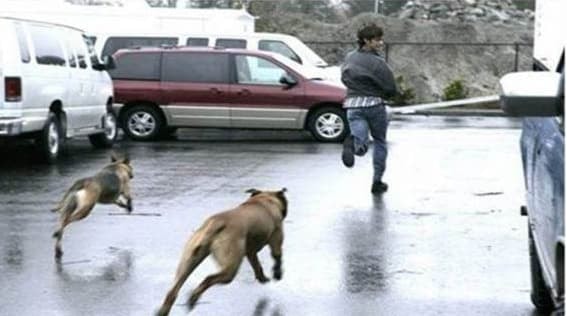
6. Some Dogs React to Fast Movement
A person walking slowly may barely attract a dog's attention.
A person running past can produce a completely different response.
The same can happen with:
-
Bicycles
-
Scooters
-
Skateboards
-
Cars
-
Joggers
-
Children running
-
People waving their arms
Fast, unpredictable movement can be highly stimulating to dogs.
For some animals, it activates play or chase behavior.
For others, it triggers anxiety.
And for some, it may combine both emotions.
This is why dog owners should pay particular attention to how their pets behave around moving pedestrians and cyclists.
7. Socialization Makes a Difference
A dog's experiences during its development can influence how it responds to unfamiliar people.
Dogs that regularly encounter different types of people in positive, controlled situations may become more comfortable with strangers.
Dogs with limited social exposure may find unfamiliar people more difficult to interpret.
For example, someone wearing a large hat may look unusual to a dog.
So might:
-
A person using a cane
-
Someone wearing a hood
-
A person carrying a large object
-
Someone moving differently
-
A child running unpredictably
-
A person approaching at night
Dogs don't necessarily understand these differences the way humans do.
They respond to what they perceive.
8. Scent Can Influence a Dog's Reaction
Dogs possess an extraordinarily powerful sense of smell.
A stranger can carry unfamiliar scents from other animals, environments, foods, chemicals, or people.
A dog may become interested in a person simply because that person smells different from the people it normally encounters.
This doesn't mean the dog can somehow "sense whether someone is good or bad."
That's a popular idea, but it shouldn't be treated as a reliable scientific rule.
A dog's reaction to a person's scent can be influenced by many ordinary environmental factors.
9. Previous Experiences Matter
Dogs learn from experience.
If a dog has previously had a frightening encounter with a particular type of person, it may become more reactive when it encounters someone who resembles that situation.
For example, a dog might become nervous around:
-
People wearing uniforms
-
People carrying objects
-
Cyclists
-
Strangers approaching the home
-
People who move quickly
The reaction may appear to come from nowhere, but the dog may be responding to an association formed earlier.
This is one reason understanding a dog's history can be valuable when addressing unusual behavior.
Does a Dog Chasing Someone Mean It Wants to Bite?
Not necessarily.
Chasing and biting are different behaviors.
A dog might chase because it is excited, curious, playful, fearful, territorial, or responding to movement.
However, a chase can still become dangerous.
A dog that runs toward someone may knock them over.
A frightened person may run, which can increase the dog's chase response.
The dog may become more excited and unpredictable.
And if the dog is displaying aggressive body language, the risk of a bite should be taken seriously.
That's why owners should never assume that chasing is harmless simply because the dog has never bitten anyone before.
Watch the Dog's Body Language
Understanding canine body language can provide useful clues.
A relaxed dog may have:
-
Loose body posture
-
Relaxed facial muscles
-
Natural ear position
-
A relatively loose tail
-
Normal movement
A highly aroused or uncomfortable dog may show:
-
Stiff posture
-
Intense staring
-
Raised hackles
-
Repeated barking
-
Growling
-
Lunging
-
Rapid movement
-
A rigid tail
-
Attempts to block or pursue someone
No single signal tells the entire story.
Look at the whole body and the situation.
A wagging tail doesn't automatically mean a dog is friendly. Dogs can wag their tails when excited, frustrated, or highly aroused.
Why Running Away Can Sometimes Make Things Worse
If a dog starts chasing you, your natural instinct may be to run.
But running can activate the dog's chase response.
That doesn't mean you should stand completely still in every situation. Your safety comes first.
If you encounter an unfamiliar dog, avoid sudden movements when possible and don't deliberately provoke the animal.
If a dog is actively approaching you, staying calm, avoiding direct staring, and creating distance can be safer than screaming or sprinting away.
If you're knocked down, protecting your face and neck and curling into a protective position may reduce the risk of serious injury.
What Should Dog Owners Do?
Owners have a major responsibility when their dogs display chasing behavior.
A secure environment is essential.
That can include:
-
Proper fencing
-
Reliable gates
-
Leashes in appropriate public areas
-
Supervision outdoors
-
Training
-
Avoiding situations that repeatedly trigger the behavior
If a dog repeatedly chases people, simply yelling "No!" may not solve the underlying problem.
The owner needs to determine why the dog is chasing.
Is it fear?
Excitement?
Territorial behavior?
Frustration?
Prey-drive behavior?
Once the motivation is better understood, training can be more targeted.
Positive Training Can Help
Behavior modification often focuses on teaching the dog an alternative response.
Instead of charging toward a stranger, the dog can learn to:
Look at the owner.
Return when called.
Remain behind a boundary.
Settle down.
Ignore passing people.
Reward-based training can help reinforce desirable behavior.
For serious reactivity, working with a qualified veterinary behaviorist or experienced positive-reinforcement trainer can be especially valuable.
The goal isn't simply to suppress the dog's behavior.
It's to help the dog learn a safer response to the trigger.
Don't Punish Fear With More Fear
If a dog is chasing strangers because it is frightened, harsh punishment can potentially make the underlying emotional problem worse.
The dog may associate strangers with unpleasant experiences.
Instead of learning:
"Strangers are safe."
It may learn:
"Strangers appear, and something bad happens."
That can increase anxiety and reactivity.
A structured behavior plan that addresses the dog's emotional response is generally more useful than punishment alone.

What About Certain Dog Breeds?
Some breeds have been selectively bred for traits such as herding, hunting, guarding, or chasing.
That means genetics can influence behavior.
But breed alone does not determine whether an individual dog will chase strangers or become aggressive.
Training, socialization, environment, health, previous experiences, and individual temperament all matter.
It's therefore misleading to assume that every dog of a particular breed will behave the same way.
Sudden Changes Shouldn't Be Ignored
If a normally calm dog suddenly becomes unusually reactive, it's worth considering whether something has changed.
Pain, illness, sensory problems, stress, environmental changes, or frightening experiences can affect behavior.
A dog that suddenly begins behaving very differently should be evaluated rather than simply labeled "bad."
If the behavior is new, severe, or accompanied by other concerning signs, consulting a veterinarian is a sensible first step.
The Real Reason May Be More Complicated Than It Looks
When a dog suddenly chases a stranger, there may not be one universal explanation.
The dog could be reacting to movement.
It could be protecting territory.
It could be frightened.
It could be excited.
It could have learned that chasing makes people disappear.
Or several of these factors could be happening simultaneously.
That's why experts generally look at the entire context, rather than assuming that chasing automatically equals aggression.
Final Thoughts
A dog sprinting after a stranger can look frightening, but the behavior isn't always what it appears to be.
Dogs chase for many different reasons.
Movement can activate instinctive pursuit.
Territorial situations can trigger protective behavior.
Fear can cause a dog to move toward something it wants to drive away.
Frustration can intensify reactions behind fences.
And previous experiences can teach a dog that chasing produces a rewarding result.
Understanding these motivations is important because it changes how we respond.
For dog owners, the goal should be to prevent dangerous situations, understand the trigger, and teach safer alternatives.
For people encountering an unfamiliar dog, staying calm, avoiding deliberate provocation, and prioritizing personal safety are key.
Most importantly, don't assume that a dog's behavior can be explained by a single stereotype.
Sometimes the dog isn't "suddenly turning aggressive." It's communicating, reacting, or following an instinct that humans don't immediately recognize.
Once you understand what may be happening beneath the surface, that surprising chase starts to make a lot more sense.