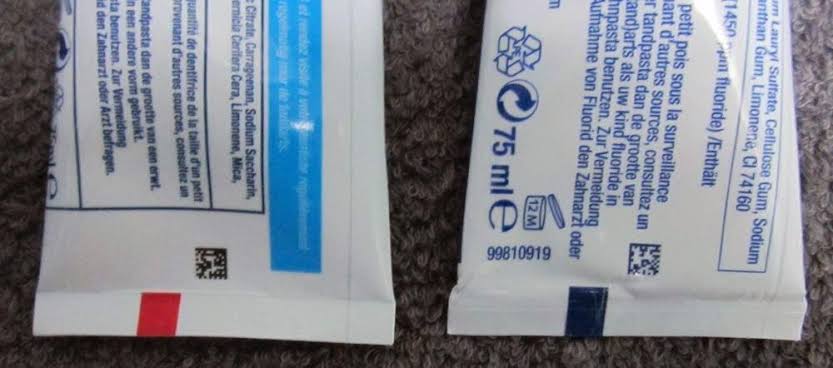
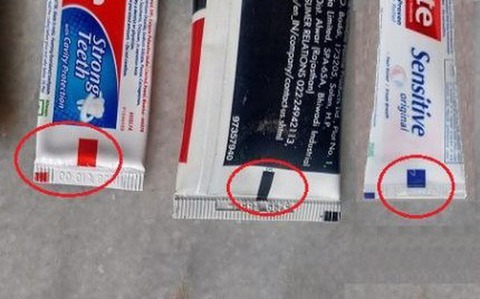
Have you ever noticed the small colored rectangle, square, or stripe near the sealed end of a toothpaste tube?
You may have seen it in black, blue, green, red, or another color and wondered whether it contains a hidden message.
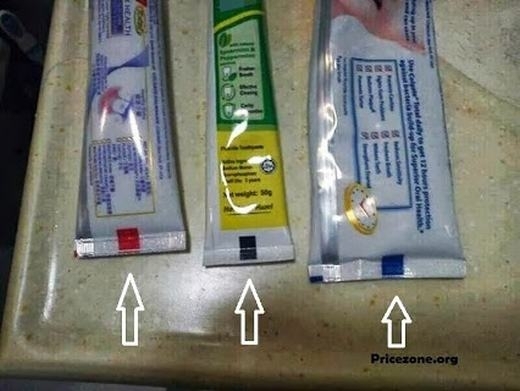
Some social media posts claim that these colored marks reveal whether toothpaste is made from natural ingredients, chemicals, medicines, or a mixture of different substances. These claims have been shared thousands of times online, making the tiny mark seem like a mysterious "secret code."
But the real explanation is much less dramatic and much more practical.
The colored mark is generally a manufacturing and packaging reference used by machines. It is not a reliable code for telling you what's inside the toothpaste.
Let's take a closer look at what the mark actually does, why manufacturers use different colors, and how you should really evaluate the toothpaste you buy.
What Is the Colored Mark on a Toothpaste Tube?
The mark is often called an eye mark, registration mark, or print mark.
It is typically placed near one end of flexible packaging.
You may find similar marks on:
-
Toothpaste tubes
-
Food packages
-
Snack bags
-
Sachets
-
Cosmetic tubes
-
Medicine packaging
-
Plastic pouches
Its purpose is related to automated packaging equipment, not the ingredients inside the product.
During manufacturing, machines need to know where the packaging should be:
-
Cut
-
Folded
-
Sealed
-
Aligned
-
Positioned
The printed mark provides a visual reference that sensors can detect.
Why Does a Machine Need This Mark?
Imagine a toothpaste tube being manufactured from a long strip of flexible packaging material.
The production machine has to perform several operations extremely quickly.
It needs to know exactly where one package ends and the next begins.
A sensor can detect the contrast between the colored mark and the surrounding packaging.
Once the sensor detects the mark, the machine can determine where to:
position → cut → fold → seal
This helps ensure that the finished tube is properly aligned.
Without reliable registration marks, packaging could be:
-
Cut in the wrong location
-
Poorly aligned
-
Sealed incorrectly
-
Printed unevenly
So that tiny colored rectangle serves a very practical purpose.
Does the Color Tell You What's Inside?
This is where one of the most common internet myths comes in.
You may have seen claims such as:
-
Green = natural ingredients
-
Blue = natural plus medicinal ingredients
-
Red = natural plus chemical ingredients
-
Black = completely chemical ingredients
This sounds convincing because the colors appear consistently on some products.
But there is no universal toothpaste color code that works this way.
The color of the registration mark does not provide a reliable summary of the toothpaste's ingredients.
A black mark does not mean the toothpaste is "100% chemical," and a green mark does not prove that the toothpaste is entirely natural.
So Why Are Different Colors Used?
The color is generally chosen based on printing and machine detection requirements.
The sensor needs to distinguish the registration mark from the background.
For example, if the packaging is mostly white, a dark mark may provide strong contrast.
If the packaging itself is dark, another color may provide better contrast.
The important factor is often the difference between the mark and its background.
In other words:
The color is about visibility—not a secret ingredient classification.
Why Is the Mark Sometimes Black?
Black provides strong contrast against many light-colored packaging materials.
This makes it easy for optical sensors to detect.
That's why black registration marks are common.
But a black mark doesn't tell you that the toothpaste contains a particular type of ingredient.
It simply may be an effective color for the packaging machine to recognize.
What About Red, Blue, or Green Marks?
The same principle applies.
A manufacturer may select a particular ink color based on:
-
Packaging design
-
Background color
-
Printing process
-
Sensor requirements
-
Production equipment
Two completely different toothpaste formulas could theoretically use the same colored registration mark.
Likewise, two nearly identical formulas could use different mark colors on different packaging designs.
Therefore, trying to determine toothpaste ingredients based on the tiny colored mark is unreliable.
Where Does the Myth Come From?
The myth likely became popular because the mark looks mysterious.
It appears in an unobtrusive location and often has no explanation printed beside it.
People naturally wonder:
"Why is that little colored box there?"
Once an explanation involving "natural," "chemical," or "medicinal" ingredients appears online, it can sound plausible—especially when several toothpaste tubes seem to have different colors.
But appearance alone isn't evidence of a formulation code.
How Can You Actually Tell What's in Your Toothpaste?
The answer is much simpler:
Read the ingredient label.
Manufacturers list the ingredients used in the product according to applicable labeling requirements.
Depending on the product and country, you may see ingredients such as:
-
Fluoride compounds
-
Abrasive agents
-
Humectants
-
Detergents or surfactants
-
Flavoring agents
-
Sweeteners
-
Thickeners
-
Preservatives
-
Colorants
The ingredient list provides far more useful information than the colored mark on the tube.
What Is Fluoride and Why Is It Important?
One of the most important things to check when choosing toothpaste is whether it contains fluoride.
Fluoride helps strengthen tooth enamel and makes teeth more resistant to acid produced by bacteria.
Regular use of fluoride toothpaste is widely recommended for preventing dental caries.
For most people, the important question isn't whether the tube has a green, blue, red, or black mark.
It's whether the toothpaste is appropriate for your dental needs and contains fluoride at an appropriate concentration, when fluoride toothpaste is recommended.
What Does "Natural" Really Mean?
The word "natural" can also be misleading.
A product may contain plant-derived ingredients and still have other ingredients produced through chemical processes.
Meanwhile, something described as "chemical" isn't automatically harmful.
In fact, everything around us is made of chemicals, including:
-
Water
-
Oxygen
-
Minerals
-
Plant compounds
-
Vitamins
Therefore, judging toothpaste safety based on whether it is "natural" or "chemical" is an oversimplification.
The specific ingredient, amount, formulation, and evidence about its safety matter much more.
Should You Avoid Toothpaste With a Black Mark?
No.
There is no scientific reason to reject a toothpaste simply because the registration mark is black.
The mark is not a safety rating.
It does not mean:
-
The toothpaste is toxic
-
The formula is artificial
-
The product contains dangerous chemicals
-
The toothpaste is inferior
If you're concerned about a toothpaste, look at its ingredients, fluoride content, intended use, expiration information, and manufacturer instead.
Does the Colored Mark Affect the Toothpaste?
The registration mark is generally part of the printed packaging, not an ingredient added to the toothpaste itself.
Its role is to help manufacturing equipment correctly position and seal the tube.
It doesn't determine:
-
The flavor
-
The cleaning ability
-
The fluoride concentration
-
The whitening effect
-
The medicinal properties
Those characteristics come from the formulation inside the tube.
What Should You Look for When Buying Toothpaste?
Instead of focusing on the colored mark, consider several practical factors.
1. Fluoride
For most people, fluoride toothpaste is an important tool for preventing cavities.
If you have specific dental concerns, your dentist may recommend a particular fluoride concentration or prescription product.
2. Your Dental Needs
Different toothpastes are formulated for different purposes.
You may want a product designed for:
-
Cavity prevention
-
Sensitive teeth
-
Gum health
-
Tartar control
-
Whitening
-
Dry mouth
Not everyone needs the same formula.
3. Sensitivity
If cold, hot, sweet, or acidic foods cause sharp tooth pain, you may benefit from toothpaste specifically formulated for sensitive teeth.
Persistent sensitivity should still be evaluated by a dentist because it can have several causes.
4. Whitening Claims
Whitening toothpastes generally work by removing or reducing surface stains.
They do not necessarily change the natural color of the tooth as dramatically as professional whitening procedures.
If you have significant discoloration, talk to a dental professional.
What About Children?
Children require special consideration because toothpaste use should be appropriate for their age.
Young children may swallow toothpaste rather than spit it out.
Parents and caregivers should follow dental guidance regarding:
-
The amount of toothpaste
-
Fluoride concentration
-
Brushing technique
-
Supervision
The colored mark on the tube has nothing to do with whether a toothpaste is suitable for children.
Can Toothpaste Cause Irritation?
Some people may experience irritation from certain toothpaste ingredients.
Potential symptoms include:
-
Burning
-
Redness
-
Mouth soreness
-
Peeling or irritation around the lips
Possible triggers can include flavoring agents, detergents, preservatives, or other ingredients.
If irritation repeatedly occurs after using a particular toothpaste, consider discussing it with a dentist or healthcare professional.
Again, the registration mark won't tell you which ingredient is responsible.
What About "Chemical-Free" Toothpaste?
Be cautious with the phrase "chemical-free."
It is scientifically misleading because toothpaste—and everything else made of matter—contains chemical substances.
A better question is:
Which ingredients does the product contain, and what evidence supports their safety and effectiveness?
That's a much more useful way to evaluate a product.
The Same Principle Applies to Other Packaging
The colored mark isn't unique to toothpaste.
You may notice similar marks on:
-
Cookie packages
-
Candy wrappers
-
Coffee bags
-
Pet food packaging
-
Cosmetic tubes
-
Snack packets
In many cases, these marks serve as references for automated packaging equipment.
So the next time you see a small colored rectangle on a package, don't automatically assume it represents an ingredient classification.
Common Myths About Toothpaste Color Marks
Myth 1: Green Means 100% Natural
False.
The mark is generally a packaging registration reference and isn't a standardized ingredient code.
Myth 2: Black Means the Toothpaste Is Dangerous
False.
Black is often simply an easy-to-detect contrast color.
Myth 3: Red Means the Product Contains Harmful Chemicals
False.
The color doesn't provide a reliable description of the formula.
Myth 4: Blue Means the Toothpaste Contains Medicine
Not necessarily.
The color of the registration mark doesn't establish whether a toothpaste contains a therapeutic ingredient.
Why This Tiny Mark Is Actually Important
Although it doesn't tell consumers much about the toothpaste, the mark is still important to manufacturers.
Modern packaging lines can operate at very high speeds.
A tiny error in positioning can result in thousands of packages being misaligned.
Registration marks help machines maintain consistency.
They can contribute to accurate:
-
Cutting
-
Sealing
-
Printing
-
Positioning
So that little rectangle isn't a secret message to consumers.
It's essentially a machine-readable positioning reference.
The Bottom Line
That mysterious colored mark near the end of your toothpaste tube is generally a packaging registration or "eye" mark used by manufacturing equipment. Its color is primarily related to contrast and detection during the production and sealing process.
It does not reliably tell you whether the toothpaste is natural, chemical, medicinal, or harmful.
If you want to know what's actually inside your toothpaste, don't inspect the colored rectangle.
Read the ingredient list.
Look for the fluoride content, consider your specific dental needs, and choose products from reputable manufacturers. If you're unsure which toothpaste is appropriate for you or your family, a dentist can provide personalized advice.
Final Thoughts
The tiny colored mark on a toothpaste tube may look like a secret code, but the real explanation is much more practical. It helps machines recognize where packaging should be positioned, cut, and sealed during manufacturing.
So the next time you pick up a tube of toothpaste and notice a little black, blue, red, or green rectangle near the end, you don't need to decode it.
It's not telling you what's inside the toothpaste. It's helping the machine package it correctly.
And when it comes to your oral health, the information that really matters is printed elsewhere: the ingredients, fluoride content, directions for use, and information relevant to your specific dental needs.