A walk through a garden can reveal some surprisingly strange things.
At first, the objects in the soil may look like tiny cups, miniature bowls, or even unusual eggs sitting inside small containers. They can appear so perfectly arranged that it's easy to wonder whether someone deliberately placed them there.
That is exactly what makes discoveries like this so fascinating.
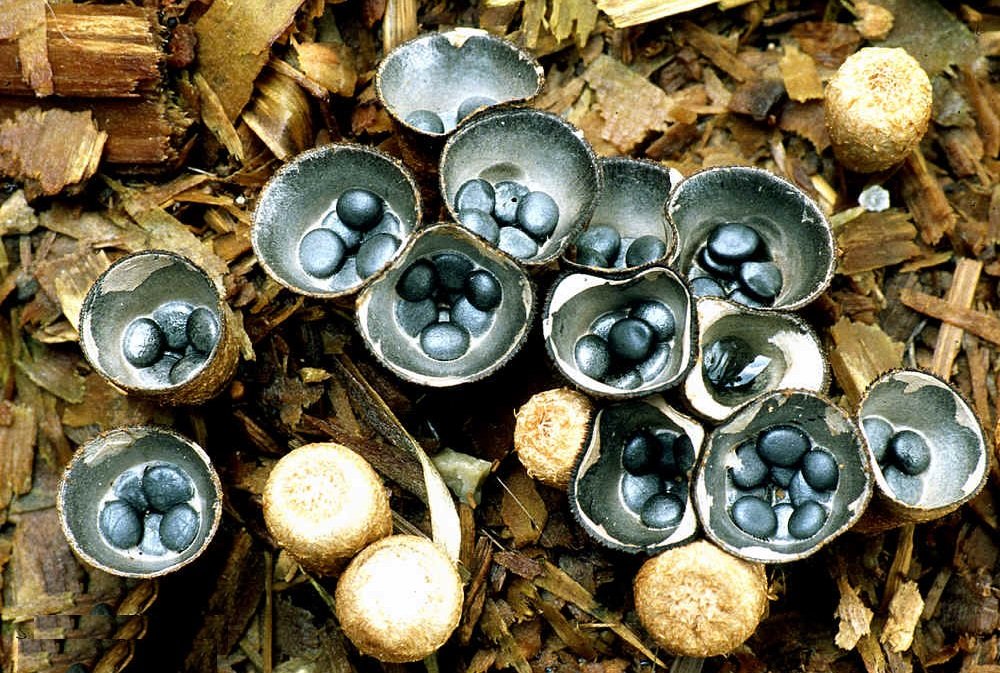
The strange structures shown in the image are associated with a remarkable group of fungi commonly known as bird’s nest fungi. Their unusual appearance can make them look like something from an entirely different world, but they are actually part of a natural fungal life cycle that often goes unnoticed beneath our feet.
What appears to be a collection of tiny gray or dark "eggs" is actually a clever reproductive structure created by the fungus.
And the way these fungi spread their spores is even more fascinating.
What Are Those Tiny Cups?
Bird’s nest fungi belong to several genera, including Cyathus, Crucibulum, and Nidularia.
They are generally small and can be difficult to notice unless you're looking closely at soil, mulch, decaying wood, or plant debris.
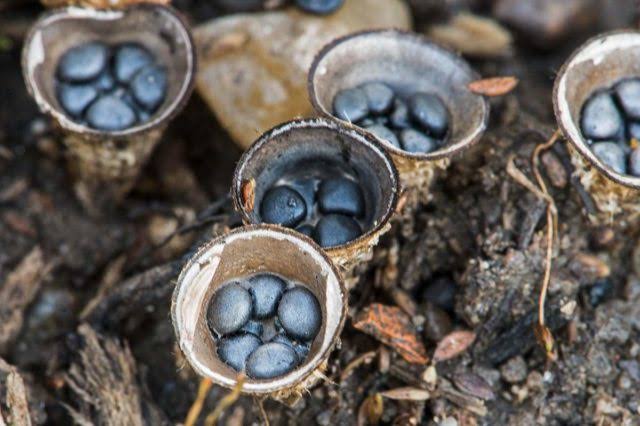
The structures are often shaped like miniature cups or nests.
Inside those cups are several small, rounded structures that resemble tiny eggs.
These structures are called peridioles.
So although the image may initially look like it shows insect eggs, seeds, or some type of animal nest, the objects are actually part of a fungus.
The resemblance to a miniature bird's nest is so striking that the common name makes perfect sense.
Why Do They Look Like Tiny Nests?
The unusual shape isn't simply decorative.
It plays an important role in reproduction.
The small cup acts as a kind of natural launching structure for the fungal reproductive bodies inside it.
As the fungus matures, the cup becomes exposed to the environment.
Rainfall provides one of the most important ingredients.
When a raindrop lands inside the cup with enough force, it can propel one or more of the tiny peridioles outward.
The process is remarkably efficient considering that the organism has no muscles, legs, wings, or other obvious means of movement.
Instead, it uses water and physics.
The Tiny "Eggs" Are Actually Spore Packages
The small round structures inside the cups can look almost like eggs when viewed in a photograph.
But they are not eggs at all.
They are peridioles, compact structures containing fungal spores.
Spores are the reproductive units of fungi.
They serve a role somewhat comparable to seeds in plants, although fungal spores and plant seeds are biologically quite different.
The spores allow the fungus to reproduce and potentially colonize new areas when the appropriate conditions are available.
This is one reason the strange structures are much more interesting than they initially appear.
Rain Becomes the Fungi's Launch Mechanism
One of the most fascinating features of bird’s nest fungi is their relationship with rainfall.
Imagine a tiny cup sitting quietly among pieces of mulch.
Nothing appears to be happening.
Then a raindrop falls directly into the cup.
The force of that drop can cause the water to splash upward and outward, carrying a peridiole with it.
In some species, the peridiole is connected to a thin fungal structure that can become attached to nearby vegetation.
This gives the reproductive structure a better chance of being transported away from the original fungus.
It's an incredibly clever natural mechanism.
The fungus doesn't need to chase anything.
It simply waits for the environment to provide the energy needed for dispersal.
Nature Can Make Something Look Almost Artificial
Part of what makes these fungi so intriguing is their appearance.
The cups can be remarkably uniform.
Some have smooth interiors, while others may have hairy or textured outer surfaces.
The peridioles inside can be dark, pale, grayish, brown, or black depending on the species and stage of development.
When several fruiting bodies appear together, they can look almost like tiny pieces of carefully constructed pottery.
That visual perfection can make people wonder whether they're looking at something manufactured.
But the entire structure is produced naturally by fungal growth.
They Often Grow on Decaying Organic Material
Bird’s nest fungi are generally associated with dead and decomposing organic matter.
You may encounter them in places containing:
-
Wood mulch
-
Decaying branches
-
Dead leaves
-
Compost
-
Garden debris
-
Rotten wood
-
Rich organic soil
This makes gardens particularly suitable environments.
A garden isn't just a collection of living plants.
Underneath the surface is an entire ecosystem involving fungi, bacteria, insects, worms, microorganisms, roots, and decomposing organic material.
Bird’s nest fungi are one small part of that ecosystem.
Why Would They Appear in Someone's Garden?
The appearance of these fungi usually isn't mysterious once you understand their preferred environment.
If a garden contains plenty of organic material and moisture, fungal organisms have access to exactly what they need.
Mulch is particularly relevant.
Wood-based mulch gradually breaks down over time. As it decomposes, it becomes a source of nutrients for various fungi.
Periods of rainfall or consistently moist conditions can also encourage fungal fruiting.
That's why you might suddenly notice strange fungal structures after several wet days.
The fungus may have been developing unnoticed for some time.
What changes is that its reproductive structures become visible.
Seeing Them Doesn't Necessarily Mean Something Is Wrong
Many people become concerned when they find unusual fungi growing around their homes.
However, the presence of bird’s nest fungi generally doesn't automatically mean that a garden is unhealthy.
In many cases, their appearance simply indicates that organic material is being decomposed.
Fungi play an essential role in natural ecosystems because they help break down dead plant material and return nutrients to the environment.
Without decomposers, forests, gardens, and other ecosystems would gradually become buried under enormous amounts of dead organic matter.
So something that looks strange may actually be part of a normal and useful ecological process.
The Garden Is Full of Hidden Decomposers
We often think of gardens as places dominated by flowers, vegetables, trees, and insects.
But much of the biological activity happens out of sight.
Fungi are especially important because their main body can exist as a network of microscopic threads called hyphae.
Together, these threads form a structure called mycelium.
The visible mushroom or fungal cup is only one part of the organism's life cycle.
In other words, the strange little cups appearing on the surface aren't necessarily the entire fungus.
They are reproductive structures produced by a much larger network that may exist within the surrounding organic material.
Why They Are Sometimes Confused With Insect Eggs
The confusion is understandable.
The peridioles inside bird’s nest fungi can be surprisingly realistic-looking.
They're small, rounded, and grouped together inside a cup.
When photographed from above, the resemblance to eggs becomes even stronger.
But there are several clues that can help distinguish them.
A bird’s nest fungus typically has:
A small cup-shaped outer structure
Several rounded peridioles inside
A location associated with soil, mulch, or decaying plant material
A clearly fungal texture
The exact appearance can vary considerably depending on the species and stage of development.
For that reason, a clear close-up photograph is often useful when attempting identification.
They Are Usually Tiny
One reason people don't notice these fungi immediately is their size.
Individual fruiting bodies are generally only a few millimeters across, although size varies among species.
At ground level, however, they can look much more dramatic.
A cluster of tiny cups surrounded by dark mulch creates an unusual visual pattern.
A camera can also reveal details that aren't obvious from a standing position.
This is a perfect example of how photography can expose miniature ecosystems that are normally overlooked.
A Closer Look Reveals an Amazing Design
When you zoom in, the structure becomes even more impressive.
The outer cup provides protection while the reproductive structures develop.
The interior holds the peridioles.
Then, when environmental conditions are favorable, rain can help launch them.
The entire process is an example of biological engineering through evolution.
There is no conscious designer controlling each step.
Instead, fungal structures that successfully dispersed their spores were more likely to reproduce, and over many generations, highly effective mechanisms developed.
The result is something that looks almost engineered despite being entirely natural.
Do You Need to Remove Them?
In most garden situations, there is no reason to panic simply because these fungi appear.
If you don't like their appearance, you can remove the visible fruiting structures by hand while wearing gloves.
You can also reduce the amount of decaying organic material or adjust watering practices if excessive moisture is contributing to their appearance.
However, eliminating every fungus from a garden isn't realistic—and generally isn't necessary.
Fungi are a normal part of healthy soil ecosystems.
In fact, attempting to eliminate harmless fungi with chemicals can create unnecessary environmental problems.
The better approach is usually to understand what you're seeing first.
Don't Eat an Unknown Fungus
Although bird’s nest fungi are fascinating to observe, it's important not to treat unidentified wild fungi as food.
Their tiny size makes them impractical as food anyway, and there is no reason to consume an unfamiliar fungal organism simply because it appears harmless.
If children or pets spend time in the garden, it can also be useful to teach them not to eat unknown mushrooms or fungi.
The safest rule is simple:
Look, photograph, learn—but don't eat unidentified fungi.
Could They Harm Plants?
Bird’s nest fungi are generally associated with decomposition rather than directly attacking healthy living plants.
Their presence in mulch or decaying material is therefore not automatically a sign that nearby plants are diseased.
If a plant is struggling, however, don't assume the visible fungus is responsible.
Plant problems can have many causes, including poor drainage, root damage, pests, pathogens, nutrient deficiencies, extreme temperatures, or inappropriate watering.
A proper diagnosis requires looking at the entire situation rather than blaming the most unusual thing in the garden.
Why Moisture Plays Such an Important Role
Water is essential to the life cycle of many fungi.
Periods of rain can provide the conditions necessary for fruiting structures to develop and release spores.
That's why fungi can sometimes seem to appear "overnight."
They didn't necessarily grow from nothing overnight.
The fungal network was likely already present in the environment, while the visible reproductive structures developed when conditions became favorable.
After a period of wet weather, the garden can suddenly reveal an entirely new collection of tiny fungal structures.
A Reminder That Gardens Are Living Ecosystems
Perhaps the most interesting lesson from a discovery like this is that a garden is much more complicated than it appears.
We may see soil, mulch, and plants.
But beneath and between those familiar objects is a constantly changing ecosystem.
Roots are growing.
Microorganisms are reproducing.
Organic matter is decomposing.
Fungi are spreading through soil and plant debris.
Insects are moving through the mulch.
Water is carrying nutrients and spores.
All of this happens quietly.
Most of the time, we never notice it.
The Strange Objects May Actually Be a Sign of Nature at Work
The next time you see tiny cup-shaped structures in a garden, don't immediately assume you're looking at insect eggs or something dangerous.
Take a closer look.
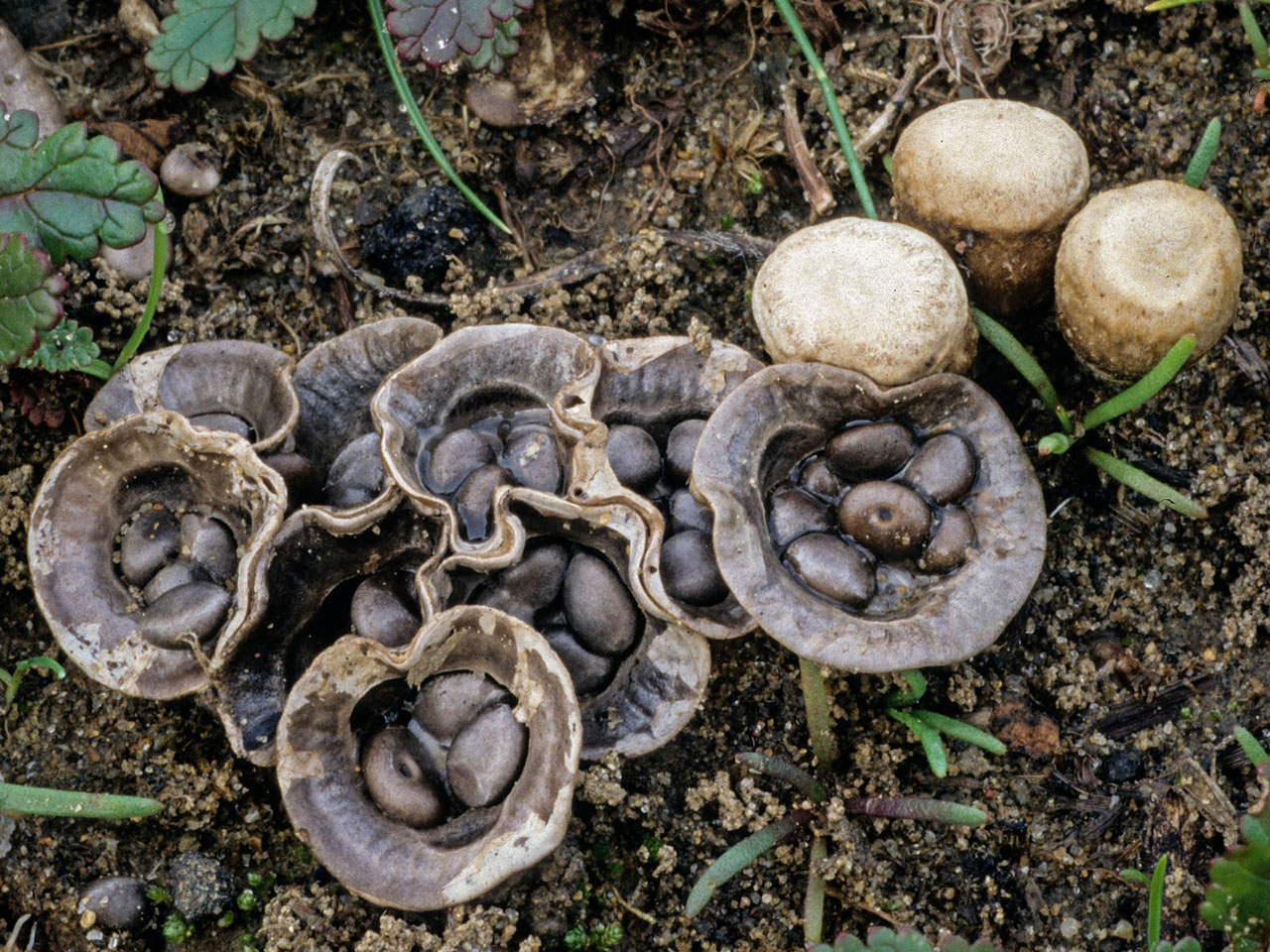
If they resemble miniature nests containing tiny dark "eggs," you may be looking at a bird’s nest fungus or a related fungal species.
What initially looks disturbing can turn out to be a fascinating example of how organisms reproduce and survive.
The tiny cups aren't invading the garden.
They're participating in it.
One of Nature's Cleverest Little Reproductive Systems
Perhaps the most remarkable part of the story is how much complexity is hidden inside something so small.
A structure only a few millimeters wide can contain an elaborate reproductive strategy.
The fungus creates a cup.
The cup protects the peridioles.
Rain provides energy.
The peridiole is launched into the surrounding environment.
Spores are dispersed.
And, under the right conditions, a new fungal colony can eventually develop.
All of this happens without the dramatic movements we normally associate with reproduction.
It's a quiet process, but an incredibly effective one.
The Next Time You Walk Through a Garden, Look Down
The strangest discoveries aren't always found in remote forests or exotic locations.
Sometimes they're sitting right beneath our feet.
A patch of mulch can contain structures that resemble miniature bowls.
A fallen branch can support an entire fungal community.
A few days of rain can reveal organisms that had previously gone unnoticed.
The image of these tiny "nests" is a perfect reminder that nature doesn't have to be large to be extraordinary.
What looks like a collection of mysterious eggs may actually be an ingenious fungal structure designed to send spores into the world.
And once you know what you're looking at, that strange garden discovery becomes much less frightening—and much more fascinating.
Sometimes, the most mysterious things in a backyard aren't signs of something going wrong. They're tiny examples of nature quietly doing exactly what it has evolved to do.