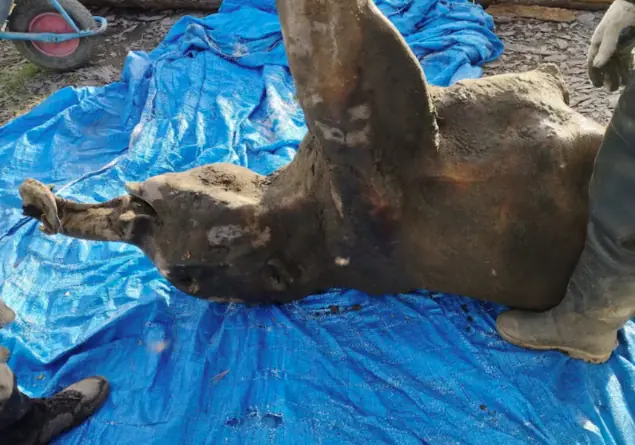
Russian researchers have discovered the remains of a mammoth calf, estimated to be only a few years old, frozen for 50,000 years. It is considered one of the seven most complete mammoths ever found.
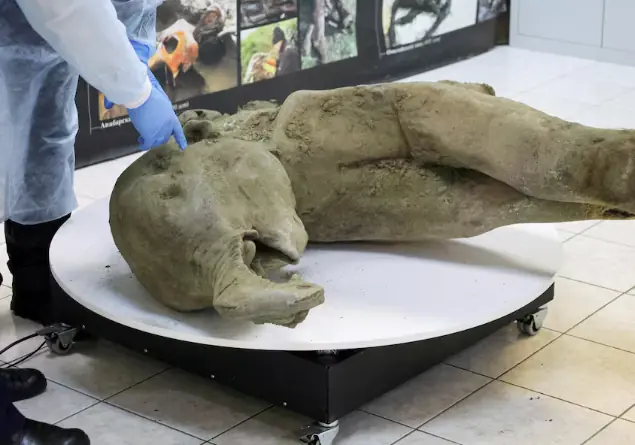
According to international news reports, researchers in Siberia revealed images of the remarkably well-preserved mammoth remains, which were discovered in the thawing permafrost layers of Yakutsk, Russia, after more than 50,000 years.
The female mammoth calf, which had been frozen for 50,000 years, was found in the Yana River basin this summer, and has been nicknamed "Yana." It was discovered in a large crater from a meteorite impact, which is more than 80 meters (260 feet) deep and continues to expand due to climate change.
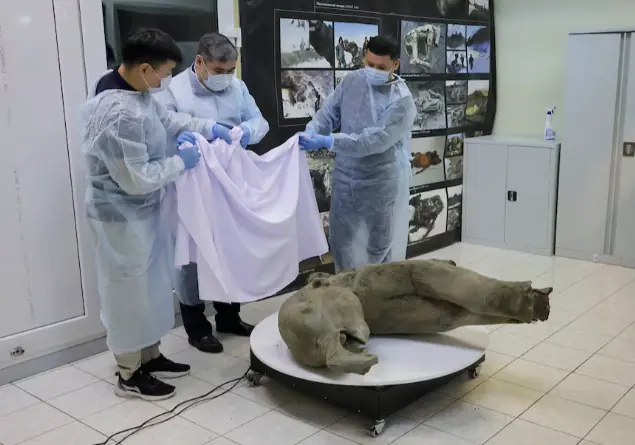
Weighing over 110 kilograms (240 pounds), Yana was brought to the surface using a temporary stretcher, according to the head of the Mammoth Museum Laboratory, Lazarev, in Yakutsk. Experts say that Yana is the most complete mammoth ever found in the world and one of the seven most complete mammoths ever discovered.
Additionally, experts are conducting further research to determine the exact age of Yana. It is currently estimated that when the mammoth calf died, it was only "about 1 year old or slightly older." Tests are expected to help scientists confirm this more accurately. The fact that both its head and body remain intact is considered very unusual.
"In general, the parts that thaw first, especially the torso, are usually eaten by predators or birds. For example, in this case, although the front legs were eaten, the head remains remarkably well-preserved," Sherpazov said to Reuters.
This is the latest significant discovery in Russia's permafrost layers. Last month, scientists in the vast northeastern region of Sakha, or Yakutia, showcased the remains of a 32,000-year-old saber-toothed tiger, and earlier this year, scientists also discovered the remains of a 44,000-year-old wolf.