Chapter 1: A Quiet Neighborhood Suddenly Covered in Giant Hailstones
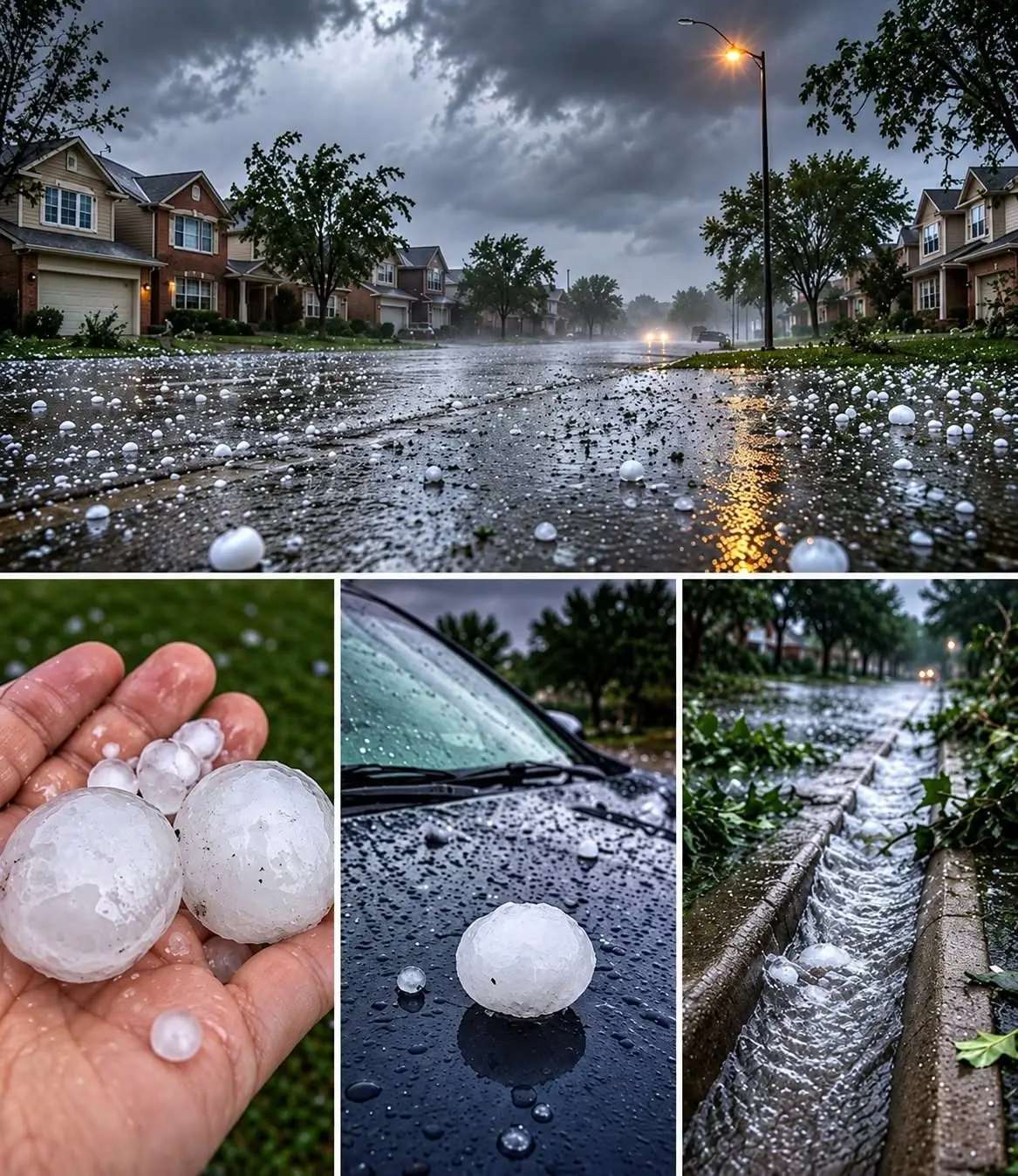
The evening may have started like any other. Families were returning home, children were finishing their daily activities and residents were preparing dinner. Cars were parked along residential streets, streetlights were beginning to glow and the neighborhood appeared peaceful.
Then the weather began to change.
Dark clouds gathered overhead, gradually covering the sky. The wind became stronger, tree branches started moving violently and the first sounds of thunder could be heard in the distance.
At first, residents might have expected an ordinary rainstorm. However, powerful thunderstorms can develop rapidly, sometimes producing dangerous weather within a relatively short period.
Rain began falling heavily, hitting rooftops, windows and roads. Soon, the sound of ice striking hard surfaces joined the noise of the rainfall.
Hailstones began falling.
Initially, the pieces of ice may have been relatively small. But as the storm intensified, larger stones could fall from the clouds, bouncing across driveways and collecting along sidewalks.
The scene depicted in the supplied photograph is particularly striking. White hailstones cover a residential road, while dark storm clouds hang above rows of houses. Water flows along the gutters, carrying smaller pieces of ice toward drainage channels.
The lower photographs show another disturbing possibility: hailstones large enough to fit in an adult's palm, a vehicle covered with ice and a roadside drainage system struggling to carry away the water.
For residents, such conditions can be frightening because hail is not simply frozen rain.
Large hailstones can fall with considerable force. They may break windows, damage roofs, dent vehicles and injure people or animals caught outside.
According to the National Weather Service, severe thunderstorms can produce hail at least one inch in diameter, while some exceptionally powerful storms generate stones much larger than that.
The danger increases when hail arrives alongside strong winds and heavy rainfall.
A person standing outside may have very little protection from falling ice. Even a short exposure can result in injuries, particularly when stones are large or falling at high speeds.
For homeowners, the first concern is often the condition of their property.
Roofing materials may crack, gutters can become blocked and windows may be damaged. Vehicles parked outdoors are also vulnerable, particularly when large hail strikes the windshield, roof and hood.
But the danger does not end when the hail stops.
As the ice begins melting, large amounts of water can accumulate on streets and sidewalks. If drainage systems cannot carry the water away quickly enough, localized flooding may occur.
Leaves, branches and other debris can make the situation worse.
The combination of ice, rainwater and scattered debris can turn an ordinary residential road into a slippery and potentially dangerous area.
It is important to emphasize that the supplied photograph does not establish the actual location, date or measured hail size of a particular storm. Nevertheless, it illustrates the kinds of conditions that can accompany severe hail-producing thunderstorms.
Understanding how these storms develop helps explain why a peaceful evening can suddenly become dangerous.
Chapter 2: How Do Giant Hailstones Form Inside Powerful Thunderstorm Clouds?
Many people assume that hail forms when rain freezes while falling through cold air. However, the actual process is more complicated.
Giant hailstones develop inside powerful thunderstorms where strong upward-moving air currents can keep ice particles suspended in the atmosphere.
These upward currents are called updrafts.
During a thunderstorm, warm, moist air rises rapidly from the lower atmosphere. As it moves higher, temperatures become colder, and water vapor condenses into cloud droplets.
At sufficiently high altitudes, some water droplets remain liquid even when temperatures are below freezing. These are known as supercooled water droplets.
When tiny ice particles encounter these droplets, water freezes onto their surfaces.
This process gradually increases the size of the ice particles.
As the hailstone moves through different parts of the storm, additional layers of ice can accumulate.
Some hailstones develop visible layers that resemble the rings inside a tree trunk. These layers reflect changes in the conditions under which the ice formed.
The stronger and more persistent the updraft, the greater the opportunity for hailstones to grow.
In certain powerful thunderstorms, especially supercells, an organized rotating updraft can support large hailstones for an extended period.
The hailstones may be carried upward repeatedly, collecting additional layers of ice before eventually falling toward the ground.