Have you ever looked in the mirror and noticed two small dents or dimples near the lower part of your back, just above your buttocks?
They may look unusual at first, especially if you have only recently noticed them. Some people even wonder whether these marks are caused by exercise, weight loss, posture, aging, or genetics. Others have heard them called “Venus dimples” and believe they might reveal something special about the body.
But the real explanation is much simpler—and much more interesting.
These small indentations are usually related to the underlying structure of your pelvis. In many people, they appear near the posterior superior iliac spines, which are parts of the pelvic bones located beneath the skin.
So what exactly causes them? Are they a sign of being fit? Do they have anything to do with health or fertility? And when should a dent in the lower back actually be checked by a doctor?
Let's take a closer look.
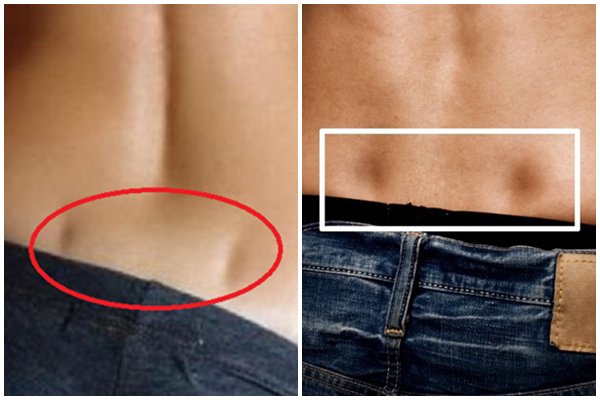
What Are the Two Dents on the Lower Back?
The two small indentations are commonly known as back dimples or, more informally, “Venus dimples.”
They are usually positioned symmetrically on either side of the lower spine, around the area where the pelvis meets the lower back.
If you place your hands on your hips and feel toward the back, you can often locate the bony structures underneath the skin. These are part of the pelvic anatomy, and the dimples may appear around that region because of the way the skin, connective tissue, ligaments, and underlying bones are arranged.
In other words, these marks aren't necessarily something that has developed because you exercised or lost weight.
For many people, they have simply been part of their anatomy all along.
Sometimes they become more noticeable as a person's body composition changes. For example, losing some body fat may make existing anatomical features easier to see, while changes in muscle development can also alter the appearance of the lower back.
Why Do Some People Have Them While Others Don't?
This is one of the most interesting things about lower-back dimples.
Not everyone has them.
The visibility of these dimples can vary considerably from person to person because of differences in:
-
Genetics
-
Bone structure
-
Pelvic anatomy
-
Skin and connective tissue
-
Body-fat distribution
-
Muscle development
-
Posture
-
Age-related changes in body composition
Some people have very obvious dimples that are visible even when standing normally.
Others may have extremely subtle indentations that can only be seen in certain lighting or positions.
And some people don't have visible dimples at all.
None of these variations necessarily indicate a problem.
Human bodies aren't built from a single template. Small differences in bone shape, soft tissue, and fat distribution can create features that look dramatically different from one person to another.
Are “Venus Dimples” a Sign of Fitness?
This is where online discussions often become misleading.
You may see claims suggesting that these two dents are proof that someone has a low body-fat percentage, strong core muscles, or an exceptionally athletic body.
There is some reason why they may become more visible in leaner people, but the dimples themselves are not a reliable fitness test.
A person can be physically fit without having visible lower-back dimples.
Likewise, someone can have very noticeable dimples without following an exercise program.
Their appearance is primarily influenced by anatomy and genetics, not simply fitness.
Exercise can change the surrounding muscles and body composition, potentially making the area look more defined, but it doesn't mean that everyone who trains will develop these dimples.
So if you have them, you don't necessarily have a “better” or “fitter” body.
And if you don't have them, it doesn't mean you're out of shape.
Can Weight Loss Make Them More Visible?
Yes, sometimes.
When someone loses body fat, previously subtle anatomical structures may become easier to see.
Think about what happens when facial features become more defined after weight loss. The underlying bone structure hasn't suddenly appeared—it was already there. The reduction in surrounding soft tissue simply makes it more noticeable.
The same basic principle can apply to the lower back.
However, weight loss isn't required for these dimples to exist.
Some people naturally have visible dimples despite having a higher body-fat percentage, while others remain relatively lean without prominent dimples.
Again, genetics and individual anatomy play an important role.
Do They Mean Your Pelvis Is Different?
Not necessarily in a problematic way.
The dimples are associated with the location of structures around the pelvis, particularly the posterior superior iliac spines.
These bony landmarks are located on the back of the pelvis.
The skin and connective tissues over this area can create a subtle indentation around those landmarks.
This is why the dimples often appear as a matching pair.
Their location can also make them useful as anatomical landmarks during physical examinations or when discussing posture and pelvic alignment.
But simply seeing two symmetrical dents doesn't mean that your pelvis is misaligned.
Are Lower-Back Dimples Connected to Sexual Health?
There are many myths surrounding this question.
Because the dimples are sometimes called “Venus dimples,” they have acquired an association with beauty, attractiveness, femininity, and even sexuality.
But the name is largely cultural and aesthetic.
There is no good scientific basis for saying that having these dimples means someone is more sexually attractive, more fertile, or sexually healthier than someone without them.
The body feature itself doesn't provide a reliable measurement of reproductive health or sexual function.
Those things depend on much more complex biological factors.
So while the dimples may be considered attractive by some people, that is a matter of personal and cultural preference—not a medical characteristic.
Do They Tell You Anything About Your Personality?
Probably not.
You may encounter personality quizzes claiming that people with lower-back dimples are confident, passionate, energetic, mysterious, or naturally attractive.
These can be entertaining, but they shouldn't be confused with science.
There is no established medical evidence that the presence or absence of back dimples predicts someone's personality.
Your personality is shaped by an enormous combination of genetics, environment, experiences, relationships, learning, and individual choices.
A pair of small indentations in the skin can't tell that story.

What If the Dents Are New?
This is an important distinction.
If you've always had two symmetrical dimples in the same location, they're most likely simply part of your normal anatomy.
But if you suddenly notice a new indentation, particularly if it is associated with other changes, it deserves more attention.
For example, you may want to seek medical advice if a new dent is accompanied by:
-
Persistent lower-back pain
-
Swelling
-
Redness or warmth
-
Skin discoloration
-
A lump or mass
-
Numbness or weakness
-
Changes in walking
-
Significant tenderness
-
Recent injury
-
Rapid changes in the appearance of the area
These symptoms don't automatically mean something serious is happening. There are many possible explanations.
But a new physical change combined with other symptoms is different from a pair of long-standing, symmetrical dimples.
Don't Confuse These With a Sacral Dimple
Another important distinction is between adult lower-back dimples and sacral dimples.
A sacral dimple is usually a small indentation located near the base of the spine, often noticed in newborns or young children.
Most sacral dimples are harmless.
However, certain features can warrant evaluation, particularly if the dimple is unusually deep or large, located higher than expected, or associated with other skin findings or neurological symptoms.
This is different from the typical pair of symmetrical “Venus dimples” seen on either side of the lower back.
The location and appearance matter.
Why Are They Sometimes More Noticeable in Certain Positions?
You might notice that the dimples become deeper when you:
-
Stand upright
-
Arch your back slightly
-
Twist your torso
-
Contract your lower-back or gluteal muscles
-
Change your posture
-
Bend forward
That's because skin, muscles, connective tissue, and underlying bones change their relationship as the body moves.
Lighting can also make a huge difference.
A shadow falling across a shallow indentation can make it appear much deeper than it really is.
This is one reason people sometimes suddenly “discover” these dimples even though they've probably had them for years.
Can Exercise Create These Dimples?
Exercise can change the appearance of the surrounding area, but it doesn't necessarily create the underlying anatomical feature.
Exercises that develop the glutes, hips, and core may make the contours around the pelvis more pronounced.
For example:
-
Squats
-
Lunges
-
Hip thrusts
-
Glute bridges
-
Romanian deadlifts
-
Core-strengthening exercises
can change muscle development and body composition over time.
As the surrounding tissues become more defined, existing anatomical landmarks may become easier to see.
But there's no special exercise that guarantees you'll develop “Venus dimples.”
If someone doesn't naturally have a prominent indentation, repeatedly training the area isn't a reliable way to create one.
Should You Try to Get Them?
Not really.
If you're exercising specifically because you want visible lower-back dimples, it's worth remembering that you cannot completely control where your body stores fat or how your bones and connective tissues are shaped.
Trying to become extremely lean simply to make these marks visible can be counterproductive.
A healthier goal is to focus on:
-
Strength
-
Mobility
-
Cardiovascular fitness
-
Adequate nutrition
-
Healthy body composition
-
Good posture
-
Overall physical function
If visible dimples happen to appear along the way, that's simply one feature of your individual anatomy.
What About Lower-Back Dents That Aren't Symmetrical?
Symmetry can vary naturally.
One side may appear slightly deeper than the other because the human body is rarely perfectly symmetrical.
Differences in posture, muscle development, pelvic positioning, and fat distribution can affect how the area looks.
However, if a noticeable asymmetry develops suddenly—especially after an injury—or comes with pain, weakness, numbness, or changes in movement, it is reasonable to have it evaluated.
The important factor isn't simply whether the two sides look identical.
It's whether there has been a meaningful change from your normal appearance or function.
Your Body Can Have Features You Never Noticed Before
One fascinating thing about the human body is how many normal anatomical details go unnoticed.
You might suddenly discover:
-
A small mole
-
A slight asymmetry
-
A tendon that becomes visible when you move
-
A natural crease
-
A bone landmark
-
A small indentation
-
A difference between your left and right side
The internet can make ordinary body features seem mysterious because almost every physical characteristic now has a nickname or a dramatic explanation.
But sometimes the truth is much simpler.
Your body is simply built the way it is.
When Should You Actually Be Concerned?
A pair of stable, symmetrical lower-back dimples generally isn't something to worry about.
What matters more is whether there are new or concerning accompanying symptoms.
Consider speaking with a healthcare professional if you notice:
1. A sudden change
A previously normal area becomes visibly indented or deformed without an obvious explanation.
2. Persistent pain
Pain that continues, worsens, or interferes with normal activities deserves evaluation.
3. Neurological symptoms
Numbness, tingling, weakness, difficulty walking, or loss of normal sensation should not simply be attributed to a cosmetic feature.
4. Skin changes
Redness, warmth, drainage, ulceration, unusual discoloration, or a rapidly changing lesion should be assessed.
5. A lump or swelling
An indentation accompanied by a new mass or swelling is different from a normal anatomical dimple.
The key message is simple: don't panic over the dimples themselves—but don't ignore genuine symptoms just because they happen to be near them.

The Truth About Those Two Little Dents
So, what are those mysterious two marks on your lower back?
For many people, they're simply normal anatomical dimples associated with the structure of the pelvis and the soft tissues over it.
They're not a secret health code.
They don't automatically mean you're exceptionally fit.
They don't prove anything about fertility or sexual health.
And they certainly don't determine your personality.
Their visibility can be influenced by genetics, anatomy, body composition, and posture. Some people have prominent dimples, some have subtle ones, and others don't have them at all.
And that's perfectly normal.
Perhaps the most surprising thing about them isn't that they have a special hidden meaning—but that something so ordinary can become the subject of so many myths.
Your body doesn't need to look a certain way to be healthy.
Sometimes, those two little dents are simply a reminder that human anatomy comes in countless natural variations—and not every unusual-looking feature is a problem that needs fixing.
If yours have been there for years, are symmetrical, and aren't causing pain or other symptoms, they're usually just another small feature that makes your body uniquely yours.