Chapter 1: The Optical Illusion That Is Hiding More Than One Animal
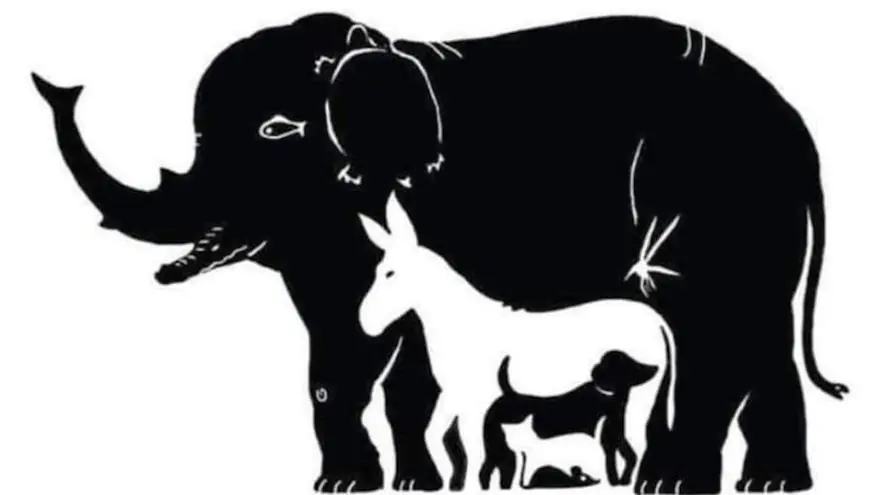
At first glance, the picture looks relatively simple. A large dark animal dominates the composition, while a pale animal appears in the middle. Several smaller shapes seem to occupy the spaces underneath and around it.
But the longer you examine the illustration, the more interesting it becomes.
The challenge is not simply to recognize an animal. It is to discover how many different creatures have been incorporated into the same collection of shapes.
Some viewers immediately notice the largest silhouette. Others focus on the pale animal in the center. A few people notice the smaller figures almost immediately, while others need to look several times before they become visible.
This is what makes the puzzle so entertaining.
Unlike an ordinary picture of several animals standing together, this illustration uses overlapping outlines and contrasting colors to create multiple interpretations.
The dark and pale regions are not merely background decorations. They form different animals, with certain boundaries serving two purposes at once.
A line that appears to belong to one animal may also form the back, neck, or legs of another.
Start by looking at the largest silhouette
The first step is to resist the temptation to examine every small detail.
Instead, look at the outside boundary of the largest dark shape.
Follow its outline slowly, beginning near the head and moving toward the back, body, and legs.
Ask yourself what kind of creature could have that overall structure.
Large animals are often easier to recognize because their bodies provide familiar visual clues.
The shape of the head, position of the legs, length of the body, and direction of the face all contribute to recognition.
Once you have identified the largest figure, move your attention toward the pale shape in the center.
The pale animal is an important clue
The central white figure is particularly noticeable because it contrasts strongly with the surrounding dark silhouette.
Its head, horns, body, and legs form a recognizable animal profile.
However, its outline also helps create the boundaries of other figures.
This is where the puzzle becomes more challenging.
Instead of treating the white shape as an isolated object, examine the spaces immediately above and below it.
You may begin noticing that the dark areas are not random.
Some of them have the proportions and contours of smaller animals.
Look beneath the central body
The lower part of the illustration contains several details that are easy to overlook.
A smaller dark silhouette appears beneath the central animal.
Its head and body become easier to recognize when you stop concentrating on the larger figure.
There are also smaller shapes near the bottom and toward the right side.
These figures are particularly challenging because their outlines are partly integrated into the larger silhouettes.
Try looking at the image from a slightly greater distance.
Sometimes stepping back makes the overall arrangement easier to understand.
You can also cover the title area and concentrate exclusively on the illustration.
Why people see different numbers
One person might confidently report seeing three animals, while another might identify five.
Someone else may discover additional shapes that were not immediately obvious.
This does not necessarily mean that one person has better eyesight or greater intelligence.
People naturally direct their attention toward different parts of an image.
Some focus on large outlines, while others are more sensitive to small details and unusual patterns.
The visual system also tends to organize complicated information into recognizable objects.
Research into Gestalt psychology explains how people group visual elements and distinguish figures from their backgrounds.
These processes help us recognize familiar objects even when their outlines are incomplete or ambiguous.
PubMed+1
That is precisely what makes this illustration interesting.
The image has not changed, but the way you organize its shapes can change as you examine it.
The real challenge is learning to look beyond the first obvious animal.
Chapter 2: The Hidden Figures and How to Find Them
Once you have recognized the main figures, the next challenge is discovering the smaller animals.
This requires a different way of looking at the picture.
Most people initially concentrate on the largest silhouette because it occupies the greatest amount of space.
That is a natural reaction.
Large objects attract attention, particularly when their outlines are clear and their proportions resemble familiar animals.
However, smaller figures are often hidden in the negative spaces between larger shapes.
Negative space is the area surrounding or separating objects.
In ordinary photographs, people tend to treat this space as empty.
In optical illusions, however, the empty-looking areas may contain the outlines of additional figures.
1. Look for recognizable heads
The head is often the easiest part of an animal to identify.
Look for familiar features such as:
-
Two ears or horns.
-
A visible eye.
-
A pointed nose.
-
A recognizable forehead.
-
A mouth or muzzle.
-
A distinctive neck shape.
Even when the rest of an animal is difficult to distinguish, its head may provide enough information to recognize the figure.
In the uploaded puzzle, the central animal has a particularly recognizable head.
Its horns and facial profile make it easier to distinguish from the surrounding shapes.
The smaller figures are more difficult because some of their facial details are represented by the boundaries between dark and light regions.
2. Follow the outlines rather than the colors
Color can influence what people notice first.
In this illustration, the dark navy areas form several connected shapes, while the pale green area creates a contrasting animal silhouette.
However, color alone does not tell you where one animal ends and another begins.
Try following the contours.
Start at a possible head and trace the outline around the body.