What makes the puzzle interesting is that the answer does not depend on a complicated mathematical trick. It depends on noticing a detail that is easy to overlook when the viewer concentrates on the overlapping clothing.
The next time you encounter a photograph that seems impossible to interpret, try changing your point of attention. Look for repeated objects, examine the edges, and separate the scene into smaller sections.
Sometimes, the most obvious part of a picture is not the most useful one.
And sometimes, the answer is waiting right at your feet.
Chapter 9: How to Look at the Picture Again Without Being Misled
Once the answer has been revealed, it can be interesting to return to the original image and examine it with a different strategy.
The first time, most viewers naturally try to count the dancers by looking at the largest visible shapes. They notice the upper bodies, the grey clothing, and the apparent number of legs. The second time, they know that these clues may be misleading.
This change in approach is important. The same photograph can appear different when the viewer knows what to look for.
Try looking at the image from the bottom upward
Instead of beginning with the heads and shoulders, start near the floor.
Look for the white sneakers and identify their separate outlines. Move slowly from left to right. If a shoe is partly hidden, examine the visible toe or sole before deciding whether it belongs to a separate foot.
This approach changes the order in which the image is interpreted.
Rather than trying to match every leg to an upper body, the viewer first establishes how many separate shoes are visible. The number of people can then be estimated by grouping the shoes into pairs.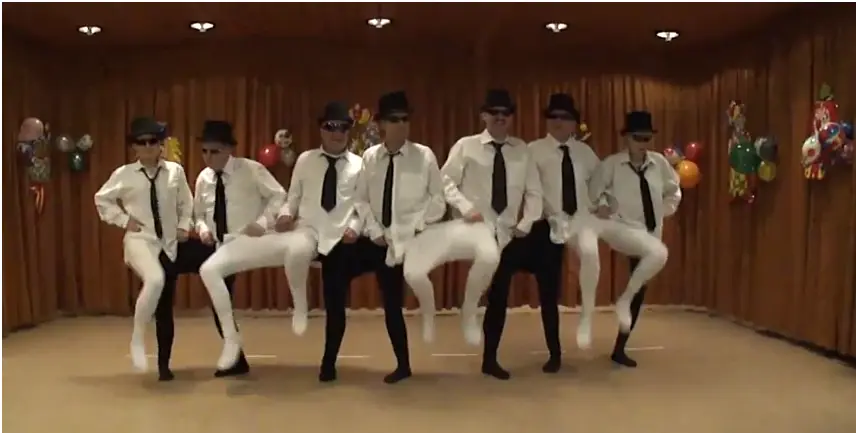
Try dividing the picture into columns
Another useful technique is to imagine three vertical sections.
The left section contains the first four sneakers described in the puzzle explanation. The center contains another four, and the right contains the final four.
This division makes the counting process easier to follow because the viewer does not need to keep every shoe in mind at the same time.
It also helps prevent double-counting. Once a sneaker has been identified in one section, it should not be counted again when examining an overlapping area.
Look for the edges, not just the colors
A white shape is not automatically a separate shoe. It is important to examine its outline.
A sneaker has a recognizable structure. It may show a toe, a sole, or part of its upper surface. When two shoes overlap, their boundaries can sometimes be distinguished by following these features.
This is a useful principle for other visual puzzles too. Color can help, but shape and edges often provide more reliable information.
Change the screen conditions if necessary
Sometimes the difficulty comes partly from the way an image is displayed.
A small phone screen may make partially hidden details hard to see. A compressed screenshot may blur the edges of shoes. Low brightness can reduce the contrast between white footwear and a pale floor.
If the picture is difficult to examine, zooming in or viewing it on a larger screen may help.
However, zooming should not be confused with changing the original evidence. It simply makes existing details easier to inspect.
Remember the difference between the puzzle and the photograph at the top of the screenshot
There is one additional detail worth clarifying about the supplied material.
The large photograph at the very top of the screenshot shows a watermelon surrounded by red fruit pieces. It does not show the dance studio or the six people described in the text.
The actual puzzle explanation refers to dancers wearing matching grey sweatpants and white sneakers. Therefore, the watermelon photograph cannot be used to count the dancers or verify the answer.
The answer of six comes from the accompanying written explanation, which identifies twelve separate sneakers. Keeping these two visual elements separate prevents confusion about what the image actually shows.
A final challenge for readers
Before looking at the answer again, try asking yourself three questions:
-
Am I counting people, or am I only counting the upper bodies that are visible?
-
Have I examined the floor and checked for partially hidden shoes?
-
Have I counted each separate sneaker only once?
These questions help shift attention away from the confusing clothing and toward the detail that solves the puzzle.
The challenge is enjoyable precisely because the answer seems obvious until the viewer looks more carefully.
Chapter 10: Frequently Asked Questions About the Six-Person Illusion
How many people are in the dance studio picture?
According to the supplied explanation, there are six people. The solution identifies twelve distinct white sneakers, which represent six pairs.
Why do some viewers think there are only three or four people?
The dancers wear identical grey sweatpants and stand close together. Their legs overlap, and some upper bodies are partly hidden behind others. This makes separate people appear to merge into a smaller number of figures.
Why should viewers count the shoes instead of the legs?
The grey trousers create continuous shapes that are difficult to separate. The white sneakers stand out more clearly and provide individual outlines that can be counted.
How many sneakers are identified in the explanation?
The explanation identifies twelve separate sneakers: four on the left, four in the center, and four on the right.
Does solving the puzzle prove someone has better eyesight?
No. A single optical illusion is not a valid eyesight or intelligence test. Screen size, image quality, attention, and viewing strategy can all influence how quickly someone notices the clue.
Is the watermelon photograph part of the puzzle?
No. The watermelon photograph at the top of the supplied screenshot is unrelated to the written dance studio puzzle. The answer of six people comes from the accompanying text about the dancers and their sneakers.
What is the simplest way to remember the answer?
Count twelve sneakers, group them into pairs, and divide by two. The result is six people.
The final lesson is straightforward: do not rely only on the most visible parts of a crowded picture. Sometimes, the smallest details provide the clearest answer.