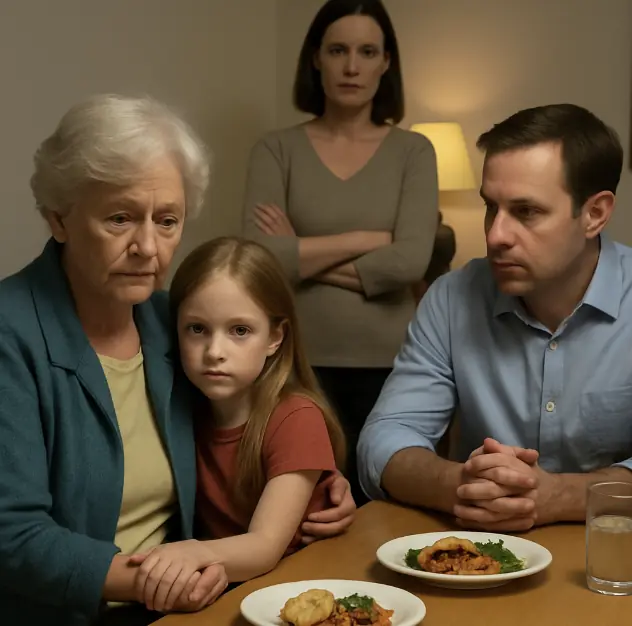
The smell of roasted chicken and freshly baked bread drifted through the house like any other Sunday evening. Sundays had always meant family to me—laughter around the table, stories shared across generations, and the comfort of believing that no matter how hard life became, family would be there. I was a widow for seven years, and those dinners had become my anchor. That evening, I felt a quiet peace as I heard the familiar footsteps of my son, his wife, and their ten-year-old daughter—my beloved Emma—approaching the front door. I had no idea that this night would change everything.
As soon as Emma stepped in, she ran straight to me and hugged my waist as if I were her safe place. Her hugs always felt sincere, never forced, never polite—just real. Her parents, however, wore different expressions. My son was unusually serious; his wife watched me with those cold eyes that pretended to care but never truly did. Still, I welcomed them with smiles and warm plates, ignoring the uneasy feeling building inside my chest.
We gathered at the dinner table. The candles flickered softly as they always did. I poured iced tea for everyone and listened to the usual questions about my health and daily routine. But something was off. My son avoided eye contact. My daughter-in-law’s words sounded rehearsed. Only Emma seemed genuine as she talked about school, her art projects, and how she made a drawing of me with sunflowers—“because you’re the warmest person I know,” she said. I felt tears rise but blinked them away, not wanting to create a scene.
Halfway through dinner, my daughter-in-law cleared her throat and placed some documents on the table. She smiled politely, but her eyes hardened. “Mother,” she said, “we need to talk about some serious matters. It’s about your house and your future.” I felt a sudden chill. She continued, explaining that they had been planning to move me into a care facility—someplace far away, supposedly better for my health. They wanted me to sign papers that would give them legal control over my property and finances. My son didn’t speak. He just kept looking down at his plate, as if ashamed.
My hands trembled slightly. I asked if I had done something wrong, or if I had become a burden. My daughter-in-law assured me that they cared deeply—but her tone betrayed her. It was all planned. The house I had shared with my late husband, the garden we built together, the memories engraved on every wall—they wanted it all. My son finally muttered that it would be “convenient” if everything was settled now rather than later. Convenient. That word stung more than any wound I’d ever felt.
Before I could respond, something unexpected happened. Emma stood up. Her little voice was calm but firm. She walked over to me and held my hand under the table. Then she turned to her parents and said something that seemed to freeze time.
“If Grandma has to leave this house,” she said, “then I’m leaving with her.”
The room went silent. My daughter-in-law blinked rapidly, shocked. My son looked up at Emma as if he were seeing her for the first time. She continued—her voice steady, clearer than any adult. She said she knew her parents talked about the house when they thought she was asleep. She heard them mention money, inheritance, selling the place quickly. She had even seen them hide documents in their room. She didn’t fully understand legal terms—but she understood betrayal.
Emma then walked to her backpack and pulled out a small notebook. In it, she had written dates, words she overheard, and even small drawings of her parents talking about “arrangements.” My daughter-in-law’s face turned pale. My son’s hands began to shake. That quiet child, who everyone thought spoke too softly, had revealed everything.
I felt both stunned and proud. She wasn’t just protecting me—she was protecting the idea of family, of loyalty, of love. She had listened carefully, watched closely, and stood up when it mattered most. I squeezed her hand so gently, afraid tears would fall if I let myself feel too much.
My daughter-in-law tried to deny it, but Emma spoke again. She reminded them of the time I stayed up all night sewing her costume for the school play, the time I waited outside in the rain for an hour just to see her win a small art contest, the time I spent my last savings on her birthday gift because she wanted paintbrushes “that made colors dance.” Emma asked her parents: If someone gives love like that, how could you take their home away?
My son finally stood up. His voice trembled. He admitted that he had been pressured and persuaded—that money had become more important than memories. At that moment, guilt seemed to swallow him. He turned to me and said he was sorry. Truly sorry. And for the first time in years, I believed him, because his apology did not come from his mouth—it came from his eyes.
The papers were never signed. My daughter-in-law said little after that, and for the first time, the silence between us did not feel like tension—it felt like consequence. My son asked to speak with Emma in another room. When they returned, his eyes were still red, but his shoulders seemed lighter somehow. He walked to me and said he realized something: a home is not defined by walls or deeds—it's defined by the people who protect each other inside it.
We cleared the dishes together, even though I insisted I could do it myself. My son stayed longer than usual. He even offered to help fix the porch steps that had been creaking for months. My daughter-in-law remained distant but no longer confrontational. Perhaps Emma had awakened something in all of us.
As the night ended, Emma hugged me tighter than ever before. She whispered, “You taught me how to love. Tonight was my turn to give it back.” I felt a warmth no words could describe. That little girl, with her quiet courage, had saved me—not just from losing my home, but from losing faith in the people I loved.
After they left, I walked through the house. The moonlight touched the framed photos, the books, the worn armchair where my husband used to sit. Everything remained just as it should. For the first time in a long while, I didn’t feel alone.
I poured myself a cup of tea and sat by the window. The night was peaceful. And in that silence, I understood something profound: sometimes, the youngest voice carries the deepest truth. Sometimes, salvation comes in the shape of a small hand reaching for yours at the right moment. And sometimes—when the world tries to take everything from you—love arrives disguised as a brave little granddaughter at a family dinner.
That night could have broken me. Instead, it healed me. And I will remember it for the rest of my life.