Most people choose their sleeping position without thinking about it.
You get into bed, pull up the blanket, turn onto your usual side or stomach, and fall asleep. After several hours, however, you may wake up with a stiff neck, aching shoulders, lower back discomfort, or a burning sensation in your chest.
Sometimes, the problem isn't simply your mattress or pillow.
The way you position your body during sleep can influence pressure on your neck, spine, shoulders, and digestive system.
There isn't one perfect sleeping position for everyone. The best position depends on your body, your symptoms, your sleep habits, and any medical conditions you may have.
For people dealing with neck pain, nighttime reflux, or frequent morning stiffness, making a few small adjustments may help improve comfort and sleep quality.
Here's what to know about the most common sleeping positions—and how to make them work better for your body.
Why Does Sleeping Position Matter?
During the day, you're constantly moving.
When you're asleep, however, you may remain in essentially the same position for hours.
That means a small problem with alignment can become a prolonged source of pressure.
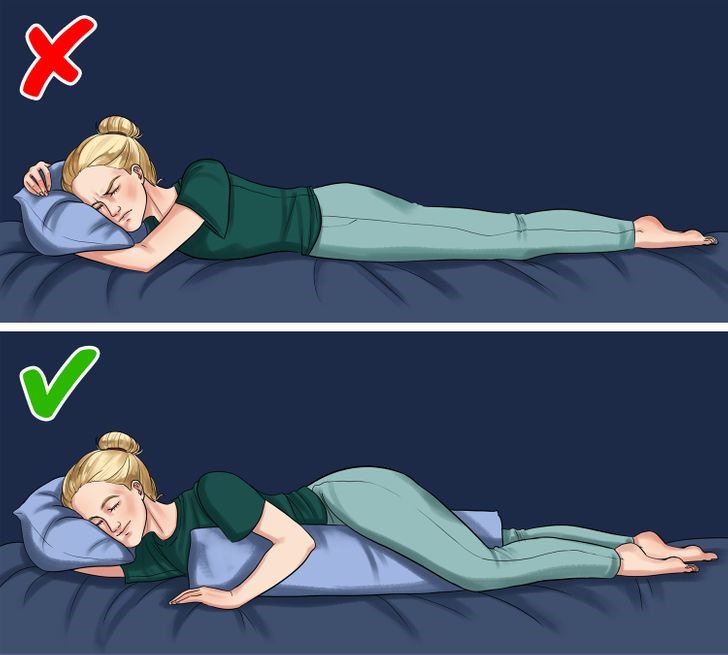
For example, if your pillow pushes your head too far forward, your neck may remain bent for hours. If you sleep on your stomach with your head turned sharply to one side, your neck stays rotated for a prolonged period.
Similarly, lying completely flat after a large meal may make reflux symptoms worse for some people because stomach contents can move more easily toward the esophagus.
Your sleeping position isn't necessarily the cause of a medical condition, but it can influence how symptoms feel during the night.
1. Side Sleeping: Often a Good All-Around Option
For many adults, side sleeping can be a comfortable and practical position.
It can help keep the spine relatively aligned when your head, neck, hips, and legs are properly supported.
Side sleeping may be particularly useful for people who:
-
Snore
-
Have mild positional breathing problems
-
Experience nighttime reflux
-
Feel uncomfortable sleeping flat on their back
-
Are pregnant
But simply turning onto your side isn't enough.
Your pillow and leg position matter too.
How to Sleep on Your Side Correctly
Your head should remain approximately in line with your spine.
If your pillow is too thin, your head may drop toward the mattress.
If it's too thick, your head may be pushed upward.
Either situation can place unnecessary stress on the neck.
A useful goal is to have your neck remain in a neutral position, rather than being sharply tilted.
You can also place a pillow between your knees.
This can help keep your hips and pelvis more comfortable and may reduce twisting through the lower back.
2. Left-Side Sleeping May Help With Nighttime Reflux
If acid reflux or heartburn frequently bothers you at night, your sleeping position may be particularly important.
For many people with nighttime reflux, sleeping on the left side may reduce reflux symptoms.
The anatomy of the stomach and esophagus means that body position can influence how easily stomach contents move upward.
When you're on your left side, the stomach's position relative to the esophagus may make reflux less likely compared with lying flat or, for some people, sleeping on the right side.
This doesn't mean left-side sleeping will eliminate reflux.
But it can be a useful part of a broader strategy.
Combine Position With Meal Timing
Your sleeping position is only one piece of the puzzle.
If nighttime heartburn is a recurring problem, consider avoiding large meals close to bedtime.
For some people, allowing several hours between eating and lying down can reduce symptoms.
Other factors can also contribute, including:
-
Alcohol
-
Large fatty meals
-
Spicy foods
-
Chocolate
-
Caffeine
-
Certain medications
Not everyone reacts to the same foods, so identifying your personal triggers can be useful.
3. Elevating the Upper Body Can Help With Reflux
Another strategy for nighttime reflux is raising the upper portion of the body.
But there's an important distinction between elevating your upper body and simply piling several pillows under your head.
Stacking pillows can bend the body at the waist and potentially put the neck in an awkward position.
A wedge-style support or properly designed adjustable bed can raise the upper torso more evenly.
For people with frequent nighttime reflux, elevating the head of the bed or using an appropriate wedge can sometimes reduce symptoms.
If you regularly experience heartburn at night, particularly if symptoms are severe or persistent, talk with a healthcare professional rather than relying solely on positioning.
4. Back Sleeping Can Be Excellent for Spinal Alignment
Sleeping on your back can be comfortable for people who prefer a neutral, symmetrical position.
When properly supported, it allows the head, neck, and spine to remain relatively aligned.
It may be especially helpful for people who experience certain types of neck or back discomfort.
However, the pillow height is critical.
A pillow that is too high can push your chin toward your chest.
A pillow that's too low may allow your head to fall backward.
The goal is to support the natural curve of your neck without forcing it into an extreme position.
Try a Pillow Under Your Knees
If you sleep on your back and experience lower-back discomfort, placing a pillow beneath your knees may help some people.
This slightly changes the position of the pelvis and can reduce the amount of stress placed on the lower back.
You don't need a complicated setup.
A regular pillow or appropriately sized cushion may be enough.
The goal is simply to find a position in which your muscles can relax without forcing your spine into an uncomfortable posture.
5. Stomach Sleeping May Be Harder on Your Neck
Sleeping on your stomach isn't automatically dangerous.
Some people sleep comfortably this way for years.
But it presents one major challenge:
Your head usually has to turn to one side so you can breathe.
That means your neck can remain rotated for hours.
If you already experience neck pain, stiffness, or headaches, stomach sleeping may make those symptoms worse.
It can also place additional stress on the lower back depending on your mattress and body position.
If you naturally sleep on your stomach and don't have symptoms, there's no need to panic.
But if you regularly wake up with neck pain, changing positions may be worth trying.
Why Your Pillow Can Matter as Much as Your Position
People often spend hundreds or thousands of dollars on a mattress while paying relatively little attention to their pillow.
Yet your pillow directly determines the position of your head and neck.
A good pillow isn't necessarily the most expensive pillow.
The right choice depends on:
-
Your sleeping position
-
Shoulder width
-
Body shape
-
Mattress firmness
-
Personal comfort
-
Neck anatomy
Side sleepers
Often need enough pillow height to fill the space between the head and mattress.
Back sleepers
Usually need a pillow that supports the neck without pushing the head too far forward.
Stomach sleepers
Often do better with a relatively thin pillow—or sometimes no traditional pillow under the head—because a thick pillow can increase neck rotation and extension.
![2026] Gợi ý 4 Tư Thế Ngủ Không Ngáy » [Nệm Bình Dương]](https://nembinhduong.com/wp-content/uploads/2025/01/tu-the-ngu-khong-ngay-2.webp)
Your Mattress Matters Too
A pillow can't completely compensate for an unsuitable mattress.
A mattress that is extremely soft may allow your body to sink deeply, while an extremely firm surface may create uncomfortable pressure points.
The ideal firmness is individual.
Instead of assuming that everyone needs a particular mattress type, pay attention to how your body feels after several hours of sleep.
Ask yourself:
Do I wake up with new pain that wasn't there before bed?
Do my shoulders or hips feel excessively pressured?
Does my lower back feel strained?
Do I feel better after getting out of bed and moving around?
These clues can help you determine whether your sleep setup needs adjustment.
What If You Have Neck Pain?
If neck pain is your primary problem, focus on neutral alignment rather than simply choosing a particular sleeping position.
Your head shouldn't be dramatically tilted upward, downward, or rotated.
For many people, back or side sleeping is easier to optimize than stomach sleeping.
You can also experiment with:
-
Different pillow heights
-
Cervical-support pillows
-
A pillow between your knees when side sleeping
-
A pillow beneath your knees when back sleeping
-
Adjusting mattress firmness
-
Gentle stretching during the day
Avoid aggressive neck manipulation if you have significant pain or an unexplained injury.
Don't Ignore the Difference Between Morning Stiffness and Persistent Pain
It's normal to occasionally wake up feeling stiff.
Maybe you slept in an unusual position or spent too many hours without moving.
But persistent or worsening pain deserves more attention.
See a healthcare professional if neck pain:
-
Continues for weeks
-
Keeps getting worse
-
Follows an injury
-
Radiates into your arm
-
Causes numbness or tingling
-
Causes weakness
-
Is associated with severe headache, fever, or other concerning symptoms
Sleeping position may contribute to discomfort, but it isn't the explanation for every case of neck pain.
What About Snoring?
Sleeping position can influence snoring.
For some people, side sleeping may reduce snoring compared with sleeping flat on the back.
When lying on the back, gravity can contribute to narrowing of the upper airway in susceptible individuals.
However, persistent loud snoring shouldn't simply be treated as a sleeping-position problem.
If snoring is accompanied by:
-
Gasping during sleep
-
Pauses in breathing
-
Morning headaches
-
Excessive daytime sleepiness
-
Difficulty concentrating
-
Waking up choking or short of breath
talk with a healthcare professional about possible obstructive sleep apnea.
Changing positions may help some people, but it isn't a substitute for appropriate evaluation and treatment.
What About Pregnancy?
During pregnancy, sleep can become increasingly uncomfortable as the body changes.
Side sleeping is often recommended later in pregnancy, and many people find it more comfortable to use pillows for additional support.
A pillow between the knees and another supporting the abdomen can reduce pressure and improve comfort.
Pregnant people should follow the advice of their own healthcare professional, particularly if they have specific medical or pregnancy-related conditions.
What If You Can't Stay in One Position?
You don't have to.
Human beings naturally move during sleep.
You may fall asleep on your left side and wake up on your back.
That's normal.
The goal isn't to force your body to remain perfectly still throughout the night.
Instead, create a sleep environment that supports comfortable positions and reduces unnecessary strain.
Your body will naturally adjust as you move.
Small Changes Can Make a Surprisingly Big Difference
You don't need to completely redesign your bedroom tonight.
Try changing one variable at a time.
If you have neck pain:
Start by adjusting pillow height.
If you have nighttime reflux:
Try left-side sleeping and avoid lying down soon after a large meal.
If your lower back hurts:
Experiment with a pillow beneath your knees when sleeping on your back or between your knees when sleeping on your side.
If you snore:
Try side sleeping and consider whether other symptoms suggest sleep apnea.
This approach makes it easier to determine what actually helps.
Common Sleeping Mistakes to Avoid
Using a pillow that's too high
This can force your neck forward and create morning stiffness.
Sleeping with your head sharply rotated
This is particularly common among stomach sleepers.
Stacking pillows for reflux
Several pillows under your head can create an awkward bend. Elevating the upper torso more evenly is generally preferable.
Eating a large meal immediately before bed
This can aggravate nighttime reflux in susceptible people.
Ignoring persistent symptoms
If pain, reflux, or breathing problems repeatedly disrupt your sleep, changing positions alone may not solve the underlying problem.
There Is No Universal "Perfect" Sleeping Position
This is worth emphasizing.
You may hear claims that everyone should sleep on their left side, everyone should sleep on their back, or stomach sleeping is always bad.
Real life is more complicated.
The best position depends on the individual.
For one person, side sleeping may relieve reflux and snoring.
For another, back sleeping may provide the best neck support.
Someone with shoulder pain may find one side uncomfortable and the other side much better.
Comfort, symptoms, anatomy, and medical conditions all matter.
When Sleep Problems Need More Than a New Pillow
If you're consistently waking up with pain, heartburn, or exhaustion despite making reasonable changes, there may be another explanation.
Persistent symptoms can sometimes be related to:
-
Sleep apnea
-
Gastroesophageal reflux disease (GERD)
-
Arthritis
-
Nerve irritation
-
Muscle disorders
-
Chronic pain conditions
-
Medication effects
-
Anxiety or stress
-
Other underlying medical conditions
A new pillow can be helpful, but it shouldn't become a substitute for medical evaluation when symptoms persist.
A Simple Nighttime Checklist
Before going to bed, consider:
✓ Is my neck in a neutral position?
✓ Is my pillow appropriate for my sleeping position?
✓ If I sleep on my side, is my head aligned with my spine?
✓ If I have reflux, have I avoided lying down soon after eating?
✓ If I sleep on my back, would a pillow beneath my knees improve comfort?
✓ If I frequently snore, do I have symptoms that could suggest sleep apnea?
✓ Am I waking up with the same pain or symptom repeatedly?
These simple questions can help you identify patterns.

The Bottom Line
The way you sleep can influence how your body feels when you wake up.
For many people:
Side sleeping can provide good overall support and may be useful for snoring and nighttime reflux.
Left-side sleeping may be particularly helpful for people who experience acid reflux at night.
Back sleeping can support a neutral spinal position when the pillow and mattress are properly adjusted.
Stomach sleeping can be comfortable for some people, but it often requires prolonged neck rotation and may aggravate neck discomfort in susceptible individuals.
But there's no single sleeping position that is perfect for everyone.
The most important goal is comfortable, sustainable alignment.
Pay attention to how your body feels when you wake up. If you repeatedly experience neck pain, heartburn, numbness, severe stiffness, loud snoring, gasping, or unexplained daytime exhaustion, don't assume your sleeping position is the whole story.
Sometimes the solution really is as simple as changing your pillow or turning onto your side.
And sometimes, your sleep is revealing a problem that deserves a closer look.