“I Found This Strange Object in My 16-Year-Old Daughter’s Bathroom…” What Could It Be?
A few unfamiliar objects on a bathroom counter can quickly turn an ordinary day into a mystery. In the photograph, several small white, curved or tube-like pieces with pink ends are resting on a piece of tissue. They appear to be personal-care items, but their exact purpose is not obvious from the low-resolution image.
One plausible explanation is that they are components of a menstrual-care product, possibly tampon applicators or a related hygiene accessory. However, the photograph is too blurry to confirm the brand, exact product, or whether the pieces are complete or disassembled. It would be irresponsible to claim a definite identification from this image alone.
That uncertainty is important, especially because the object was reportedly found in a 16-year-old girl's bathroom. Menstrual products and other personal-care items are ordinary parts of adolescent health and hygiene. Finding an unfamiliar item is not, by itself, evidence of anything alarming or inappropriate.
To understand what the objects might be, it helps to look at how menstrual products and their applicators are designed, what other bathroom accessories can look similar, and how a parent can approach an unexpected discovery without embarrassing or frightening a teenager.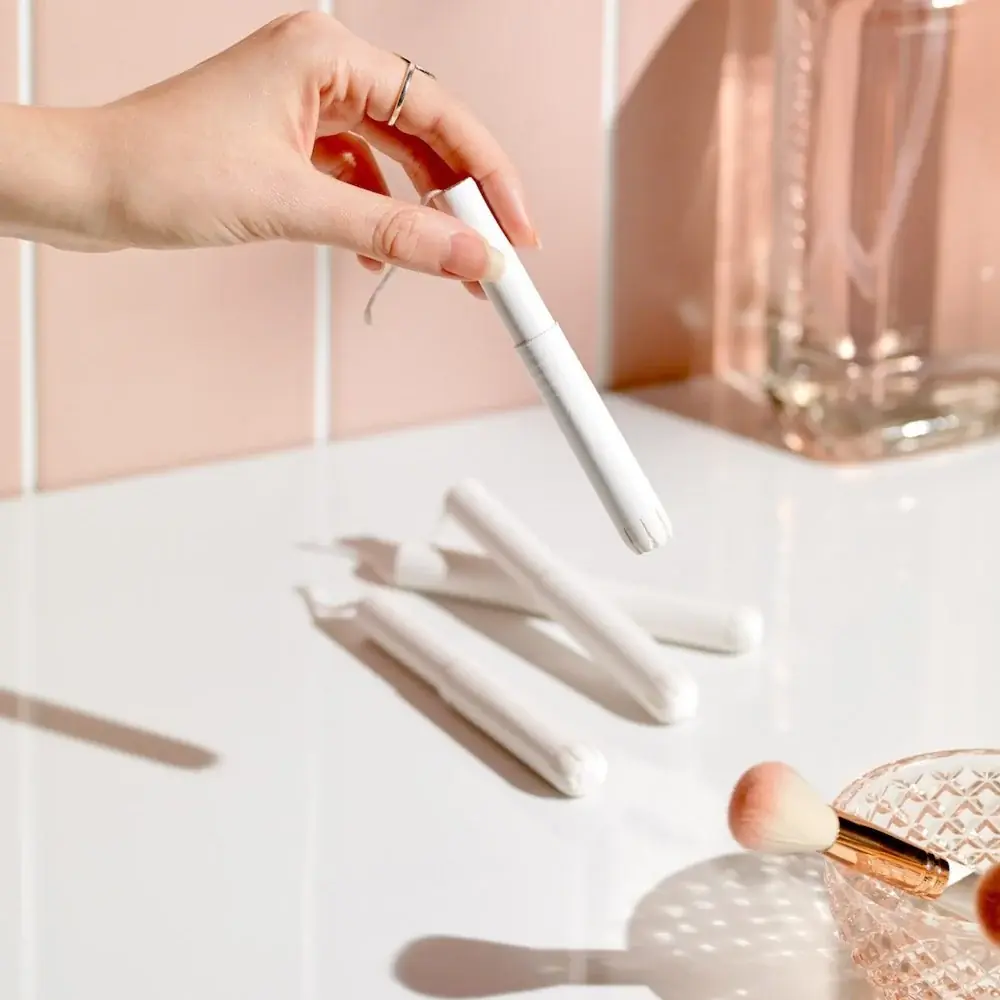
Chapter 1: A Small Discovery That Can Raise a Lot of Questions
Bathrooms are full of objects that are easy to recognize when you use them regularly but difficult to identify when you have never seen them before. A small plastic tube, a curved applicator, a removable cap, or a piece of packaging may have a very specific purpose that is not immediately obvious to someone outside the routine.
That is particularly true of personal-care products. Many are designed to be compact, discreet, and easy to store. Some come in several pieces. Others have removable parts that can look unusual when they are separated from the original package.
The photograph shows a hand holding a folded piece of tissue or paper towel. Several small, pale objects with pink-colored ends lie on top. The image appears to have been taken near a bathroom sink or bathtub. The objects seem slender and slightly curved, with a shape that could be associated with a personal-hygiene accessory.
There is no visible brand name, packaging, instruction leaflet, or readable label. Their size is also difficult to judge because there is no familiar object beside them for comparison.
These limitations matter.
A small plastic component from one product can look very similar to a component from another. A photograph taken from one angle may hide the feature that would make identification straightforward. Even a person who regularly uses a particular product might struggle to recognize it after it has been removed from its packaging or separated into parts.
Why the bathroom is a difficult place to identify unfamiliar objects
A bathroom contains products for many different purposes:
-
Menstrual care and feminine hygiene.
-
Hair styling and hair removal.
-
Skin care and acne treatment.
-
Dental care.
-
Cleaning and personal hygiene.
-
First aid and minor medical care.
-
Travel-sized toiletries.
-
Reusable personal-care accessories.
Many of these products use similar materials: white or translucent plastic, soft silicone, cotton, paper, and small colored components. Their designs often prioritize comfort, portability, and ease of use rather than making their purpose obvious to someone who has never handled them.
For example, a narrow plastic tube might be part of a tampon applicator, a cosmetic dispenser, or a medical-use accessory. A small colored piece might be a grip, cap, handle, or protective component.
The shape alone cannot always distinguish these possibilities.
Why the first reaction should be curiosity, not suspicion
When a parent discovers an unfamiliar object in a teenager's bathroom, it is natural to wonder what it is and why it is there.
But the object itself does not tell a complete story.
It does not reveal who purchased it, whether it belongs to the teenager, whether it is new or old, or whether it was brought into the bathroom by someone else. It also does not establish that the object has been used.
A calm approach is much more useful than immediately assuming the worst.
If the item is a menstrual-care product, it may simply be part of ordinary personal hygiene. If it is a different kind of accessory, the teenager may be able to explain its purpose in a few words.
The most important thing is to identify the item accurately before drawing conclusions about it.
Chapter 2: Could the Objects Be Tampon Applicators?
One possibility worth considering is that the objects are related to tampons or another menstrual-care product.
Tampons are absorbent products designed to be placed inside the vagina during menstruation. They absorb menstrual fluid before it leaves the body. Some tampons are inserted using the fingers, while others come with an applicator.
An applicator is a device designed to help position and insert the tampon. It is usually made from plastic or cardboard, although designs vary by manufacturer.
The photograph's pale, narrow components and colored ends could resemble parts of an applicator-based product. Nevertheless, the image does not show enough detail to establish that identification.
What does a tampon applicator look like?
A conventional tampon applicator often consists of two main parts.
The outer tube holds the tampon in position. It is designed to be inserted gently into the vagina to the appropriate depth.
The inner tube, sometimes called the plunger, is pushed to move the tampon out of the outer tube and into position.
After insertion, the applicator is removed and discarded. The tampon remains in place, with its removal string outside the body.
Some applicators are longer and more rigid. Others are compact and designed to fit into a small handbag or pocket. Materials can include smooth plastic or specially designed cardboard.
The outer tube may have a rounded or petal-shaped tip to make insertion more comfortable. The opposite end may have a grip or flange that helps the user hold it.
The plunger is usually a separate narrow component.
Why might an applicator have colored ends?
Manufacturers sometimes use colored plastic to distinguish different parts, product sizes, absorbency levels, or product ranges.
A colored grip can also make a small component easier to see and handle.
However, there is no universal color code. A pink end does not automatically identify a particular brand, product size, or intended use.
Without the original packaging, it would be difficult to determine which manufacturer produced an item from color alone.