The Great Toilet Paper Debate: Which Way Is Actually Correct?
One roll of toilet paper. Two completely different opinions. And a surprisingly passionate argument that has divided couples, families and roommates for generations. But is there really a correct way to hang it—or has everyone simply been defending the habit they grew up with?
It is the kind of disagreement that can begin with something incredibly small. Someone walks into the bathroom, notices that the toilet paper has been changed, and immediately turns the roll around. Another person comes in later and changes it back. Neither understands why the other cares so much.
To one person, the loose end should fall over the front of the roll. It looks tidy, feels natural and makes the next sheet easy to grab. To someone else, the paper should hang underneath, closer to the wall. That arrangement may seem neater, less exposed and less likely to unravel when a curious pet gets involved.
The disagreement sounds ridiculous until it happens in your own home.
Suddenly, a bathroom accessory becomes a symbol of personal preference, household routine and the familiar habits people carry from childhood. Some people are convinced there is an obvious answer. Others insist that the entire debate is unnecessary.
Yet the question has a surprisingly interesting history. The modern toilet-paper roll became popular in the late nineteenth century, and early product illustrations provide an important clue about the direction its makers expected people to use. That historical detail is one reason the debate has continued for so long.
But history does not automatically settle every practical question. A bathroom with a curious cat may call for a different arrangement from a bathroom used by a family with no pets. A holder placed close to a wall may behave differently from one with plenty of space around it.
So which way is actually correct?
To answer that, we need to look at the two arrangements, the reasons people defend them, the history behind the familiar roll and the small practical details that can make one option more convenient than the other.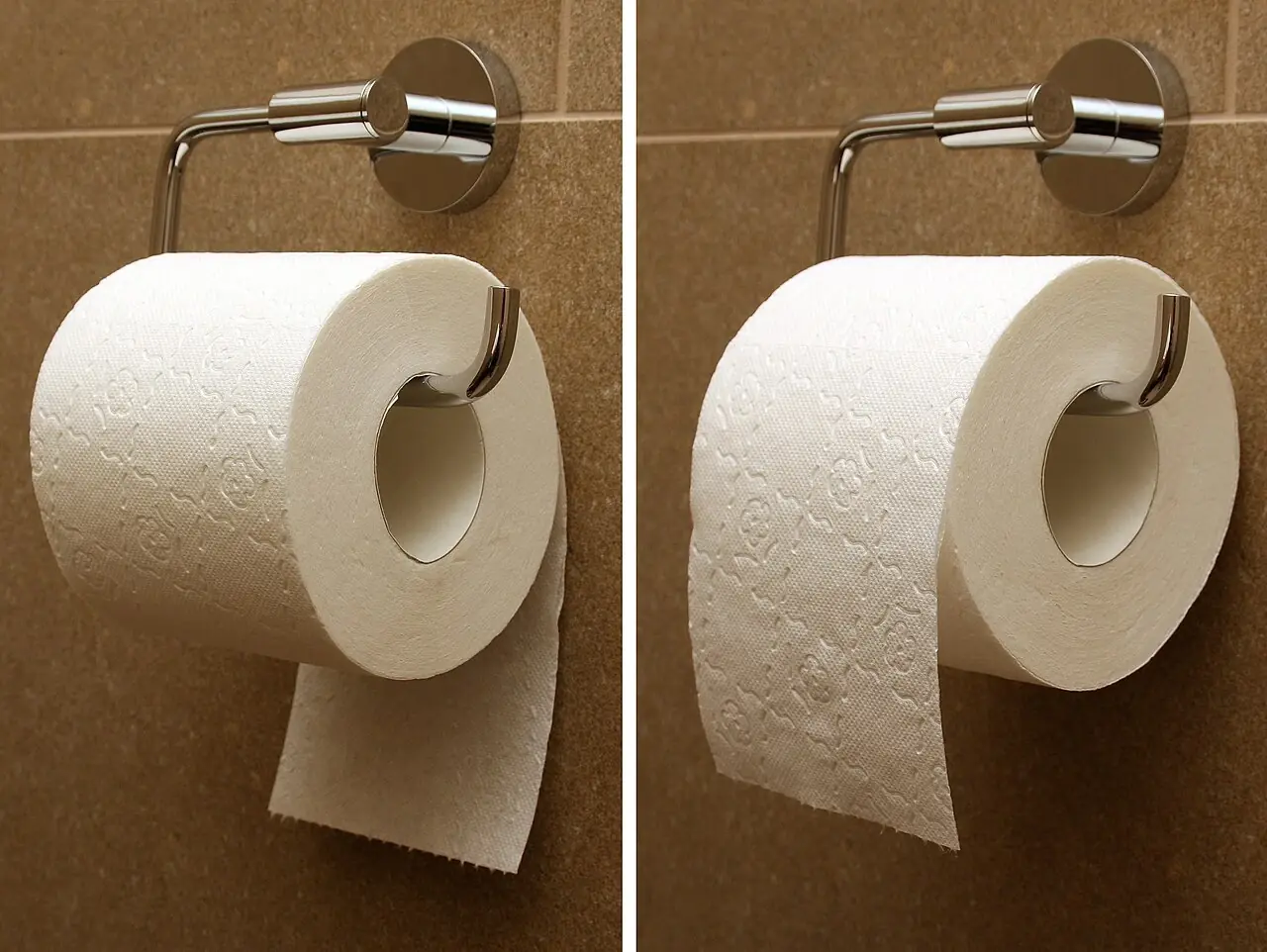
Chapter 1: The Tiny Bathroom Habit That Starts Surprisingly Big Arguments
Few household objects are as ordinary as a roll of toilet paper.
It sits quietly on a holder, usually unnoticed until someone needs it. Most people do not think about its position when entering the bathroom. They simply reach for a sheet, use it and move on with the rest of their day.
But ask a group of people how the roll should hang, and the conversation can become unexpectedly lively.
There are two familiar arrangements.
In the first, the loose end hangs over the front of the roll, facing away from the wall. In the second, the loose end hangs underneath, closer to the wall.
Both arrangements are easy to recognize. Both allow people to pull off sheets. Both can work with most standard toilet-paper holders.
And yet many people have a strong preference.
For those who support the over position, the answer seems obvious. The loose end is visible, easy to find and simple to reach. A person can pull the paper forward without searching around the back of the roll. The arrangement may also look more orderly because the loose edge is clearly displayed.
Supporters of the under position see things differently. They may prefer the paper to fall close to the wall, where it appears less exposed. Some believe this arrangement makes the bathroom look tidier. Others say it can reduce the chance of a roll being pulled apart by a pet or a small child.
The debate is not always about convenience. Sometimes it is simply about what feels familiar.
A person who has seen toilet paper hanging over the front for decades may find the opposite arrangement strangely uncomfortable. Someone who grew up with the loose end underneath may think the over position looks untidy or unfinished.
These reactions are often stronger than the practical differences would suggest.
Why Do People Care So Much?
One explanation is that household habits become part of everyday expectations.
People learn how to arrange things through repetition. They observe how parents, relatives and other household members do something, and eventually the habit becomes automatic.
The same process influences many small domestic routines:
-
How towels are folded.
-
Which direction a bed should face.
-
Where shoes should be placed.
-
Whether dishes should be washed immediately or left until later.
-
How a dishwasher should be loaded.
-
Which way toilet paper should hang.
People rarely stop to question these habits because they have become part of the normal arrangement of their homes.
When someone changes the arrangement, the result can feel wrong even if it still works perfectly well.
That is why the toilet-paper debate can become a miniature disagreement about respect and consideration. One person may think, "I have already explained how I like it." The other may think, "Why does this tiny detail matter so much?"
Neither person may realize that the disagreement is less about the paper itself and more about the comfort of familiar routines.
The Over Position: Easy to See, Easy to Reach
The over arrangement places the loose end in front of the roll.
Its biggest practical advantage is visibility. A person entering the bathroom can immediately see where the paper begins.
The loose edge is also easy to grasp. There is no need to reach behind the roll or search near the wall.
For many people, this makes tearing off a sheet more straightforward. The paper can be pulled forward and downward, and the user can usually see how much is being taken.
The arrangement may also make it easier to notice when the roll is running low. Because the loose edge is visible, the remaining paper can be assessed quickly.
Another argument in favor of the over position is appearance. Some people think it creates a cleaner, more finished look, especially when the holder is mounted in an open area.
The roll appears to hang deliberately rather than being tucked close to the wall.
However, the over position is not perfect for every household.
A curious cat may discover that the loose end is an entertaining toy. A toddler may pull several sheets before an adult notices. In a busy bathroom, the exposed paper may also be more likely to move when someone brushes past it.
These concerns do not make the arrangement wrong. They simply show that convenience depends on the environment.
And that is where supporters of the under position make their strongest argument.
Chapter 2: The Under Position and Why Some Households Prefer It
The under arrangement places the loose end behind the roll, so the paper falls closer to the wall.
To people who prefer this method, the result can look more discreet. The loose edge is less prominent, and the roll may appear more compact and orderly.
Some people also find that the paper stays out of the way when the bathroom is small. If the holder is positioned near a sink, cabinet or narrow passage, a loose sheet hanging forward may occasionally brush against something or get caught as people move around.
The under position can reduce that particular inconvenience.
But its most frequently mentioned advantage involves pets and children.
When Cats Turn Toilet Paper Into a Toy
Anyone who has lived with a curious cat may recognize the familiar scene.