A Better Cleaning Routine
Instead of waiting for your faucet to become heavily coated, consider a simple routine:
Daily or after use
Quickly wipe excess water from the faucet.
Weekly
Inspect the base and spout for mineral spots.
When buildup appears
Use an appropriate descaling method rather than immediately reaching for an abrasive scrubber.
Periodically
Clean the aerator and inspect the water flow.
If buildup keeps returning
Consider whether hard water may be the underlying reason.
This approach requires less effort than repeatedly attacking thick deposits.
What If the Faucet Still Looks Dull After Cleaning?
Sometimes mineral deposits are not the only problem.
A faucet can also become dull because of:
-
Scratches
-
Chemical damage
-
Tarnishing
-
Worn coatings
-
Corrosion
-
Long-term surface deterioration
If you've completely removed the mineral deposits and the surface still looks cloudy, the problem may not be limescale anymore.
At that point, aggressive cleaning could make things worse.
The safest option may be to follow the manufacturer's instructions for the particular finish.
The Biggest Cleaning Mistake to Avoid
Perhaps the biggest mistake is assuming:
“If it doesn't come off, I need to scrub harder.”
Not necessarily.
Sometimes the surface is telling you that you're using the wrong approach.
Mineral deposits often respond better to the right chemical treatment and adequate contact time than to brute force.
A soft cloth plus the correct descaling method can be far more effective than a rough sponge and ten minutes of aggressive scrubbing.
The Real Secret Is Prevention
The satisfying transformation in the image may make it tempting to focus entirely on removing the existing buildup.
But the real secret to keeping a faucet looking clean is preventing heavy deposits from accumulating in the first place.
Three habits can make a surprisingly large difference:
Wipe away water.
Treat small deposits early.
Avoid damaging the finish with abrasive cleaning.
Those simple habits can save considerable time later.
Final Thoughts
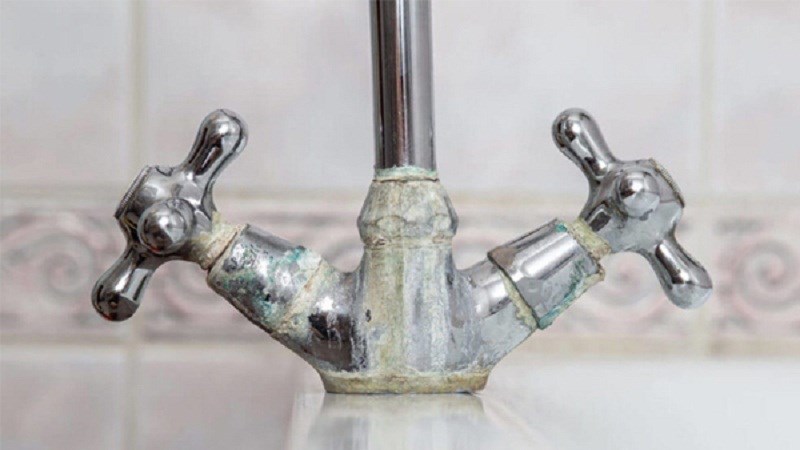
That crusty faucet in the “before” picture isn't necessarily a sign that your bathroom is dirty.
It may simply be a sign that minerals in your water have been accumulating on the surface.
And if you've been spending your weekends aggressively scrubbing those deposits away, you may be making the job harder than it needs to be.
The better strategy is often to soften the mineral buildup first, gently remove it, rinse thoroughly, and keep the surface dry afterward.
For many ordinary fixtures, an appropriate diluted acidic cleaner such as white vinegar can help dissolve mineral deposits. But always check the manufacturer's instructions first, especially if your faucet has a specialty finish or the surrounding surface is made from acid-sensitive material.
The biggest lesson is simple:
Don't fight limescale with force when you can safely loosen it first.
A few minutes of the right treatment can turn a cloudy, crust-covered faucet into a much cleaner and brighter fixture—and regular maintenance can help keep it that way.