Imagine walking back to your car after shopping, leaving work, or spending an evening with friends. Everything looks normal at first. Your car is exactly where you left it, nothing appears damaged, and there are no obvious signs that anyone has touched it.
Then you notice something strange.
There is a penny—or another small coin—sitting inside or near one of your car's door handles.
At first, it may seem completely harmless. Maybe someone dropped it. Maybe it simply got caught there by accident. After all, finding a coin on or around a car is hardly unusual.
But stories circulating online have given this simple discovery a much more alarming reputation. According to a commonly repeated warning, someone may deliberately place a coin near a vehicle's door handle as part of an attempt to interfere with the locking mechanism or create an opportunity to access the vehicle.
So, if you really do find a penny in your car door handle, should you be worried?
The answer is more complicated than many viral posts suggest.
The Story Behind the Penny-in-the-Door-Handle Warning
The basic story is usually told like this: a person parks their car, locks it, and walks away. Someone nearby allegedly places a coin in a particular position around the passenger-side door handle. When the owner later uses the vehicle, the coin is supposedly positioned in a way that interferes with the door lock.
The owner may then believe the vehicle has been securely locked when, according to the story, one door remains unlocked.
The alleged purpose is simple: if the owner walks away believing the car is protected, another person could potentially take advantage of the situation.
This story has circulated widely on social media, websites, and warning messages for years. It is easy to understand why it attracts attention. It combines something ordinary—a small coin—with something potentially dangerous—a vehicle security problem.
But there is an important point that often gets lost in the retelling.
Finding a penny near your door handle does not automatically mean someone is trying to steal your car.
Modern vehicles use many different locking systems, and the effect of placing a coin near a door handle depends heavily on the design of the vehicle. In many cars, a coin simply will not interfere with the locking system in the dramatic way described online.
That means the discovery should not immediately lead to panic.
Still, it is unusual enough that you should take a moment to check your vehicle.
Why Would Someone Put a Coin There?
There are several possible explanations.
The simplest is also the most innocent: someone dropped it.
Coins are small, slippery, and easy to overlook. A penny could become lodged in a gap, caught near a handle, or simply fall onto the ground beside the car.
It could also have been placed there accidentally by someone who was handling change, cleaning the vehicle, or moving objects around it.
But there is another possibility: someone may have deliberately placed it there.
The problem is that you cannot determine someone's intentions simply by looking at the coin.
A penny by itself is not proof of criminal activity.
This is an important distinction because online warnings sometimes present the situation as though a coin automatically signals an attempted theft. Real-world vehicle security is more complicated than that.
Instead of assuming the worst, look at the bigger picture.
Is anything else unusual?
Does the car show signs of tampering? Is another door unexpectedly unlocked? Are there scratches around the locks? Has anything inside the vehicle been moved? Is there a strange object attached to the car?
These details are more meaningful than the presence of a penny alone.
The Most Important Thing to Do: Check Your Car
If you discover a coin in your door handle, the first thing you should do is inspect the vehicle.
Don't immediately assume that your car has been targeted. Instead, calmly check whether everything appears normal.
Try the doors and verify that they are properly locked.
If your vehicle has a key fob, use it according to the manufacturer's instructions and pay attention to whether the car gives you a normal confirmation that it has been locked.
Some vehicles have visual or audible indicators. Others allow you to confirm the lock status through the vehicle's dashboard or a connected app.
The exact behavior varies from one vehicle to another.
If you are uncertain about how your car's locking system works, consult the owner's manual rather than relying on a viral social-media warning.
Don't Rely Only on the Sound of the Lock
One useful lesson from stories like this is that you should not assume a vehicle is secure simply because you heard a clicking sound.
Modern cars can have multiple doors, sensors, electronic locking systems, alarms, and other security features. Depending on the vehicle, the behavior of the locks can vary.
Take a second to visually confirm that the doors are actually locked when possible.
This is particularly useful in crowded parking lots, where people may be distracted, in a hurry, or dealing with bags, children, phones, or other belongings.
A quick check can eliminate uncertainty.
Look for Other Signs of Tampering
If the penny appears deliberately placed, take a closer look at your vehicle.
Check the door handles.
Look around the locks.
Inspect the windows.
Look underneath the vehicle only if it can be done safely and without putting yourself in danger.
You can also check whether anything inside the car has been disturbed.
Pay attention to unfamiliar objects or signs that someone has been near the vehicle.
However, avoid turning an ordinary coin into evidence of a crime without additional information. A scratch, dent, or unusual mark may have an innocent explanation.
The goal is not to become paranoid.
The goal is to become observant.
What If Your Car Won't Lock?
This is where you should pay more attention.
If you discover the coin and then notice that your vehicle does not lock normally, do not simply walk away and assume everything is fine.
Remove the obstruction if it is safe to do so and try locking the vehicle again.
If the problem continues, move to a safer location if possible and contact the appropriate assistance—such as roadside assistance, your vehicle manufacturer, or a trusted automotive professional.
If you believe someone is actively attempting to access your vehicle, do not confront them yourself.
Your personal safety is more important than protecting the car.
Be Careful With Remote Unlocking
Another important consideration is your vehicle's electronic security.
Some modern cars use keyless entry and proximity systems. These technologies are convenient, but they have also created new security considerations for vehicle owners.
The presence of a penny does not automatically mean that someone is attempting an electronic attack. These are separate issues.
Nevertheless, if you are concerned about vehicle security, it is worth understanding how your particular car's keyless entry system works.
Some manufacturers provide security features that allow owners to disable passive entry, change settings, or use additional locking procedures.
Your owner's manual is the best place to start.
Don't Forget the Most Obvious Possibility
One of the biggest mistakes people can make when encountering something strange is immediately choosing the most frightening explanation.
A penny is still just a penny.
Someone could have dropped it.
A child could have placed it there.
It could have become trapped by accident.
A passerby might have noticed it on the ground and put it somewhere they thought was convenient.
Not every unusual event is a warning.
This is particularly important because stories about coins in car door handles have been shared online for years, often without enough context. A dramatic headline can make a possibility sound like a certainty.
That is rarely a good way to evaluate a potential safety issue.
Why These Stories Spread So Easily
There is a reason warnings like this become popular.
They are simple.
They are memorable.
And they involve something people encounter every day.
If someone tells you that a strange device was attached to a sophisticated part of a vehicle, you might forget the details. But if they say, "Watch out for a penny in your door handle," you are much more likely to remember it.
The story also creates a sense of vulnerability.
Most people assume that once they press the lock button, their car is secure. The idea that someone could interfere with that process using something as ordinary as a coin feels unsettling.
That combination makes the story highly shareable.
But being memorable does not necessarily make a warning universally true.
The Better Lesson: Pay Attention to Your Surroundings
Even if the penny itself turns out to be meaningless, the situation can still teach an important lesson.
Pay attention when you leave and return to your vehicle.
Before walking away, make sure the doors are locked.
Avoid leaving valuable items visible inside the car.
Park in well-lit areas when possible.
Be aware of your surroundings, especially when returning to your vehicle at night.
If something about the vehicle looks different from the way you left it, stop and investigate rather than automatically assuming everything is fine.
These habits are useful regardless of whether the penny story is true in a particular situation.
What You Should Not Do
If you find a coin in your door handle, there are several things you should avoid doing.
First, don't panic.
There is no reason to assume that you are being followed or that your vehicle is about to be stolen based solely on the presence of a penny.
Second, don't confront a stranger you suspect may have placed it there.
You cannot know their intentions simply from the object, and confronting someone could create an unnecessary and potentially dangerous situation.
Third, don't share an unverified claim as fact.
If you tell someone that a penny in a door handle definitely means a thief is targeting their car, you may unintentionally spread misinformation.
Instead, explain that it can be a reason to check the vehicle and remain aware of your surroundings.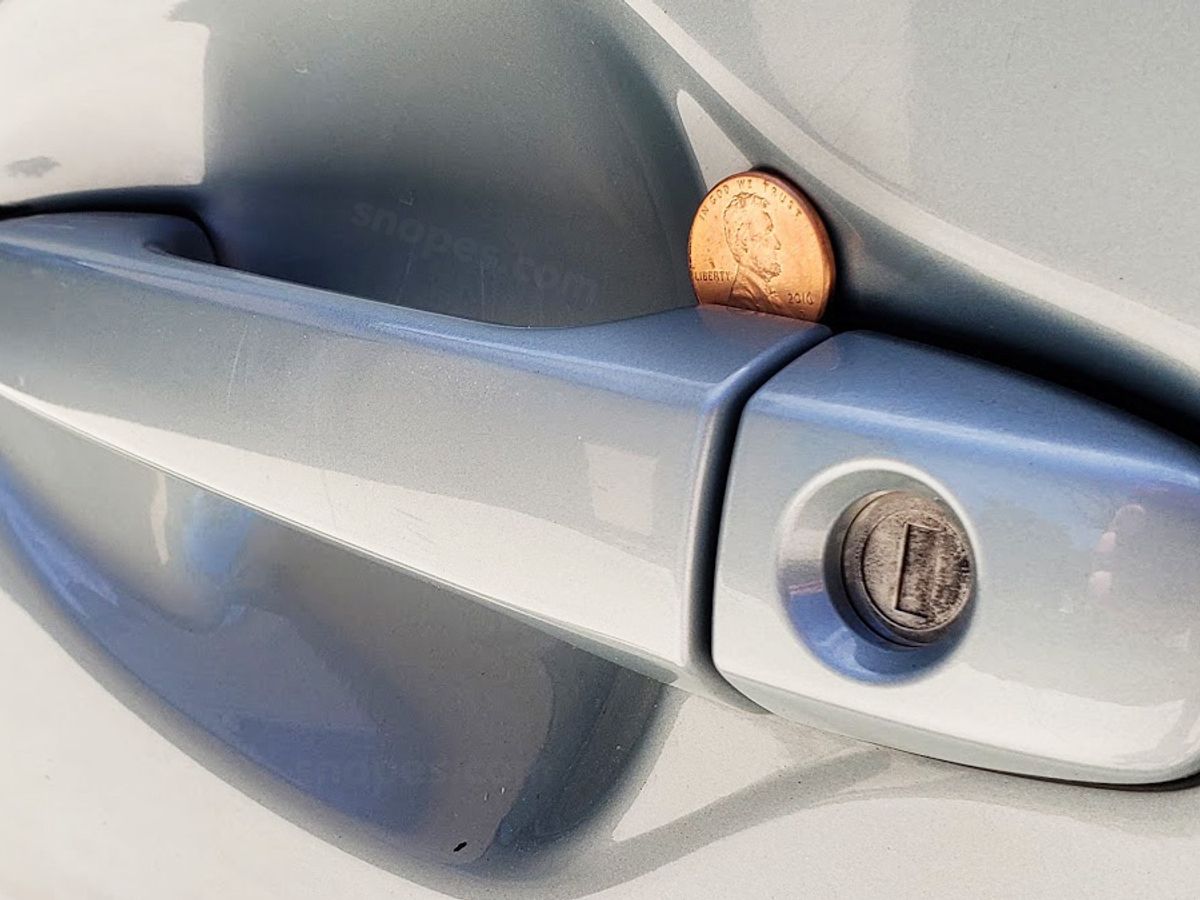
When Should You Take the Situation More Seriously?
The presence of the coin becomes more concerning when it is accompanied by other unusual circumstances.
For example, you should pay closer attention if:
- Your vehicle will not lock normally.
- A door appears to have been left unlocked unexpectedly.
- You notice signs of forced entry or tampering.
- Items inside the vehicle have been disturbed.
- You notice someone behaving suspiciously around the car.
- You find unfamiliar objects attached to or near the vehicle.
- Your vehicle behaves differently from normal when locking or unlocking.
None of these signs automatically proves that a crime has occurred.
But together, they justify taking additional precautions.
If you believe your vehicle has been tampered with, move somewhere safe and contact the appropriate authorities or assistance service rather than confronting anyone yourself.
The Penny May Not Be the Real Warning
Perhaps the most useful way to think about this entire story is to separate the object from the lesson.
The penny itself may have an innocent explanation.
The broader safety message, however, is valuable.
Your car should not be treated as secure simply because you pressed a button and walked away without checking.
Take a moment to confirm that it locked.
Keep valuables out of sight.
Be aware of unusual changes.
And if something genuinely seems wrong, take it seriously.
These habits require only a few extra seconds but can make a meaningful difference in preventing avoidable problems.
A Small Object With a Big Story
A penny is one of the most ordinary objects imaginable. It can sit unnoticed on a sidewalk, disappear beneath a car seat, or become trapped in a pocket for months.
So when one suddenly appears in your car door handle, it is understandable to wonder whether there is a hidden reason behind it.
The truth is that there is no universal explanation.
It could be accidental.
It could be harmless.
In some circumstances, it could potentially be connected to an attempt to interfere with a vehicle's security—but the coin itself is not proof.
That distinction matters.
Instead of allowing an alarming story to create unnecessary fear, use the discovery as a reminder to practice good vehicle-security habits.
Check your locks.
Look around your car.
Pay attention to anything genuinely unusual.
And most importantly, trust your instincts if something feels wrong—but respond calmly and safely rather than confronting a potential threat.
Final Thoughts
Finding a penny in your car door handle is certainly unusual, but it does not automatically mean that someone is trying to steal your vehicle.
The popular warning surrounding this situation has been repeated for years, but real-world vehicle locking systems differ considerably, and a coin does not have the same effect on every car.
The smartest response is neither panic nor complete dismissal.
Take a moment to inspect your vehicle. Confirm that the doors are properly locked. Look for other signs of tampering. If anything appears genuinely suspicious or your vehicle is not functioning normally, move to a safe location and seek appropriate assistance.
Sometimes a strange object has a perfectly innocent explanation.
But sometimes unusual details are worth noticing.
And when it comes to your personal safety and the security of your vehicle, taking a few seconds to look twice is almost always a good habit.