The Meaning of the Three-Dot Tattoo: What Those Three Small Marks Can Really Say
Three tiny dots on a hand may look like a simple design, but their meaning can be far more complicated than most people realize.
At first glance, the tattoo seems almost too simple to attract attention: three small dots, often arranged in a triangle, placed on the hand, near the fingers, or somewhere else on the body. There are no elaborate pictures, no long words, and no complicated patterns. Yet this modest design has become one of the most widely recognized tattoos associated with ideas of identity, loyalty, hardship, and life on the margins of society.
For some people, the three dots represent the phrase “Mi Vida Loca”—Spanish for “My Crazy Life.” For others, the design is connected to the idea of the Three Wise Monkeys: see no evil, hear no evil, speak no evil. In certain prison or gang-related environments, it may carry associations with silence, solidarity, or a difficult past.
That is where the story becomes more interesting—and more important.
A three-dot tattoo does not have one universal meaning. Its significance can change depending on the country, the community, the person wearing it, the placement, and even the circumstances in which it was created. A design that carries a personal message for one individual may be interpreted very differently by someone familiar with a particular prison culture or subculture.
The most common mistake is to look at three dots and assume that they reveal someone's criminal history, loyalties, or personality. They do not. A tattoo alone cannot establish who someone is, what they have done, or which group they belong to.
To understand why these three small marks have attracted so much attention, it helps to look at the different traditions and interpretations associated with them—and why the same design can tell very different stories.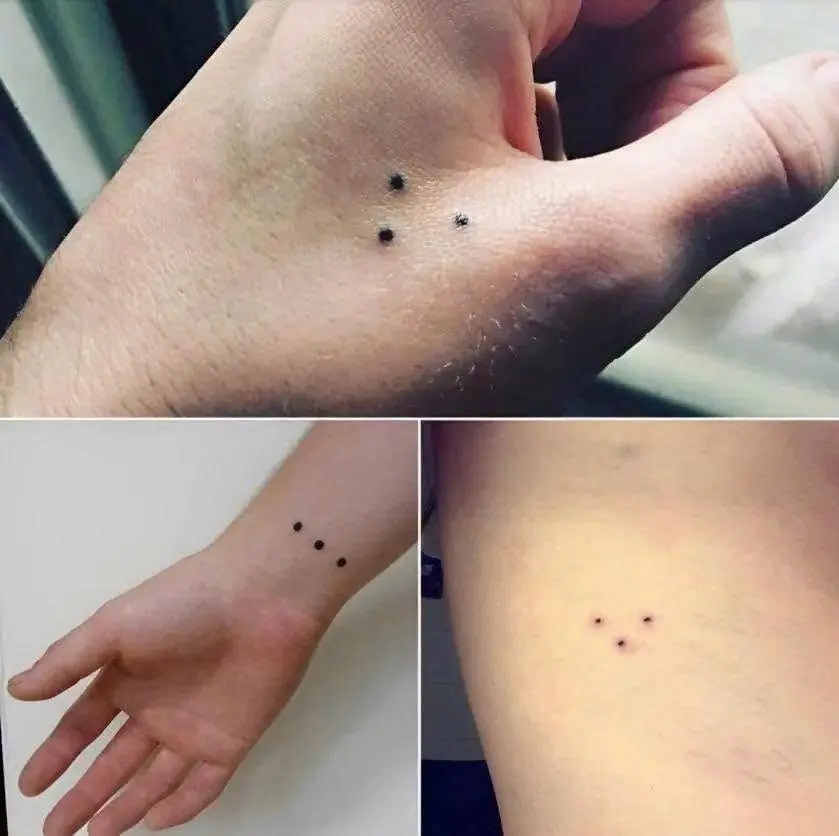
The Most Recognized Interpretation: “Mi Vida Loca”
One of the best-known meanings of the three-dot tattoo comes from the Spanish phrase Mi Vida Loca, which translates into English as “My Crazy Life.”
The phrase is often associated with Chicano culture and with communities in which street life, incarceration, hardship, and personal identity have influenced tattoo traditions. In this context, the three dots can represent a turbulent or unpredictable way of life. They may express the idea that the wearer has experienced difficult circumstances, lived outside conventional expectations, or identifies with a particular street culture.
The phrase itself is important because it does not describe one specific event. It does not necessarily mean that someone has committed a particular crime, served a particular sentence, or belonged to one named organization.
Instead, it can function as a broad personal statement.
For one person, “My Crazy Life” may describe years of instability and difficult decisions. For another, it may reflect a rebellious identity or a connection to friends and a neighborhood. Someone else may choose the phrase because of its cultural associations or because the design has become familiar through music, film, and tattoo art.
The three dots provide a compact visual version of that phrase. They are small enough to be discreet, but recognizable enough to carry a message for people who understand the reference.
What Does “My Crazy Life” Really Suggest?
The word “crazy” in this expression should not automatically be interpreted as a reference to mental illness or a medical condition. In this cultural phrase, it is more closely connected to a chaotic, difficult, unpredictable, or rebellious life.
The idea may involve hardship, risky choices, survival, loyalty, or experiences that have placed someone outside the expectations of ordinary society.
It can also carry a sense of fatalism: a recognition that life has not followed a safe or predictable path.
However, the meaning is not identical for every wearer. Tattoos are personal objects, and even a symbol with a well-known cultural association can be given an individual interpretation.
Why Is the Tattoo Associated With Chicano Culture?
Chicano tattooing developed within a broader Mexican-American cultural environment that includes lettering, religious imagery, portraits, family tributes, neighborhood references, and other visual expressions of identity.
Some designs became associated with prison and street cultures, while others reflected faith, remembrance, love, cultural pride, or personal history.
The three-dot motif became widely recognized within this wider visual vocabulary. It is often discussed alongside other familiar Chicano tattoo imagery, including the theatrical faces associated with “Smile Now, Cry Later,” portraits, lettering, and religious symbols.
But Chicano tattoo culture should never be reduced to gang imagery. It is a much broader artistic and cultural tradition, with many designs having meanings unrelated to crime or prison life.
The Connection to Prison and Gang Culture
The three-dot tattoo is also documented in some prison and gang-related environments. This association is one reason the design has developed such a strong reputation.
In certain contexts, the three dots have been interpreted as a symbol of a life connected to street culture, incarceration, or a particular social environment. Some law-enforcement and correctional reference materials describe the design as Mi Vida Loca and note that it has appeared among both gang-affiliated and non-gang individuals.
A National Gang Center newsletter published by the US Department of Justice makes an especially important distinction: three dots are used by different gangs, but they are also worn by people who are not gang members. The same material notes that the design can have other interpretations, including a religious meaning.
That distinction should be taken seriously.
A tattoo can be associated with a particular subculture without being exclusive to that subculture. A symbol may be adopted by people who identify with its original meaning, people who admire its appearance, and people who simply give it a private interpretation.
Does the Tattoo Prove Someone Belongs to a Gang?
No.
Three dots by themselves do not prove that a person belongs to a gang, has been imprisoned, or has committed a crime.
The US Department of Justice's National Gang Center specifically warns that tattoos should be evaluated alongside other indicators before a definite gang designation is made. It notes that some designs are used by gang members and by members of the general population.
Office of Justice Programs
This is a crucial point because a tattoo is visible, but the story behind it is not.
Someone may have chosen the design years ago for personal reasons. The tattoo may have been copied from a photograph or selected because it looked simple. It may have been created as a symbol of faith, friendship, or a difficult period in life.
Without additional reliable context, an observer cannot know.
Why Did Small Tattoos Become Important in Prison Environments?
In some prison systems, tattoos have historically functioned as a form of communication.
Where personal freedom is limited and ordinary ways of expressing identity are restricted, body markings can become a visible record of experience, affiliation, beliefs, or status.
Prison tattoos have sometimes communicated information that would otherwise be difficult to express openly. Their meanings may be understood within a specific institution or social group, even if outsiders cannot interpret them accurately.