
It may be awkward or majorly embarrassing, but there's a perfectly normal reason why dogs sniff your crotch
Dogs sure have their share of quirks. Some make our hearts melt with their splayed-out splooting and goofy doggy smiles. Other dog behavior has us cringing with embarrassment and wondering why dogs hump or sniff other dogs’ butts. Even more awkward is this question: Why do dogs sniff your crotch?
We’ve all been there: We’re saying hello to an adorable puppy when—boom!—its nose is in a place we’d rather it not be. Or just as embarrassing, we watch in horror as our dog’s smell-seeking missile gets up close and personal with someone’s crotch. Cute as a dog’s facial expression may be just before it goes for the goods, this isn’t a behavior you really want to witness.
So why exactly do dogs do this—and can dog training help curb the behavior? We talked to veterinarians and canine behavior experts to find out.
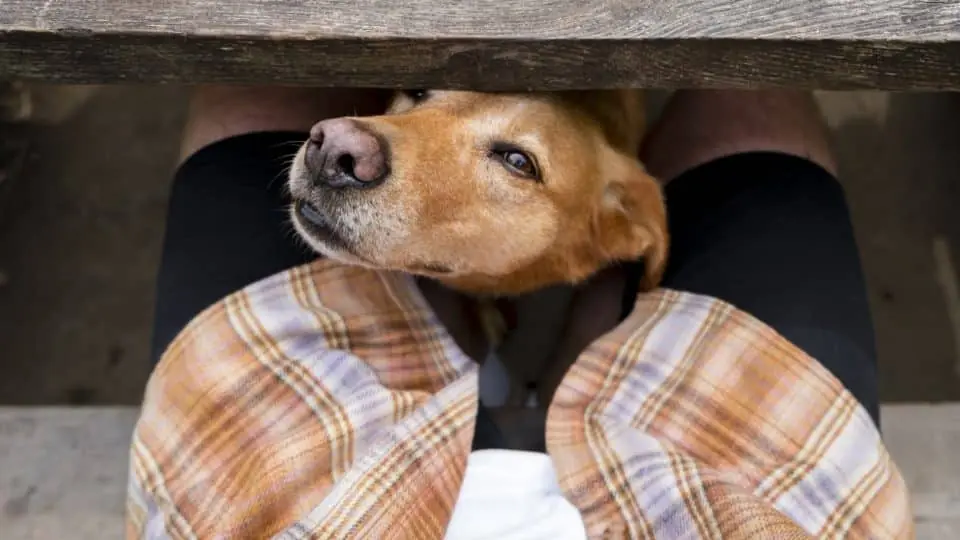
Why do dogs sniff your crotch?
Dogs are curious by nature, and they use their noses to gather all kinds of intel on humans, animals and their environment. “For them, it’s a way of life,” says Vernard Hodges, DVM, a veterinarian at Critter Fixer Veterinary Hospital in Bonaire, Georgia. “Dogs have a phenomenal sense of smell, and that crotch sniff is just another tool they use to get to know us.”
But why do dogs sniff your crotch area specifically? Simply put, it’s the most accessible location for a dog. They detect pheromones, which are chemical signals produced by apocrine (sweat) glands located primarily in the groin and armpits of humans. Both areas of the body convey an abundance of information, such as your age, sex, mood and health issues, but the crotch just happens to be a lot easier for our four-legged friends to access than the armpit.
Still, the inner workings of the nose are quite impressive, thanks to Jacobson’s organ. It’s located on the roof of the mouth, with ducts that open to both the nose and the mouth, allowing for optimal sniffing abilities.
“Jacobson’s organ contains millions of special olfactory receptors, which capture odorants, allowing for enhanced scent detection,” says veterinarian Hilary Wheeler, DVM, medical director of the Street Dog Coalition in the San Francisco Bay Area. “A dog’s nose is anywhere from 100,000 to 1 million times more sensitive than a human nose, but some breeds, such as Bloodhounds, have noses that are 10 to 100 million times more sensitive than ours.”
Can dogs smell pregnancy and other health issues?
Pregnancy-sniffing dogs probably won’t be replacing pregnancy tests anytime soon. “Dogs can’t smell pregnancy, per se. What they can smell is a change in our bodies that can be due to hormones,” says Deianira Smith, DVM, a veterinarian at Rood and Riddle Equine Hospital in Lexington, Kentucky. “Pregnancy, or perhaps other health issues, can alter the smell of someone, so that may be the cause of the excessive sniffing in an area of the human body.”
Your dog doesn’t single out a particular health issue, but it does pick up on the change in pheromones and the change in odors that occur during ovulation, a monthly period, pregnancy and even recent childbirth. Still, a diagnosis-sniffing dog isn’t a far-fetched prospect. “There have been some isolated studies researching dogs’ ability to be trained to detect specific health conditions, including the imminent onset of a seizure, blood glucose or blood pressure changes, and the presence of certain types of cancer,” adds Dr. Wheeler.
Is crotch sniffing normal for dogs?
You’ve asked “Why do dogs sniff your crotch?” Veterinarians have provided perfectly reasonable answers. And yet …
Well, it’s still an awkward thing to experience, and kind of embarrassing if your dog is doing the sniffing. We’ll forgive you for wondering whether your pup (or your crotch) is normal. The good news: Crotch sniffing is a 100% natural behavior.
When you think about it, crotch sniffing isn’t all that different from dogs sniffing one another’s butts to say hello and gather information about their age, gender and reproductive status. Since dogs consider humans part of their pack, the urge to sniff crotches is likely an instinctual way to greet humans.
“When a dog sniffs a person’s crotch, they are simply trying to gather information about that person and communicate with them in their own way,” says Bradley Phifer, a certified professional dog trainer and behavior consultant in Indianapolis.
When does crotch sniffing signify a problem?
Rarely. Most of the time, dogs use their noses to get information: I smell hamburgers! My human is feeling blue. The neighbor’s dog is in heat.
That said, occasionally, crotch sniffing could signify an issue. “At times, sniffing may indicate that the dog is stressed or unsure of a situation,” says Heidi Meinzer, a certified professional dog trainer and certified nose work instructor in Alexandria, Virginia.
A more likely scenario is that your dog learned that crotch sniffing is acceptable behavior. “If you continually allow your dog to greet houseguests with a crotch sniff, you may be inadvertently reinforcing the behavior,” she says. “An easy way to ensure that your dog greets guests more appropriately is to teach your dog an incompatible behavior, like sitting politely to greet people.”
How do you stop a dog from sniffing your crotch?
Now that you know the reasons dogs sniff your crotch, how can you convince them to stop doing it? The goal is to interrupt the dog the moment before the crotch sniffing starts.
“The authentic approach is to recreate your dog’s triggers in order to have rehearsals of a successful outcome,” says certified dog trainer Ivan Petersel, founder of Dog Wizardry in New York City. “For example, if guests coming over is a trigger, then you’ll need to recreate that experience in order to give the dog repetitions. Dogs need repetition in order to learn.”
As Meinzer mentioned, you can train your dog to do something else, such as “sit” or “leave it,” when they zone in on the crotch area. But that might not work for all dogs, especially if crotch sniffing is an established habit or they are easily excited and enthusiastic to greet you or your visitors.
“From the dog’s perspective, sniffing a crotch is either rewarding or not rewarding. I use many ways to communicate to a dog that sniffing a crotch is not appropriate,” says Petersel. You don’t have to decide on a single method. In many cases, all the methods may work, depending on whether you’re at home or on a dog walk.
Use the “place” command
- Set up a mat, dog bed or elevated cot so your dog has somewhere to go when you use the “place” dog command.
- Lure your dog to the mat with a treat.
- Say “place” as soon as your dog puts its paws on the mat, and mark the action with a click, or say “yes!” Immediately reward your pup with a treat placed on the mat to establish an association between the treat and the mat.
- Say your release word—like “free” or “OK”—and lure your dog off the mat by tossing a treat or dog toy away from the mat.
- When you know guests are coming over, do a trial run. Attach a 5-foot drag leash (a leash without a handle) to your dog’s collar so your pup can easily drag it around before your guests arrive. This allows your dog to still have some freedom.
- When your dog tries to sniff inappropriately, use the “place” command. If your dog breaks the command, gently lead it back to its place with the leash.
- Acknowledge appropriate behavior by saying “good place.” Continue saying “good place” or bringing treats to lengthen the amount of time your dog stays in its place. When your dog has calmed down, you can say “free” or “OK.” You can also give it something long lasting (like a bully stick) to gnaw on while it’s sitting or lying in its place.
Redirect your dog
- When you see that your dog is sniffing the air or about to make direct contact with the crotch area, toss high-value treats onto the ground, away from the person.
- Repeat until your dog makes a new association that it’s treat time—not sniffing time—when it’s looking at the crotch.
- If treats aren’t doing the trick, give your pup a new yummy little something, like a fresh marrow bone or bully stick that it hasn’t already been chewing on. It’ll lure your dog away from the crotch area.
Try a sound distraction
- Look for signs that your dog is about to sniff your crotch.
- As your pup leans in, turn around abruptly while simultaneously making a hissing sound. (It should sound like compressed air in a can you spray your keyboard with.) You can also say “eh” or “nope.”
- Reward your dog for responding to the sound. Repeat as necessary.
Keep it moving
- Tell your guests to keep moving when they come in. Typically, guests freeze once they get through the doorway, but this may feel like an invitation for your furry pal to sniff.
- If your guests are OK with it, ask them to present their hands, coats, hats, gloves or shoes to your dog—while they’re moving away from the entryway—so your pup can sniff those items instead of their crotches. This trick will teach your dog that sniffing everywhere except for the crotch area is rewarding.
At this point, you should be able to easily answer “Why do dogs sniff your crotch?” Ready for more dog-behavior info from experts? Learn why your dog licks your feet and other fascinating facts about dogs.
AdvertisementAbout the experts

- Vernard Hodges, DVM, is a veterinarian and fish biologist who practices on all types of animals, from koi to camel, at Critter Fixer Veterinary Hospital in Bonaire, Georgia. He’s the star of Critter Fixers: Country Vets, a National Geographic Wild and Disney+ TV show that chronicles his veterinary life. Dr. Hodges is a proud dog dad to Bane, Koi and Ghost.
- Hilary Wheeler, DVM, is the medical director of The Street Dog Coalition in the San Francisco Bay Area, where she focuses on improving animal health-care options. Dr. Wheeler has two dogs, Posey and Tikka, and enjoys working with the rescue groups The Dancing Cat and Humane Society Silicon Valley.
- Deianira Smith, DVM, is a veterinarian at Rood and Riddle Equine Hospital in Lexington, Kentucky. Her focus is client education, community outreach and small-animal emergency medicine and surgery. She lives with her golden retriever, Addison West.
- Heidi Meinzer is the interim chair for the Association of Professional Dog Trainers, a certified professional dog trainer, certified nose work instructor and animal law attorney in Alexandria, Virginia. She lives with her favorite canine companions, Hannah and Arwen.
- Bradley Phifer is a certified professional dog trainer and behavior consultant with 17 years of experience, owner of Bradley Phifer Dog Training and executive director of the Certification Council for Professional Dog Trainers. He lives in the Indianapolis area with his dogs Wren, Liv, Dharma and Harper.
- Ivan Petersel is a certified professional dog trainer, canine behavior consultant and founder of Dog Wizardry in New York City. He specializes in training service dogs for autism assistance, PTSD and seizure response, as well as diabetes alert dogs. He also trains in advanced obedience and dog sports.