Have you ever gone to bed beside your partner, only to notice that they have turned away from you?
For some couples, this happens almost every night. One person curls up facing the wall, while the other lies behind them wondering whether the position means something about their relationship.
It is easy to interpret body language emotionally. “Are they upset with me?” “Do they want more space?” “Are we becoming distant?” These questions can become especially powerful at night, when everything is quiet and small behaviors seem more meaningful.
But the truth is more complicated.
Sleeping with your back toward your partner does not automatically mean that someone is angry, unhappy, emotionally distant, or falling out of love. Sleep positions are influenced by many factors, including comfort, temperature, mattress size, personal habits, physical health, and individual sleep preferences.
At the same time, sleeping positions can sometimes reflect how comfortable two people feel sharing physical space.
So what might it mean when your partner consistently sleeps with their back toward you?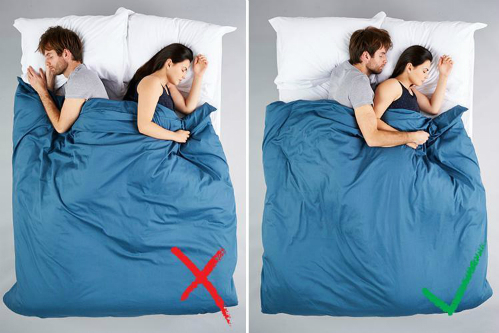
1. They May Simply Be More Comfortable That Way
The simplest explanation is often the most overlooked: your partner may simply sleep better in that position.
Some people naturally sleep on their side. Others prefer sleeping on their stomach or back. Side sleepers may find it more comfortable to face one particular direction because of their preferred posture, pillow placement, mattress support, or even the location of the bedroom.
Over time, a sleeping position can become an automatic habit.
Your partner may turn away from you without consciously thinking about it.
In other words, what looks emotionally significant to one person may be nothing more than a familiar sleeping posture to the other.
This is why interpreting a single sleeping position as proof of a relationship problem can be misleading.
2. Turning Away Does Not Necessarily Mean Rejection
One of the most common assumptions is that facing away from a partner means, “I don't want you near me.”
That interpretation is not necessarily accurate.
A person can turn away while still feeling deeply connected, secure, and affectionate toward their partner.
In fact, some couples feel comfortable enough in their relationship that they do not need to maintain physical contact throughout the entire night.
They may cuddle before falling asleep and then naturally separate once they become comfortable.
This can actually reflect a practical understanding of each other's need for sleep and personal space.
Affection during waking hours and sleeping posture are not the same thing.
3. They May Need More Personal Space While Sleeping
Sharing a bed does not eliminate the need for personal space.
Some people sleep better when they have room to stretch their legs, move around, or adjust their position without touching another person.
Turning away can create a small sense of physical separation while still allowing both partners to share the same bed.
This becomes especially understandable when couples have different sleep preferences.
For example, one person may sleep hot while the other prefers warmth. One may move frequently while the other barely moves. One may prefer a firm mattress while the other prefers something softer.
In these situations, turning away may simply be a way of creating a comfortable sleeping environment.
4. Temperature Can Play a Bigger Role Than You Think
Body temperature is another practical factor.
During sleep, people regulate their body temperature in complex ways. Some people naturally feel warmer at night and prefer to keep some distance from another person's body heat.
If your partner turns away, moves toward the edge of the bed, or avoids physical contact after falling asleep, it may have nothing to do with your relationship.
They might simply be trying to cool down.
This is particularly common in warm climates or bedrooms without adequate ventilation.
Sometimes what looks like emotional distance is actually thermal comfort.
5. They May Feel Secure Enough to Relax
There is another possible interpretation that is quite different from rejection.
A person who feels comfortable and secure with their partner may not feel the need to maintain constant face-to-face contact.
They can turn away, close their eyes, and fall asleep knowing their partner is still there.
That kind of comfort can be completely ordinary in a long-term relationship.
Couples often develop their own sleeping routines over the years.
They may have a preferred side of the bed, a particular position, a certain bedtime routine, or an unwritten agreement about blankets.
These habits can become so automatic that neither person consciously thinks about them.
6. What Happens Before Sleep May Matter More Than the Sleeping Position
If you are trying to understand what your partner's sleeping position means, pay attention to what happens before both of you fall asleep.
Do you talk?
Do you laugh together?
Do they reach for your hand?
Do you usually cuddle?
Do they show affection during the day?
Do they ask how you are feeling?
Do you feel listened to and respected?
These behaviors provide much more context than whether someone's back is facing you at 2 a.m.
A person who turns away after a warm conversation and a goodnight kiss is in a very different situation from someone who has suddenly stopped communicating, avoids affection, and consistently withdraws from you both during the day and at night.
Context matters.

7. The “Back-to-Back” Position Can Still Involve Closeness
Interestingly, couples can sleep back-to-back while remaining physically close.
For example, two people may lie on their sides with their backs touching or lightly pressed together.
This position allows each person to face away while maintaining physical contact.
That is very different from deliberately creating a large physical barrier between the two people.
Even then, however, it would be a mistake to assign one universal psychological meaning to the position.
People have different habits, personalities, and physical needs.
8. Sometimes People Need Space After an Argument
There is one situation in which turning away may have emotional significance: when it occurs alongside obvious relationship tension.
Suppose your partner normally sleeps close to you but suddenly begins facing away after an argument.
Perhaps they also become quieter, avoid conversation, refuse affection, or appear upset.
In that situation, the sleeping position may be one small part of a larger pattern.
The important point is not that turning away caused the emotional distance.
Rather, the position may be reflecting a feeling that is already present.
This distinction matters.
A sleeping position by itself is weak evidence. A significant change in behavior combined with communication problems may deserve attention.
9. A Sudden Change May Be More Noticeable Than a Long-Standing Habit
If your partner has always slept facing away from you, there may be very little to interpret.
It is simply their normal sleeping style.