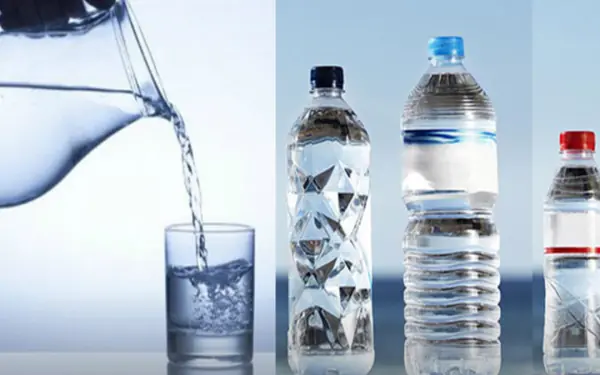
Some people are used to drinking traditional boiled water, while others are worried about the quality of tap water and choose to drink bottled water. Two new studies will give you the answer.
A study published earlier this year in the scientific journal Proceedings of the National Academy of Sciences (PNAS) found that there were an average of a quarter of a million plastic particles in a 1-liter bottle of water, 100 times more than previously estimated.
Specifically, scientists looked at five different water bottles from three popular brands (names not given). They found an average of 240,000 particles from seven different types of plastic, mostly in nano form. Previous studies have focused on microplastics (pieces smaller than 5mm and larger than 1 micron (1/1000 mm), while nanoplastics, which are smaller than 1 micron in size, are considered more dangerous because they can easily penetrate organs such as the gut, lungs, blood vessels, even the heart and brain. It can even cross the placenta and eventually reach the fetus.
"This study provides a powerful tool to address the challenges of "Nanoplastic analysis promises to bridge the current knowledge gap on plastic pollution at the nanoscale," said Naixin Qian, lead author of the study, Columbia University, USA.
A recent study in the journal "Environmental Science and Technology Express" by Professor Li Zhanjun, Guangzhou Medical University and Professor Zeng Yongping, School of Environment, Jinan University, showed that by simply boiling water and filtering, it is possible to remove up to 84% of nano/microplastics. This is the simplest and most harmless way to purify water, thereby reducing the amount of microplastics that humans absorb through drinking water.
The study found that during the process of boiling water, as the water temperature increased (25-95 degrees Celsius), the efficiency of removing microplastics in water gradually increased from the initial 2% to 28% and increased sharply to 84% at 100 degrees Celsius. At the same time, the concentration of microplastics decreased from the initial 30 particles/microliter to 4.8 particles/microliter.
So where do the microplastics in water go? The study showed that the missing microplastics were transferred from water to sediment. Calcium carbonate in the sediment can remove microplastics from water by co-precipitating with microplastics.
Finally, the study compared the amount of microplastics that adults and children drank from boiled water and tap water in 67 areas on six continents based on different water quality and drinking habits around the world. The amount of microplastics absorbed daily through boiled water was found to be 2-5 times less than the amount of microplastics ingested through tap water.
Scientists reinforce the argument that the ancient wisdom of drinking boiled water that has been cooled can indeed remove microplastics.