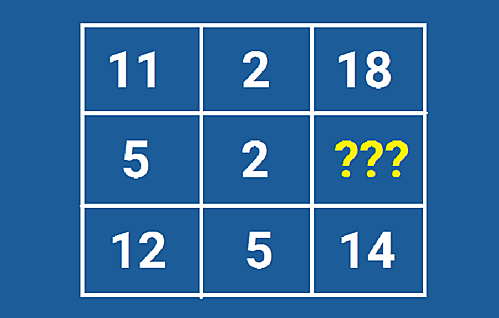
At first glance, the puzzle in the image looks like a simple addition problem:
1 + 4 = 5
2 + 5 = 12
3 + 6 = 21
5 + 8 = ?
It seems straightforward. After all, the numbers are small and the first three equations appear to follow a pattern.
But there is a catch.
The puzzle is not really asking you to add the numbers in the usual way.
Instead, you have to discover the hidden rule connecting the equations.
And that is where the challenge begins.
Look Beyond the Plus Sign
The first equation is:
1 + 4 = 5
That works perfectly under ordinary addition.
The second equation is:
2 + 5 = 12
But 2 + 5 equals 7, not 12.
So something else is happening.
Now look at the third line:
3 + 6 = 21
Ordinary addition gives 9, which is again different from the number shown.
At this point, it becomes clear that the plus sign may not represent ordinary addition in the way we initially expect.
The goal is therefore to find a mathematical pattern that produces all three given answers.
One Common Pattern Leads to 45
A particularly clean way to solve the puzzle is to look at multiplication.
Consider the first equation:
1 + 4 = 5
You can interpret the result as:
1 × (4 + 1) = 5
Now try the same rule with the second equation:
2 × (5 + 1) = 2 × 6 = 12
It works.
Now apply it to the third:
3 × (6 + 1) = 3 × 7 = 21
It works again.
So the hidden rule can be written as:
First number × (Second number + 1)
Now we can apply exactly the same pattern to the final line:
5 + 8 = ?
Following the rule:
5 × (8 + 1)
= 5 × 9
= 45
So under this pattern:
The answer is 45.
But There Is Another Way to See the Pattern
There is an even more interesting way to approach the puzzle.
Look at the answers themselves:
5 → 12 → 21
The differences between them are:
12 − 5 = 7
and
21 − 12 = 9
The numbers are increasing by progressively larger odd numbers.
If the pattern continues, the next difference could be:
11
That would give:
21 + 11 = 32
But this produces a completely different answer.
And that's an important lesson about these viral math puzzles:
A sequence can often be made to fit more than one mathematical rule.
Without additional information specifying the intended rule, there may not be a single mathematically unique answer.
Another Popular Solution Uses the Previous Result
There is another pattern that many people use when solving puzzles like this.
Start with:
1 + 4 = 5
Then take the previous answer and incorporate it into the next equation:
2 + 5 + 5 = 12
Then:
3 + 6 + 12 = 21
Following that same idea:
5 + 8 + 21 = 34
This method gives:
34
So now we have two plausible answers:
45 using one rule
34 using another rule
Which one is correct?
Why These Puzzles Can Be Tricky
The problem is not necessarily your mathematical ability.
The real challenge is that the puzzle doesn't explicitly tell you what kind of pattern you're supposed to find.
In mathematics, a finite set of examples can often be explained by many different rules.
For example, if someone gives you three points on a graph, there can be many mathematical functions passing through those points.
The same principle applies here.
With only three completed equations, there is not enough information to prove that one particular hidden rule is the only possible rule.
That's why these puzzles are better understood as pattern-recognition challenges rather than formal mathematical proofs.
Why 45 Is Often Considered the Intended Answer
The 45 solution is particularly attractive because the same compact operation works on every line:
1 × (4 + 1) = 5
2 × (5 + 1) = 12
3 × (6 + 1) = 21
Therefore:
5 × (8 + 1) = 45
The rule is consistent from beginning to end and doesn't require introducing the previous answer into the next equation.
It also creates a recognizable mathematical structure:
1 × 5 = 5
2 × 6 = 12
3 × 7 = 21
5 × 9 = 45
That consistency is one reason 45 is a strong candidate for the intended answer.
The Real Challenge Is Not Calculation
Notice something interesting about the puzzle.
None of the multiplication involved is difficult.
You don't need advanced mathematics.
You don't need algebra.
You don't even need a calculator.
The difficult part is recognizing that the apparent operation isn't ordinary addition.
That's why these puzzles can feel frustrating.
Your brain naturally wants to read:
1 + 4
and calculate:
5
When that works, you assume the same operation applies to the next line.
But then:
2 + 5 = 7
while the puzzle says 12.
That contradiction forces you to step back and ask:
“What am I missing?”
That moment of questioning is the entire point of the puzzle.
Don't Be Fooled by the “97% Will Fail” Claim
The image also contains the statement:
“97% will fail to solve this test.”
That kind of wording is commonly used in viral puzzles to make the challenge seem more difficult and encourage people to comment.
There is no evidence in the image itself establishing that exactly 97% of people would fail.
So it is better to treat that number as attention-grabbing puzzle language, not as a scientifically measured statistic.
The puzzle itself is challenging enough without needing an exaggerated percentage.
Why People Get Different Answers
If you post this puzzle online, you'll probably see several different answers in the comments.
Some people will say:
34
Others will say:
45
Someone may even find another mathematical pattern and produce a completely different result.
That doesn't necessarily mean everyone who gets a different answer is bad at mathematics.
It means the puzzle is underdetermined.
If the creator intended a specific rule, the expected answer depends on identifying that intended rule.
This is common in recreational mathematics.
A good puzzle should ideally provide enough information that the intended solution is reasonably clear. When it doesn't, several interpretations can become defensible.
How to Approach Similar Puzzles
When you encounter a puzzle like this, don't immediately start guessing.
Instead, work systematically.
Step 1: Test ordinary arithmetic
Check addition, subtraction, multiplication, and division.
If the displayed results don't match, move on.
Step 2: Look for relationships between the numbers
Ask whether one number is being multiplied, squared, increased, or combined with another.
Step 3: Check every line
A proposed rule isn't useful if it works for only one or two equations.
Try it against all the examples.
Step 4: Keep the rule simple
When several patterns are possible, the simplest consistent rule is often the intended one.
Step 5: Remember that some puzzles are ambiguous
If two different rules fit equally well, there may not be a uniquely provable answer.
So, What's the Answer?
Using the most straightforward multiplication-based pattern:
1 × (4 + 1) = 5
2 × (5 + 1) = 12
3 × (6 + 1) = 21
Therefore:
5 × (8 + 1) = 45
Answer: 45
But there's an important caveat.
The puzzle does not mathematically establish that 45 is the only possible answer. Another consistent pattern can produce 34, for example, by incorporating the previous result.
So if this is a viral brain teaser and you're asked for the intended answer, 45 is a strong choice.
The bigger lesson is perhaps more interesting than the number itself: sometimes solving a puzzle isn't about calculating faster. It's about being willing to question the assumption that the symbols mean exactly what they appear to mean.
The next time you see a simple-looking equation, don't just calculate it. Look for the rule hiding underneath.