Jay-Z’s Daughter Breaks Her Silence? What Blue Ivy Has Actually Said About Her Father
The headline in the screenshot promises a personal revelation: “My dad used to…” But there is an important detail readers should know before accepting that promise as fact: the screenshot does not show Blue Ivy speaking, and it does not provide the words that supposedly followed that phrase. I could not verify a public statement from her matching that unfinished quote.
There is, however, genuine recent material about the relationship between Jay-Z and his daughter. In a 2026 interview, Jay-Z spoke warmly about Blue Ivy’s growth as a performer, her musical ability, and the way fatherhood has changed his priorities. Those comments offer a much more reliable foundation for an article than inventing a confession or attributing words to a young person who has not said them publicly.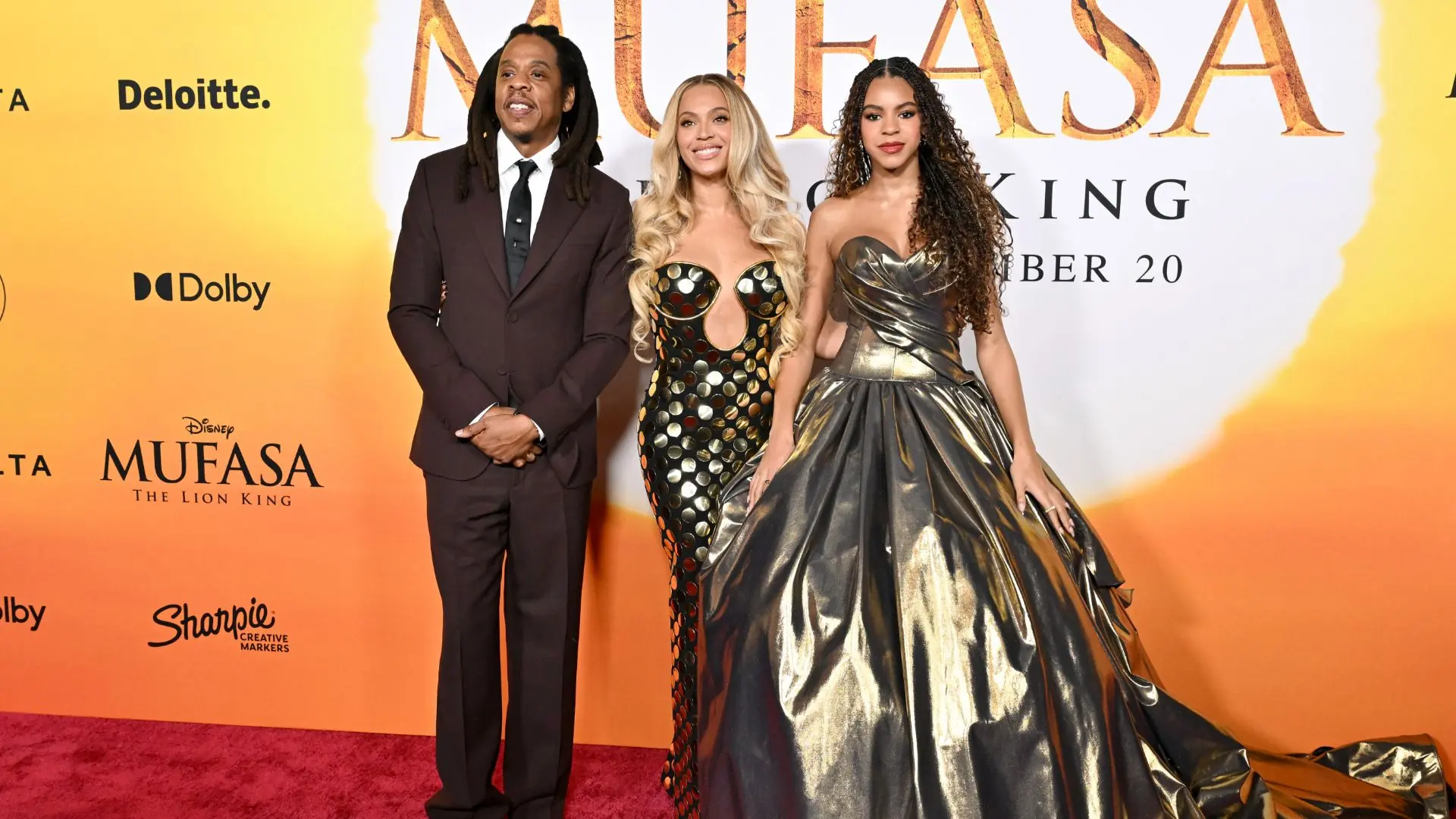
Chapter 1: The Headline That Left Everyone Waiting for the Rest of the Sentence
There is a reason a headline ending with “My dad used to…” can make people stop scrolling. It sounds like the beginning of a personal memory, perhaps something funny, emotional, or revealing. When the name attached to that sentence is Jay-Z, one of the most recognizable figures in music, curiosity becomes even stronger. Readers naturally want to know what his daughter supposedly remembers and why she would choose to speak about it now.
The photograph accompanying the headline adds another layer of intrigue. On one side, it shows Jay-Z with Blue Ivy when she was a young child. On the other, it shows a young woman in a pink dress. The contrast invites readers to think about how much time has passed and how dramatically a celebrity child can grow up under public attention.
But a photograph and an unfinished quotation are not proof of a confession.
The screenshot does not provide a recording, interview transcript, direct statement from Blue Ivy, or the missing words after “My dad used to.” The recent, verifiable interviews about the father-daughter relationship actually feature Jay-Z speaking about Blue Ivy—not Blue Ivy making the alleged statement suggested by the headline.
That distinction matters. A headline can create the impression that a celebrity's child has revealed a private family secret even when the material available does not support that conclusion.
There is nevertheless a genuine story worth exploring. During 2026, Jay-Z spoke publicly about watching his daughter develop as a performer, her ability to teach herself music, and the pride he felt when she worked hard to earn a place onstage. He also described how important ordinary moments of fatherhood have become to him. In July, Blue joined him onstage at Yankee Stadium to play piano. In October, she appeared again during his Los Angeles concert, accompanying him on songs from his catalogue.
Those moments provide a much more meaningful picture than an invented quotation could offer. They reveal a father watching his child develop an identity of her own, while trying to balance the excitement of public success with the instinct to protect her.
The real question, then, is not what Blue Ivy supposedly said in an unfinished sentence. It is what Jay-Z has actually shared about raising her, how their relationship has evolved, and why the family's rare public moments continue to attract so much attention.
Chapter 2: Growing Up as the Daughter of Jay-Z and Beyoncé
Blue Ivy Carter was born into a family whose influence reaches across music, fashion, business, film, and popular culture. Her parents, Jay-Z and Beyoncé, are internationally recognized artists whose careers have developed over decades. Their professional achievements are enormous, but their family life has generally been treated as something separate from their public brands.
That separation has not always been easy.
From the moment Blue Ivy was born in January 2012, public interest in her was intense. People wanted to know what she looked like, what her parents would name her, whether she would appear in music videos, and whether she would eventually follow them into entertainment.
Her earliest public recognition came partly through music. Jay-Z released “Glory,” a song celebrating the arrival of his daughter, and included her newborn cries in the recording. Her voice was therefore heard by listeners when she was only days old. The song was a deeply personal expression of fatherhood, but it also placed Blue in the public musical record almost immediately.
For a child, growing up with that kind of attention is unusual. Most children have time to develop interests and personalities before strangers begin discussing their future. Blue Ivy's childhood, by contrast, unfolded under a level of public curiosity that few families experience.
Yet her parents have repeatedly tried to preserve a private world for their children.
Beyoncé has spoken about wanting her children to experience as much normalcy and privacy as possible, rather than allowing their personal lives to become a constant public spectacle. That intention helps explain why the family does not share every detail of daily life, school, friendships, or family routines.
A childhood surrounded by creativity
Music is a natural part of the environment in which Blue Ivy has grown up. Her father is known for songwriting, rap performance, business strategy, and the development of musical careers. Her mother is celebrated for singing, performance, visual storytelling, choreography, and ambitious live productions.
A child growing up around those activities may encounter rehearsals, recording sessions, musicians, dancers, producers, and creative discussions as ordinary parts of family life.
But exposure to music does not automatically determine a child's future.
Some children of famous performers choose to enter entertainment. Others prefer entirely different careers. Even when a child shows obvious musical ability, parents must decide how much encouragement is appropriate and how much freedom the child should have to explore independently.
Jay-Z's comments about Blue's piano playing suggest that he recognizes this balance. He has praised her ability while also explaining that she does not want formal lessons because she does not want music to become a job.
That detail is revealing. It suggests that the family is not simply trying to turn every talent into a professional opportunity. Blue appears to want space to enjoy music on her own terms.
The challenge of being recognized everywhere
A celebrity child can experience attention before fully understanding what public recognition means.
People may recognize their parents in restaurants, airports, stadiums, and public events. Cameras may appear whenever the family attends a major ceremony. Even an ordinary outing can become a story online.
As Blue has grown older, she has appeared more frequently at public events, including sporting occasions, award ceremonies, and concerts. Those appearances have generated photographs and commentary about her fashion, confidence, and resemblance to her parents.
But public visibility should not be confused with complete public access.
Being photographed at an event does not mean that a young person has agreed to share every part of their life. A public appearance does not turn private family conversations into public property.
This is especially important when headlines suggest that a celebrity child has revealed something personal. Readers should look for the actual interview, statement, or recording before treating such a claim as fact.
The difference between a famous surname and an individual identity
Blue Ivy's surname connects her to two major entertainment figures. Yet her own identity has developed through experiences that are separate from her parents' careers.
Her performances with Beyoncé, her awards, her voice work, and her piano playing are part of that development. They have allowed audiences to see her not only as the child of famous musicians but as someone who is gradually learning what she enjoys doing.
The distinction is important because children of celebrities can face an unusual expectation: they are often judged as though they must either reproduce their parents' success or reject it entirely.
Neither expectation is fair.
A young person should be able to experiment, make mistakes, learn, and change direction without every decision becoming a public verdict on their potential.
For Blue Ivy, the most interesting part of the story may be that she is beginning to demonstrate her own interests while still remaining close to the family environment in which she grew up.
Chapter 3: The Father-Daughter Relationship Jay-Z Has Discussed Publicly
One of the clearest glimpses into Jay-Z's relationship with Blue Ivy came during a 2023 interview with Gayle King for CBS Mornings.
At the time, Jay-Z joked that his daughter had not always considered him particularly cool. He described a familiar parent-child dynamic: a father convinced that he has style, while his daughter is not always impressed.
He recalled that there had been a period when Blue reacted with embarrassment to him. But he also explained that she had begun asking his opinion about her sneakers and whether certain fashion choices looked good.
It was a small anecdote, but it resonated because it sounded familiar to many parents.
The changing meaning of being a “cool dad”
When children are very young, parents often make most decisions for them. They choose clothes, organize activities, and determine what music or entertainment is available at home.