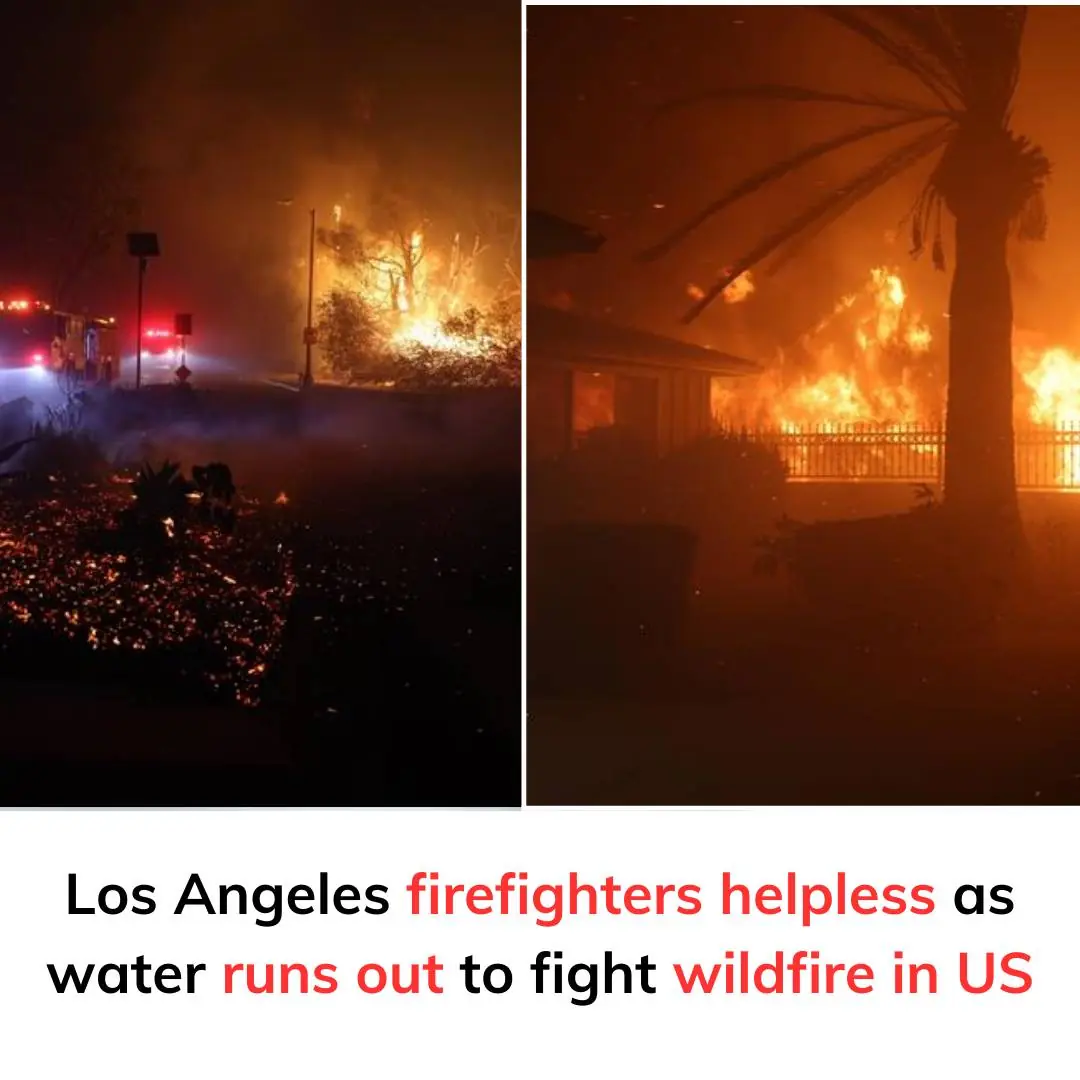
Captain Kevin Easton and his crew spent hours battling the out-of-control blaze that was spreading through the Pacific Palisades neighborhood of Los Angeles, leaving homes in its wake. But shortly after midnight, the fire hoses ran dry.
“It’s completely dry, there’s no water to be had,” said Captain Easton, a member of a mobile patrol of firefighters trying to protect the Palisades Highlands neighborhood. As of Friday afternoon — hours after the fire hydrants ran dry — there was still no water. Homes in the Highlands had burned to the ground, joining more than 5,000 structures destroyed by the Palisades Fire so far.
Local officials say water tanks for high-elevation areas like the Highlands and pumping systems that supply water can’t keep up with demand as the fire spreads from neighborhood to neighborhood. In part, those who designed the systems didn’t account for the terrifying speed with which multiple fires would spread across the Los Angeles area this week.
Marty Adams, former general manager and chief engineer of the Los Angeles Water Department “We’re in a situation that is completely out of the question for any domestic water system,” said Los Angeles Electric, which is responsible for providing water to nearly four million Los Angeles residents.
The city’s water systems are designed so that firefighters can tap multiple hydrants at once, allowing them to maintain a steady flow of water to crews who may be trying to protect a large structure or a handful of homes. But these systems can collapse when wildfires, like the dry brush fires that surround Los Angeles’ hillside communities, rage through residential neighborhoods.
As urban sprawl spreads into wildland areas across the country and climate change creates conditions that favor fires, more and more cities are facing sudden water outages while fighting fires, most recently Talent, Oregon; Gatlinburg, Tennessee; and Ventura County, California
The problem can be especially acute in high-wind conditions, as Los Angeles experienced this week, when firefighting aircraft cannot safely drop water and fire retardant in the air as they normally would.
Photo caption
Smoke billows from a wildfire in Pacific Palisades, Los Angeles, California, U.S., January 7, 2025. Photo: THX/TTXVN
During the 2022 fire in Louisville, Colorado, when firefighters were running low on water supplies, crews took the bold step of dumping untreated water into the system. In 2023, on the Hawaiian island of Maui, firefighters battling a wildfire found their fire hoses running dry as flames ripped through the community of Lahaina, killing 102 people in the deadliest U.S. wildfire in more than a century.
Municipal water systems like the one in Los Angeles are designed to handle high demand, including demand from large fires that can require multiple fire trucks to tap the system at once. But getting water to the upper reaches of hillside communities like Pacific Palisades can still be a challenge. There, water is collected in a reservoir that pumps it into three high-elevation tanks, each holding about a million gallons. The water then flows by gravity to homes and fire hydrants.
But the pumping and storage system was designed for a fire that burns many homes, not hundreds like the current disaster.
Ahead of this week’s dangerous weather, water tanks in Pacific Palisades and other hillside communities affected by the fire were filled. But as the Palisades Fire spread on Jan. 7, the first tank there quickly ran dry. Hours later, the second tank ran dry, and the third tank ran dry on the morning of Jan. 8.
By the evening of Jan. 9, Los Angeles Fire Chief Kristin M. Crowley said firefighters had stopped using hoses altogether.
Water supplies were just one of many challenges as crews across Los Angeles County were overwhelmed by fires burning on multiple fronts. In the Altadena area, where the Eaton Fire has burned more than 13,000 acres and up to 5,000 structures, firefighters were also dealing with water system overload.
“Those erratic winds were blowing embers miles in front of the fire, and that’s really what fueled the fire,” said Fire Chief Augustin.
Los Angeles City Council member Traci Park said the city’s water system is among the most severely underfunded pieces of infrastructure.
“There are environmental disasters waiting to happen everywhere with our water mains,” said Park, adding that some of the water mains are centuries old.
Greg Pierce, a researcher at the University of California, Los Angeles, who studies natural resources