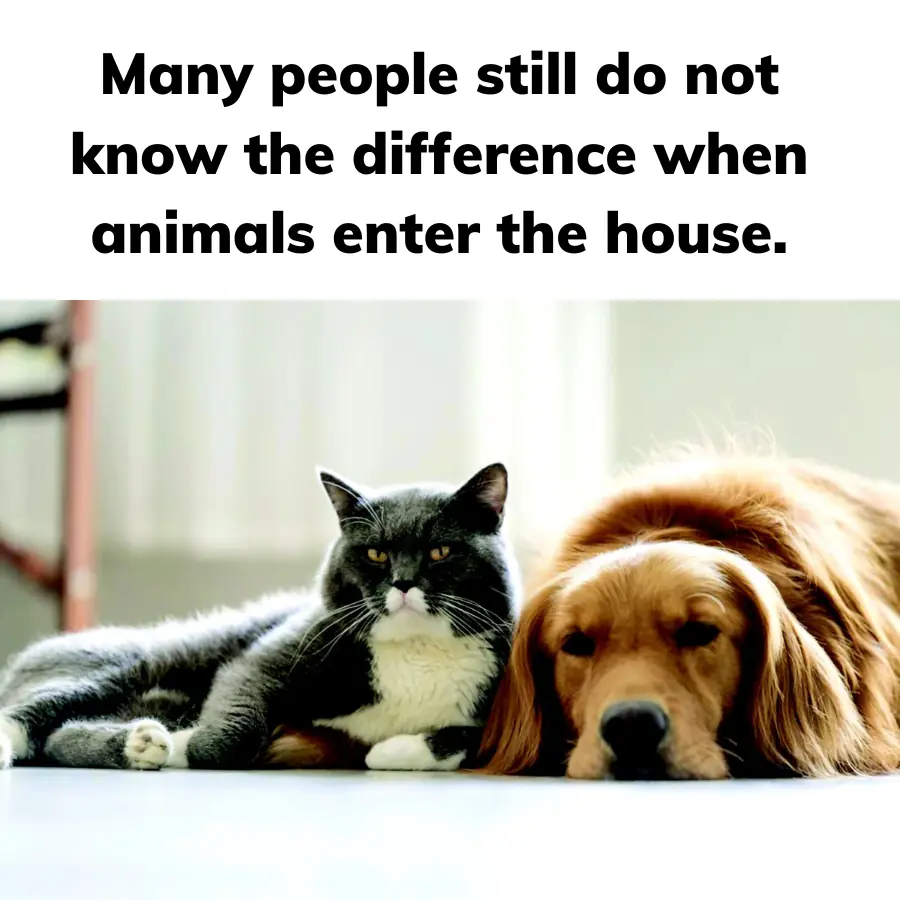
Folklore based on the characteristics of these two animals created proverbs. Dogs are loyal animals, have good memories, "when dogs come to the house, the house has someone to guard the house, protect the property, the manifestation of the guardian god, so it will be rich". In contrast to dogs, cats stay when there is food, when there is no food, they leave, "representing the loss of property and people believe that cats bring bad luck, poverty...". On the other hand, there is also the influence of "energy field" - "cats really like areas with radiation or bad energy fields; On the contrary, dogs like areas with good radiation and energy fields"...
Interestingly, the Chinese also have the same saying "When a cat comes, it's difficult, when a dog comes, it's rich" (Miêu lai cùng, cầu lai phú - 貓 來 窮, 狗 來 富). They believe that an ownerless cat (liu lang miêu - 流 浪 貓) that suddenly comes to the house is a sign that the homeowner is about to be poor. On the contrary, an ownerless dog (liu lang cau - 流 浪 狗) that suddenly comes to the house is a sign that the homeowner will be rich. They believe that this is not necessarily superstition. The reason is that in ancient times, only rich families had tiled floors; poor families had rough dirt floors, and there were many rats and insects digging holes to live in. This is the reason why cats pay attention to poor families. Meanwhile, rich families' meals often had meat, and dogs have extremely sensitive noses, so they sought them out. Stray dogs, dogs A homeless dog suddenly coming to someone's house is like a prediction of the homeowner's fortune.
There is also a Chinese proverb that says "A child does not despise an ugly mother, a dog does not despise a poor family" (Nhi bat hiem mau xu, cau bat hiem gia ban - 兒 不 嫌 母 醜, 狗 不 嫌 家 貧). Dogs are man's most loyal friends. Dogs bark "wang", which sounds like the word "vuong" (旺), meaning good luck and wealth will come. Meanwhile, cats meow "miào" (喵), which sounds like the words "miè" 滅 (destroy), "méi" 沒 (one) - all meaning "dissipation", "loss", "death". Therefore, a stray cat coming to the house is a taboo. The Chinese also have a saying "When a dog comes, there will be wealth, when a cat comes, there will be mourning" (Cẩu lai tài, máo lai Hiếu - 狗 來 財, 貓 來 孝)... This explanation, in our opinion, has a basis in reality.
Returning to the interpretations and explanations of Vietnamese dictionary compilers and folklore researchers. The dictionary compilers' interpretations of "another house's dog", "another house's cat" coming to one's house or "a cat coming to someone's house", "a dog coming to someone's house" are, in our opinion, unclear in meaning. Because "cat" or "dog" here must be understood as a stray, ownerless cat or dog (as the Chinese understand as "liu lang miêu", "liu lang cau"), not a cat or dog from "another house". That is, these stray cats and dogs appear like angels signaling good or bad luck to the homeowner, then they are effective. Dogs and cats also come to the house, but if the neighbor's dog or cat (has an owner), people can chase both away (to avoid them pooping or stealing food), but there is no waiting or joy.
The sound of a dog barking "woof, woof" is similar to "rich, rich", the sound of a cat meowing "gheo ngheo" is similar to "poor poor" so it is taboo