Noticing an unusual white spot on your lips or in an intimate area can be unsettling. Your first thought might be, “Is this something serious?”
The good news is that white spots are often caused by relatively harmless conditions. At the same time, changes in the skin or mucous membranes should not automatically be ignored—especially when they are new, persistent, painful, spreading, or accompanied by other symptoms.
White spots can have many different causes, and where they appear, what they look like, how long they have been there, and whether you have other symptoms can all provide important clues.
A white spot on the lip, for example, may be caused by something completely different from a white patch in the genital area.
So before assuming the worst, let's look at some of the most common possibilities and the warning signs that mean it's time to get checked.

Why Can White Spots Appear?
“White spot” is a broad description rather than a diagnosis.
A spot may look white because of:
-
A buildup of skin cells
-
Changes in pigmentation
-
A blocked or visible gland
-
Irritation or inflammation
-
A fungal infection
-
A viral infection
-
A benign skin condition
-
Scarring
-
Changes in the surface of the mucous membrane
Sometimes the area isn't actually producing more white pigment. Instead, the surface becomes thicker, drier, inflamed, or coated with material that makes it appear white.
This is why simply looking at a photograph—or trying to diagnose the spot yourself—may not be enough.
👄 White Spots on the Lips
The lips are particularly exposed to irritation from food, cosmetics, toothpaste, sunlight, weather, and habitual behaviors such as lip licking or biting.
Several conditions can produce small white or pale spots.
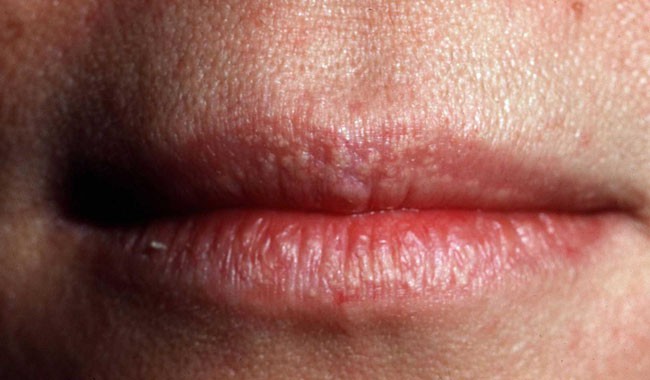
1. Fordyce Spots
One of the most common benign explanations is Fordyce spots.
These are small, visible sebaceous glands that can appear as tiny white, yellowish, or skin-colored dots.
They are generally:
-
Small
-
Painless
-
Not contagious
-
Not caused by poor hygiene
-
Not considered a sexually transmitted infection
Fordyce spots can occur on the lips and elsewhere around the mouth, and many people have them without realizing it.
They may become easier to see when the skin is stretched.
If the spots have been present for a long time and aren't changing or causing symptoms, they are often harmless.
2. Cold Sores
Cold sores are caused by the herpes simplex virus, most commonly HSV-1.
They don't usually begin as simple, painless white dots.
Instead, a typical cold sore may start with sensations such as:
-
Tingling
-
Burning
-
Itching
-
Tenderness
Small fluid-filled blisters can then develop and eventually break, forming a crust as they heal.
Because cold sores are contagious, avoiding kissing or oral contact while an active lesion is present is important.
If a lip lesion repeatedly appears in the same general area and goes through a blistering or crusting stage, a healthcare professional can help determine whether it may be a cold sore.
🦷 3. Oral Thrush
Oral candidiasis, commonly called thrush, is a fungal infection that can cause creamy white patches in the mouth.
The patches may occur on:
-
The tongue
-
Inner cheeks
-
Gums
-
Roof of the mouth
-
Other areas inside the mouth
Some people experience soreness, redness, burning, or an altered taste.
Thrush is more common in certain situations, including after antibiotic use, with inhaled corticosteroids, or when the immune system is weakened.
Unlike a simple Fordyce spot, oral thrush generally involves patches or plaques rather than isolated tiny dots on the outer lip.
If white material repeatedly appears inside the mouth or is associated with discomfort, it's worth having it evaluated.

☀️ 4. Sun-Related Changes
Your lips receive significant exposure to ultraviolet radiation.
Long-term sun exposure can cause changes to the lips, particularly the lower lip. A condition called actinic cheilitis can cause dryness, scaling, roughness, discoloration, or changes in the normal border of the lip.
Persistent rough or scaly areas should not simply be dismissed as dry skin.
Because long-term ultraviolet exposure can contribute to precancerous changes, a persistent or changing lesion on the lip deserves professional evaluation.
🩹 5. Irritation or Minor Injury
Sometimes the simplest explanation is irritation.
White or pale areas may develop after:
-
Biting the lip
-
Eating very hot foods
-
Using irritating cosmetic products
-
Aggressive tooth brushing
-
Contact with certain dental products
-
Repeated lip licking
-
Friction or minor trauma
If the cause is removed, the area may gradually return to normal.
However, a spot that doesn't heal as expected should be checked rather than repeatedly irritated or treated at home.
🌸 White Spots in the Intimate Area
White spots or patches in the genital area can have many causes.
Some are harmless and require little or no treatment, while others need medical evaluation.
The exact appearance matters enormously.
A small, smooth, painless bump is very different from a white patch accompanied by severe itching and cracking.
1. Fordyce Spots Can Also Appear Around the Genitals
Fordyce spots aren't limited to the lips.
Visible sebaceous glands can also occur around the genital region.
They may appear as:
-
Tiny pale or white bumps
-
Small yellowish spots
-
Groups of similar-looking dots
-
Painless lesions
They are generally benign and are not considered an STI.
Because genital skin can naturally contain many visible glands and follicles, what looks unusual may sometimes simply be a normal anatomical variation.
2. Yeast Infection
A Candida infection can affect the genital area and may cause significant itching, redness, irritation, and sometimes a white discharge or coating.
In people with a vulva, vaginal yeast infections commonly cause:
-
Intense itching
-
Burning
-
Redness
-
Swelling
-
Thick white vaginal discharge
In people with a penis, Candida can cause irritation, redness, itching, or inflammation around the glans.
A yeast infection isn't diagnosed simply because something looks white, however.
Other conditions can cause similar symptoms, so persistent or recurrent symptoms should be evaluated.
3. Lichen Sclerosus
One condition that deserves particular attention is lichen sclerosus.
It is a chronic inflammatory skin condition that can cause pale or white patches, often affecting the vulvar or genital region.
Symptoms may include:
-
White or lighter-colored skin
-
Itching
-
Burning
-
Fragile skin
-
Small cracks
-
Pain
-
Discomfort during sexual activity
The skin may become thinner and more easily irritated.
Lichen sclerosus can affect people of different ages and should be diagnosed by a healthcare professional.
Treatment can help control symptoms and reduce complications.
Because there is a small increased risk of certain skin cancers in affected areas, ongoing medical follow-up is important when lichen sclerosus is diagnosed.
4. Pearly Penile Papules
On the penis, particularly around the edge of the glans, some people have small, smooth, pale or flesh-colored bumps called pearly penile papules.
They are:
-
Benign
-
Not contagious
-
Not caused by an STI
-
Usually painless
They often form a relatively symmetrical row or rows.
Because they can resemble some sexually transmitted infections, people sometimes become unnecessarily worried after discovering them.
A clinician can usually distinguish them from other lesions through examination.
5. Genital Warts
Genital warts are associated with certain types of human papillomavirus (HPV).
They can appear as small bumps or growths and may be flesh-colored, pink, grayish, or sometimes pale.
Unlike typical Fordyce spots or pearly penile papules, genital warts may:
-
Increase in number
-
Grow larger
-
Have an irregular surface
-
Cluster together
Some people have no symptoms at all.
If a new genital growth appears after sexual contact or changes over time, professional evaluation is appropriate.
6. Molluscum Contagiosum
Another viral condition that can affect the genital region is molluscum contagiosum.
These lesions are typically small, smooth, firm bumps that may have a characteristic central indentation.
They can spread through close skin-to-skin contact, including sexual contact in adults.
They aren't always white, but they can appear pearly or pale.
Because several different skin conditions can look similar, a healthcare professional can help distinguish molluscum from other bumps.
7. Normal Anatomical Variations
Not every unusual-looking mark is a disease.
Genital skin naturally contains:
-
Hair follicles
-
Oil glands
-
Sweat glands
-
Small blood vessels
-
Natural pigmentation variations
-
Minor folds and bumps
These features can become more noticeable depending on lighting, temperature, shaving, skin stretching, or hormonal changes.
A person may notice them for the first time and assume they recently developed, even though they may have been present for years.
This is one reason suddenly discovering something doesn't necessarily mean something suddenly appeared.
🚨 When Should You Be Concerned?
A white spot deserves medical attention when it doesn't behave like a temporary irritation.
Consider getting evaluated if the area:
-
Persists for several weeks
-
Continues to grow
-
Changes shape or color
-
Becomes painful
-
Bleeds without an obvious reason
-
Develops an ulcer or open sore
-
Causes persistent itching or burning
-
Produces unusual discharge
-
Is associated with swelling
-
Appears repeatedly
-
Becomes hard or thickened
-
Doesn't heal normally
A new lesion in the genital area should also be assessed if there is a possibility of an STI.
And if a persistent white or rough patch develops on the lip—especially in someone with significant sun exposure—it's worth having it examined rather than assuming it's harmless.
🔬 Why Appearance Alone Isn't Enough
One of the biggest mistakes people make when searching for answers online is assuming:
“It looks like this, so it must be this condition.”
Unfortunately, many skin conditions overlap in appearance.
A white bump might be a harmless gland.
A white patch might be irritation.
A white lesion could also represent an infection or another dermatological condition.
Healthcare professionals may consider:
-
Exact location
-
Size
-
Texture
-
Color
-
Duration
-
Number of lesions
-
Associated symptoms
-
Medical history
-
Medication use
-
Sexual exposure
-
Recent irritation or trauma
Sometimes a visual examination is enough. In other cases, testing may be needed.
🚫 Don't Pick, Scratch, or Try Random Treatments
If you notice an unexplained white spot, avoid the temptation to squeeze, scrape, burn, or scratch it away.
This can cause:
-
Skin damage
-
Bleeding
-
Infection
-
Scarring
-
Increased irritation
Be particularly careful with products marketed online as “wart removers” or strong acids.
Products designed for ordinary skin warts may be unsafe for genital skin or mucous membranes.
Likewise, repeatedly applying antifungal, antibiotic, steroid, or other creams without knowing the cause can sometimes make the situation worse or delay the correct diagnosis.
🧼 Simple Habits That Can Protect Sensitive Skin
Good hygiene doesn't mean aggressively scrubbing sensitive areas.
In fact, excessive cleaning can cause irritation.
For the lips and genital region:
-
Use gentle cleansing products
-
Avoid harsh fragrances when possible
-
Don't scrub affected skin
-
Keep the area reasonably dry
-
Avoid picking or squeezing lesions
-
Change out of damp clothing promptly
-
Use lip protection with sunscreen when outdoors
-
Avoid products that repeatedly trigger irritation
If you suspect an infection, don't rely solely on home remedies.
❤️ What About Sexually Transmitted Infections?
A white spot in the genital region does not automatically mean an STI.
Many completely noninfectious conditions can produce white or pale spots.
However, some sexually transmitted infections can cause genital lesions, bumps, sores, or other changes.
If the lesion is new and you have had recent sexual contact with a new partner, particularly without barrier protection, discussing it with a healthcare professional is a sensible step.
Testing can provide a much more reliable answer than trying to identify a lesion from internet photographs.
🧠 Don't Let Anxiety Fill in the Blanks
Seeing an unfamiliar mark on your body can trigger a lot of anxiety.
It's easy to search online, compare photographs, and immediately jump to the most frightening possibility.
But remember:
Unusual does not automatically mean dangerous.
Fordyce spots, normal anatomical variations, minor irritation, and several other benign conditions can look surprisingly unusual.
At the same time, reassurance should not become an excuse to ignore persistent changes.
The best approach is to look at the whole picture.
🩺 When a Doctor Can Help
If you're uncertain about a persistent white spot, a dermatologist, dentist/oral-health professional, gynecologist, urologist, sexual-health clinician, or primary-care professional may be able to evaluate it depending on where it appears.
You don't need to know what the spot is before making an appointment.
That's exactly what the examination is for.
A clinician may simply reassure you that the finding is normal, or they may recommend testing or treatment if something needs attention.
The Bottom Line
White spots on the lips or intimate area can have many different causes, and most cannot be diagnosed from appearance alone.
Some common explanations are harmless, such as Fordyce spots, normal anatomical variations, or minor irritation. Other causes, including yeast infections, viral infections, inflammatory skin conditions, or persistent sun-related changes, may require medical attention.
The most important clues are how the spot looks, where it appears, how long it has been present, and whether it is changing or causing symptoms.
Don't panic when you notice something unusual—but don't ignore a persistent or changing lesion either.
And perhaps the most important rule is simple:
Your body doesn't need to look perfectly uniform to be healthy. But when a new change refuses to go away, getting it checked is always better than guessing.