Chapter 1: The Morning Phong Chau Bridge Suddenly Disappeared Into the River
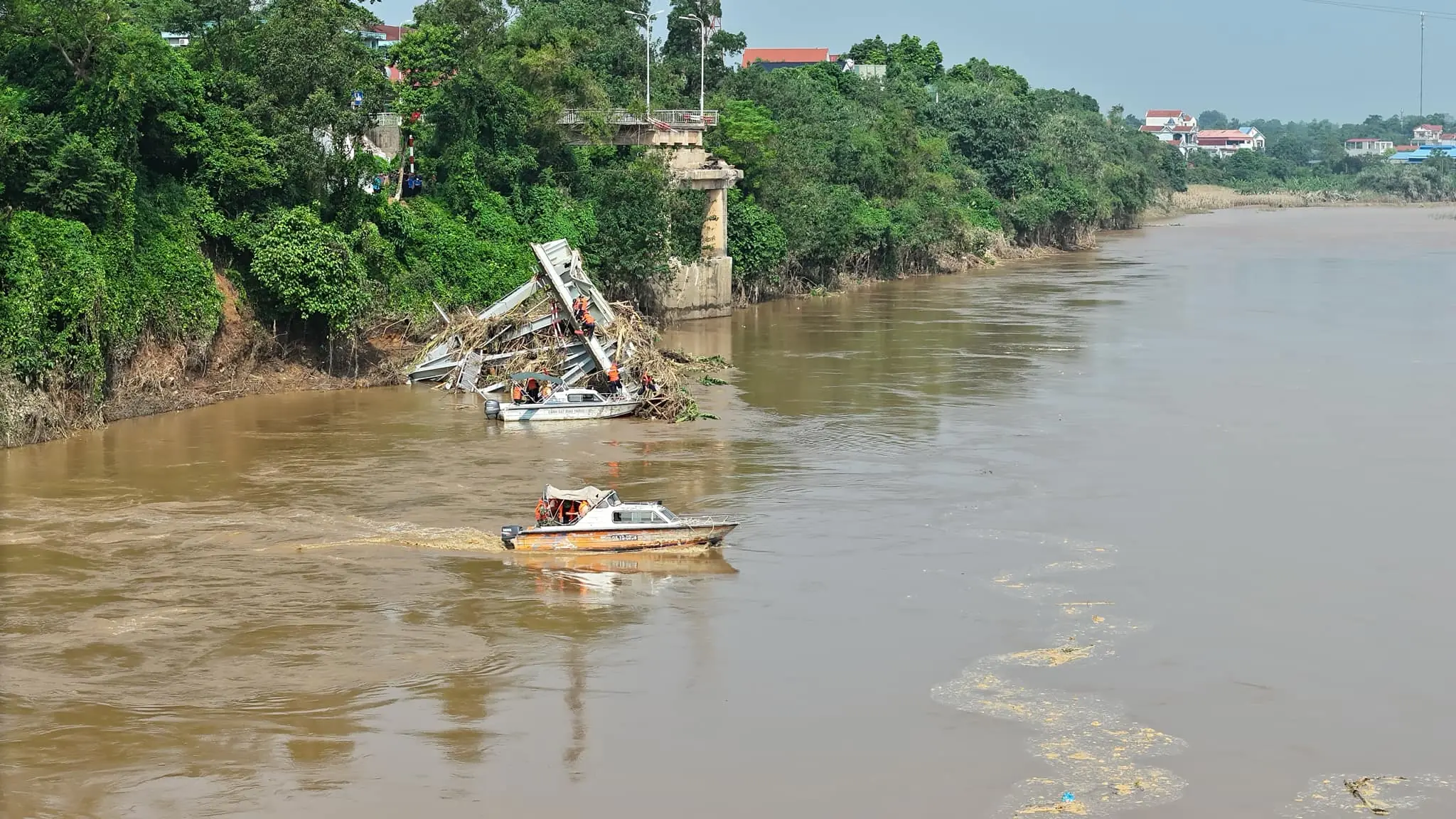
On the morning of September 9, 2024, residents of Phu Tho Province in northern Vietnam witnessed a disaster that would leave an unforgettable mark on their communities. After days of intense rainfall associated with Typhoon Yagi, the Red River had risen dramatically. Its powerful current was carrying enormous amounts of water through the region, placing tremendous pressure on roads, riverbanks, and bridges.
At approximately 10:02 a.m., part of Phong Chau Bridge suddenly collapsed.
The disaster happened so quickly that motorists crossing the structure had little opportunity to react. Two main steel-truss spans fell into the swollen river, taking vehicles and their occupants with them.
The incident immediately triggered an emergency response involving police, military personnel, medical workers, and local authorities.
What had previously been an ordinary morning commute became a desperate search for people who had disappeared beneath the muddy floodwaters.
A vital connection between two districts
Phong Chau Bridge crossed the Red River, also known locally as the Thao River in this area, connecting Lam Thao and Tam Nong districts in Phu Tho Province.
The bridge was an important transportation route for residents, workers, students, and businesses.
For many people, crossing it was part of their everyday routine. Motorcycles traveled across its steel structure alongside cars and commercial vehicles.
The bridge had been inaugurated in 1995 and measured approximately 375 meters in length.
Its importance extended beyond convenience. It helped connect communities on opposite sides of the river and supported the movement of agricultural products, supplies, and other goods.
Because of its strategic position, the collapse created an immediate transportation emergency in addition to the humanitarian crisis.
The terrifying moment of collapse
According to official information released after the disaster, one supporting pier, identified as T7, failed as floodwaters surged beneath the structure.
The failure caused two main bridge spans to collapse.
The enormous steel sections dropped into the river, creating a sudden gap that divided the remaining bridge into disconnected sections.
Initial official reports indicated that ten vehicles were on the bridge when the incident occurred. These included one truck, two tractor-trailer trucks, six motorcycles, and one electric motorcycle.
Three injured survivors were rescued and transported for medical treatment.
Authorities initially identified eight people as missing, although the number of people and vehicles involved was still being reviewed.
The rapidly moving water made it difficult to establish exactly what had happened to everyone who had been crossing the bridge.
xaydungchinhsach.chinhphu.vn+1
Families waited for news
As information spread throughout the province, families began searching for relatives who had not returned home.
Some people were unable to contact loved ones who regularly used the bridge.
Others began visiting hospitals and contacting local authorities to determine whether their relatives had been rescued.
The uncertainty was particularly painful because the river was still dangerously high.
The water was muddy, filled with debris, and moving too quickly for rescuers to search every section safely.
Even experienced emergency personnel faced considerable challenges.
The disaster also attracted national attention, with government leaders directing emergency agencies to coordinate search operations and assist affected families.
A disaster that changed an ordinary journey
One of the most disturbing aspects of the Phong Chau Bridge collapse was how quickly a familiar journey became life-threatening.
People who had crossed the bridge countless times could never have expected that an ordinary trip would end in such a catastrophe.
The incident demonstrated how vulnerable transportation infrastructure can become when extreme weather combines with powerful river currents and structural failure.
It also raised difficult questions about how communities can prepare for increasingly severe flooding.
For the residents of Phu Tho, the morning of September 9 was not simply another natural disaster headline.
It was the day an important connection disappeared beneath the Red River, leaving families waiting for answers and rescue teams facing an enormous challenge.
Chapter 2: How Typhoon Yagi and Powerful Floodwaters Contributed to the Collapse
To understand why Phong Chau Bridge collapsed, it is necessary to look at the weather conditions that affected northern Vietnam during the days before the incident.
Typhoon Yagi was one of the most destructive storms to strike the region in recent decades.
After making landfall, the storm brought heavy rainfall, damaging winds, widespread flooding, and landslides to several northern provinces.
Even after the storm weakened, its effects continued.
Large quantities of rainwater flowed into rivers and streams, causing water levels to rise rapidly.
The Red River became particularly dangerous as strong currents moved through the region.
The danger of rising river levels
A bridge may appear stable from the road, but its supporting structures are constantly exposed to environmental forces.
During ordinary conditions, river water flows around bridge foundations and supporting piers.
However, severe flooding changes the conditions dramatically.
As water levels rise, currents can become stronger and carry branches, trees, sediment, and other debris.
These materials can strike bridge structures or become trapped around supporting elements.
Fast-moving water can also increase the amount of sediment removed from around bridge foundations.
This process is known as scour.
Scour is a recognized hazard for bridges crossing rivers because the removal of supporting soil can undermine foundations.
It is particularly dangerous during floods when water levels and flow speeds change rapidly.
The failure of supporting pier T7
According to the Vietnamese Government's official report, the collapse of Phong Chau Bridge involved the failure of pier T7.
This failure led to the collapse of two main steel-truss spans.
The exact engineering sequence requires careful investigation, but the official information identified the high water level and strong current associated with Typhoon Yagi as the circumstances surrounding the structural failure.
xaydungchinhsach.chinhphu.vn+1
The distinction is important.
It would be inaccurate to claim that a single factor, such as poor construction or inadequate maintenance, was conclusively responsible without a complete engineering investigation.