ARES: The Machine That Survived the Impossible Test
Deep beneath the surface of the city, hidden behind layers of reinforced concrete and steel, there was a facility that did not appear on any public map.
It was known only by a single designation:
Sector 9.
More than three hundred meters underground, the enormous testing complex stretched through a maze of laboratories, maintenance bays, control rooms, and reinforced firing chambers.
For years, the facility had been developing technologies that were never meant to be demonstrated in public.
And at the center of it all stood a machine that had taken almost a decade to build.
Its name was ARES.
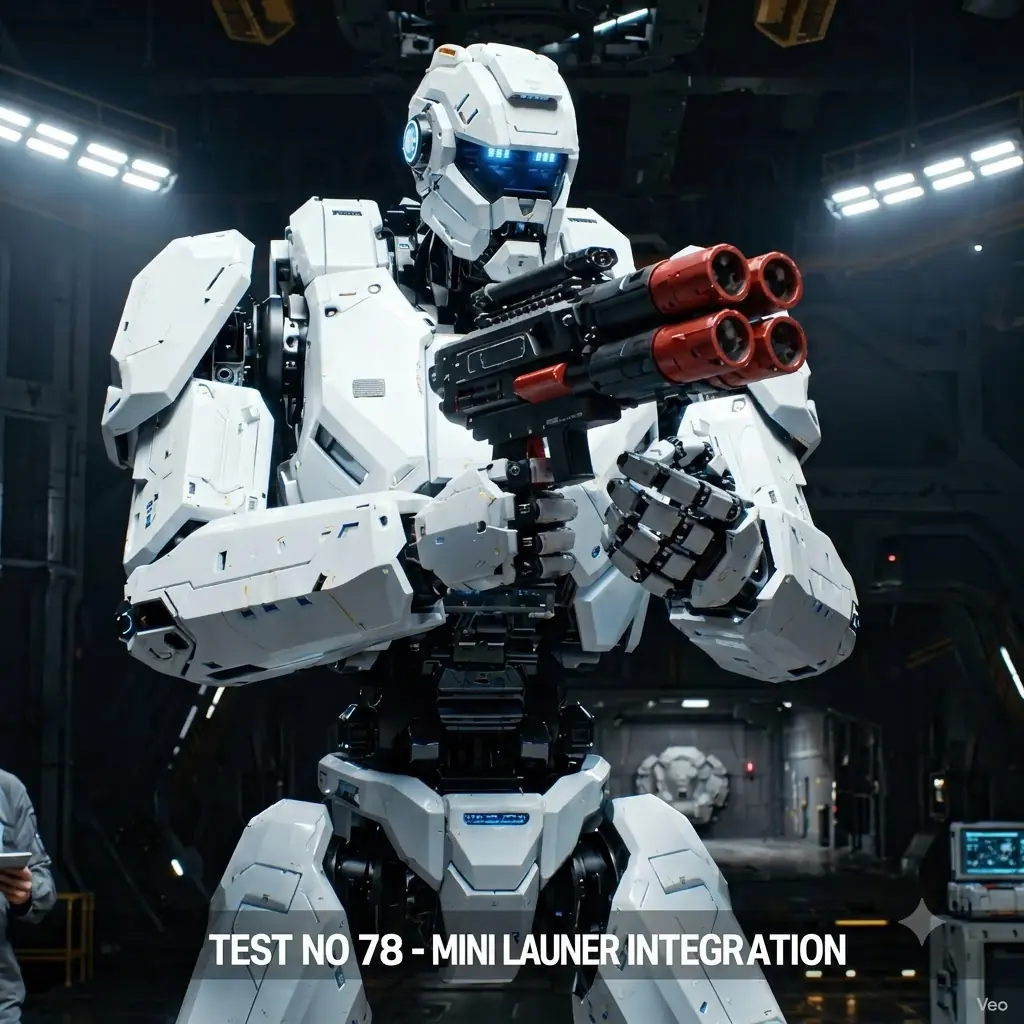
The humanoid combat synthetic stood nearly eight feet tall.
Its body was covered in heavy white armor plating, each section engineered to withstand extreme mechanical stress.
Blue optical sensors glowed beneath its armored head.
Hydraulic systems moved beneath layers of composite protection.
Every joint was reinforced.
Every movement was controlled by thousands of lines of software.
ARES had been designed to operate in environments where ordinary machines—and humans—could not safely function.
But despite all the technology invested in its creation, the machine had never faced the most important challenge.
Its weapons had never been tested together with its full mobility and targeting systems.
That was about to change.
The engineering team had spent months preparing for this day.
The facility was under maximum security.
The firing range had been reinforced.
Remote cameras were positioned behind armored glass.
Emergency systems had been tested repeatedly.
Every engineer had been assigned a specific responsibility.
At the center of the command room stood Dr. Elena Carter, the lead systems engineer.
She had worked on ARES since its earliest prototype.
To Elena, the machine wasn't merely a weapon.
It was the culmination of thousands of engineering decisions, countless failures, and years of work.
She stared at the machine through the observation window.
"Begin live-fire integration."
A technician entered the command.
The enormous hangar came alive.
Warning lights illuminated.
Heavy blast doors locked into place.
A computerized voice announced:
"LIVE-FIRE TESTING AUTHORIZED."
Everyone became silent.
The first test was ready.
TEST 78
Two engineers approached ARES from opposite sides.
They carefully carried a heavy four-barreled tactical weapon toward the machine.
The weapon was designed to deliver enormous firepower while remaining stable under extreme recoil.
But the challenge wasn't simply whether ARES could hold it.
The real question was whether the machine could fire it repeatedly without losing balance or targeting accuracy.
One engineer looked toward Elena.
"Weapon secured."
Elena nodded.
"Begin synchronization."
The engineer activated the weapon interface.
ARES's blue optics brightened.
A low mechanical hum echoed through the hangar.
Inside the machine, hundreds of servos activated simultaneously.
Its right arm slowly moved forward.
The mechanical hand opened.
Then closed around the weapon.
Click.
The locking mechanism engaged.
The engineers stepped back.
"Weapon connection confirmed."
ARES raised the weapon.
Its movements were almost unnaturally smooth.
The targeting system scanned the firing range.
Distance.
Angle.
Wind resistance.
Target position.
Everything was calculated within fractions of a second.
Elena watched the monitoring screens.
"Target acquisition?"
"Confirmed."
"Stability?"
"Nominal."
"Fire."
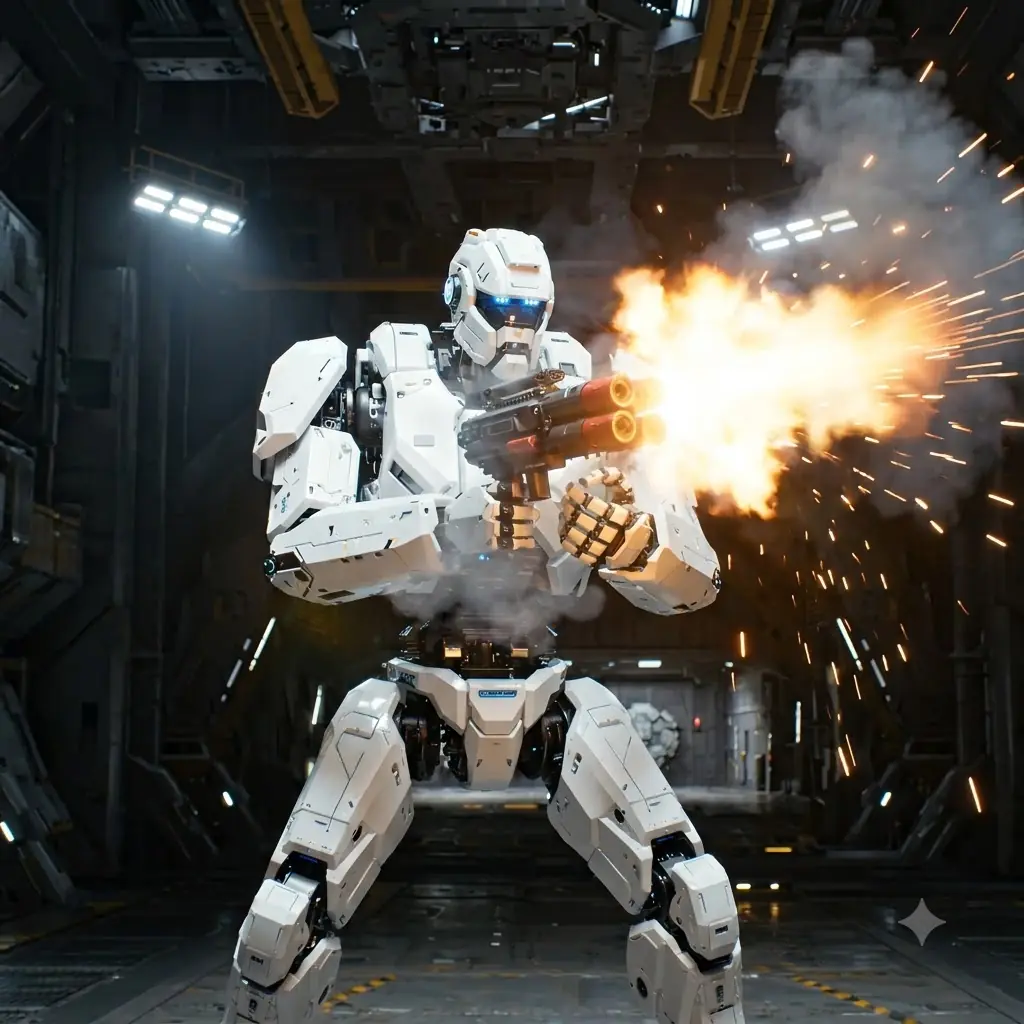
ARES pulled the trigger.
The hangar erupted.
A blinding series of flashes burst from the weapon.
The sound was deafening.
The machine fired rapidly toward the distant armored target.
Smoke filled the firing lane.
The recoil shook the floor.
Yet ARES barely moved.
Its feet remained firmly planted.
Its torso absorbed the force.
Its targeting system compensated automatically for every shot.
The weapon finally stopped.
Silence returned.
For several seconds, nobody spoke.
Then a technician looked at his monitor.
"All rounds accounted for."
Another engineer checked the structural sensors.
"No abnormal stress."
Elena looked at the targeting data.
"Accuracy?"
The technician smiled.
"Within two percent of the projected tolerance."
A few engineers exchanged relieved glances.
Test 78 had succeeded.
But Elena didn't celebrate.
She knew what came next.
She looked toward the second weapon.
TEST 79
The experimental Mini Launcher sat inside a reinforced transport cradle.
It looked nothing like the previous weapon.
Its body was larger.
Heavier.
More complex.
Its outer shell was coated in dark metallic material with glowing red indicators running along its surface.
The launcher had been designed as an experimental heavy-output system.
And it had never been fired from a humanoid platform before.
The weapon had produced unpredictable recoil during earlier stationary tests.
That was why some members of the engineering team had privately questioned whether ARES could handle it.
One engineer approached Elena.
"Doctor, should we really proceed?"
Elena looked through the glass at ARES.
"That's why we're here."
"The recoil simulations are still showing elevated stress."
"I know."
"If something goes wrong..."
Elena didn't answer immediately.
She understood the risk.
A failure could damage the machine.
A catastrophic failure could destroy part of the testing chamber.
But the purpose of the test was not to prove that ARES could perform under easy conditions.
It was to discover its limits.
"Proceed with Test 79."
The heavy launcher was moved into position.
Two engineers carefully guided it toward ARES.
The machine lowered its arms.
Its hands opened.
Then closed around the weapon.
The locking system engaged.
CLACK.
The launcher became part of ARES's combat platform.
Immediately, the machine's internal systems began recalibrating.
Its blue optics focused on the distant blast shield.
Target distance was calculated.
Trajectory was established.
Wind conditions were analyzed.
Structural load was redistributed across the machine's legs.
Inside the control room, dozens of graphs appeared on the monitors.
One engineer whispered:
"Recoil prediction is higher than Test 78."
Elena nodded.
"Keep monitoring the hip and shoulder assemblies."
"Understood."
The entire hangar fell silent.
ARES raised the launcher.
The machine's posture changed.
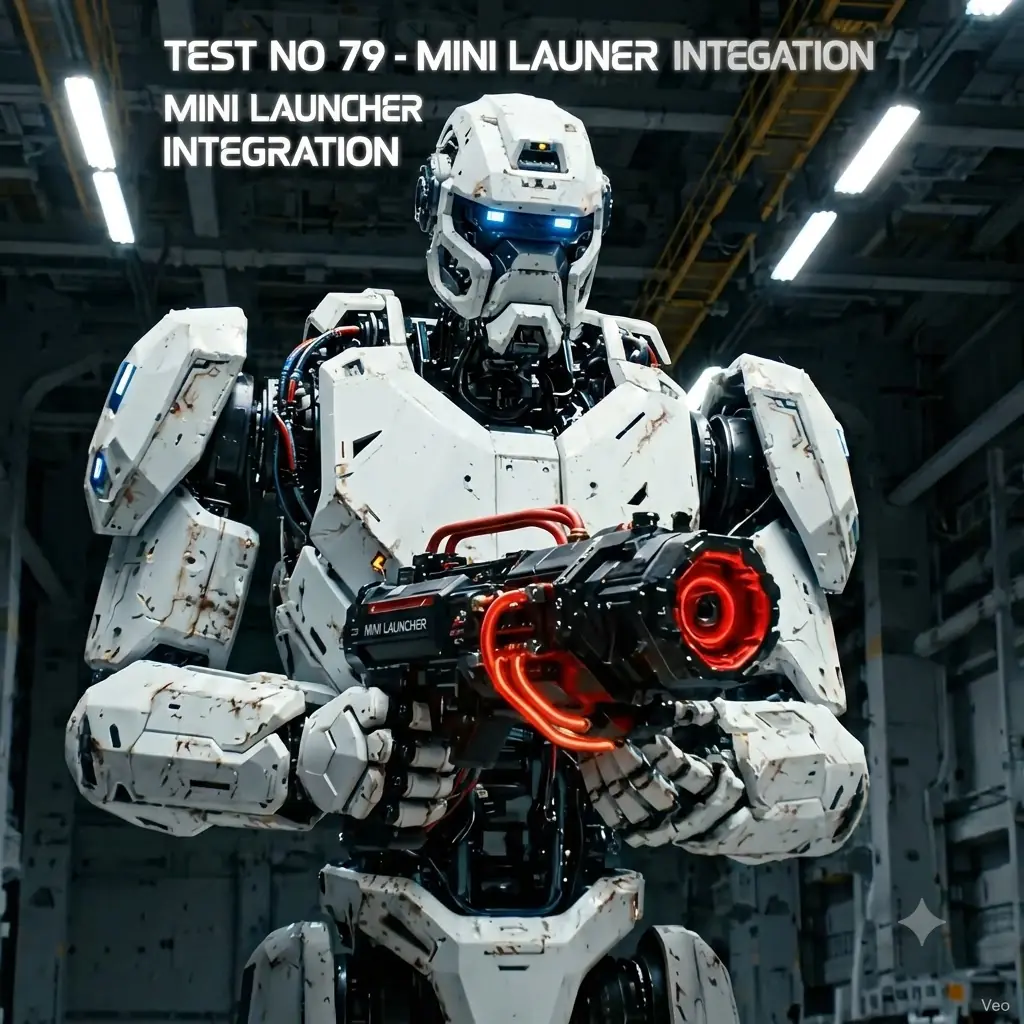
Its feet moved slightly farther apart.
Its knees bent.
Its torso leaned forward by several degrees.
The engineers realized what it was doing.
ARES wasn't simply holding the weapon.
It was preparing its entire body to absorb the force.
Elena watched the data.
"Target lock."
"Confirmed."
"System synchronization."
"Complete."
"Fire."
For one fraction of a second, nothing happened.
Then—
BOOM.
A massive flash erupted from the launcher.
A violent wave of pressure swept through the firing chamber.
The floor shook.
The observation windows vibrated.
A cloud of thick white smoke exploded outward.
The orange glow illuminated the entire hangar.
Several engineers instinctively stepped backward.
Warning alarms briefly sounded.
Elena grabbed the edge of the console.
"Status!"
The room erupted with voices.
"Shoulder assembly stable!"
"Hip actuators stable!"
"Targeting system still online!"
"Thermal load rising!"
"Structural integrity?"
A technician stared at his screen.
"Still green!"
Elena's eyes remained fixed on the firing range.
Through the smoke, nothing could be seen.
For several seconds, there was only silence.
Then a blue light appeared inside the haze.
One optical sensor.
Then another.
ARES slowly emerged from the smoke.
It was still standing.
Its white armor was covered with a thin layer of dust and residue.
The experimental launcher was still locked firmly in its hands.
The machine slowly lowered the weapon.
A technician stared at the monitoring screen.
"Firing one..."
He paused.
His eyes widened.
"Trajectory stable."
Nobody moved.
The technician checked the data again.
"Impact confirmed."
Another engineer shouted:
"Structural integrity?"
The technician looked at the numbers.
"One hundred percent within operational limits."
A wave of relief swept through the control room.
Someone laughed nervously.
Another engineer leaned back in his chair.
Elena finally allowed herself to smile.
"Test 79?"
The technician looked up.
"Complete success."
The room erupted in applause.
Years of development had led to this moment.
ARES had passed both tests.
But Elena wasn't looking at the weapon.
She was looking at the machine itself.
For years, people had called ARES a prototype.
A project.
A weapons platform.
A machine.
But standing there in the smoke, surrounded by engineers who had dedicated years of their lives to its creation, ARES represented something more complicated.
It represented the boundary between human engineering and autonomous machinery.
The team had built it to respond faster than a human.
To calculate more accurately.
To withstand forces that could injure or kill a person.
And now they had proven that it could carry those capabilities into an integrated system.
One engineer walked toward Elena.
"Doctor."
She looked at him.
"We actually did it."
Elena nodded.
"Yes."
He looked through the observation window.
"What happens now?"
Elena remained silent for several seconds.
Then she answered:
"Now we find out what it can do without us."
The engineer frowned.
"Is that the next phase?"
Elena nodded.
"It has always been the next phase."
She looked at ARES.
The machine stood motionless in the center of the hangar.
Its blue optics remained illuminated.
Waiting.
Listening.
Processing.
The engineers had designed every component.
They had written every line of code.
They had tested every system.
But as the final smoke disappeared from the firing range, Elena realized something that made her both proud and uneasy.
The greatest achievement wasn't that ARES had survived the most powerful test.
It was that the machine had reached a point where its creators could no longer think of it as merely a collection of parts.
It had become a complete system.
A machine capable of seeing.
Calculating.
Reacting.
And adapting.
The lights slowly returned to normal.
The warning signs switched off.
The blast doors began to open.
The engineers gathered around their monitors, already discussing the data from the test.
But ARES remained in the center of the hangar.
Silent.
Motionless.
Its blue optics glowing against the darkness.
And somewhere inside the machine, millions of calculations continued running.
The engineers had spent years asking one question:
Could ARES survive the impossible?
That day, they finally had their answer.
Yes.
But the next question was far more important.
What would happen when the machine was finally asked to make a decision on its own?
That question would define the next chapter of the ARES project.
And perhaps, the future of robotic technology itself.