Have you ever looked closely in the mirror and noticed tiny white or pale bumps around your eyelids, under your eyes, or near the corners of your eyes? They may be so small that you barely notice them at first. Because they are close to such a sensitive area, however, it is natural to wonder whether they are caused by a skin problem, an infection, or something more serious.
The good news is that many small bumps around the eyes are harmless. One of the most common causes is milia, tiny keratin-filled cysts that can develop when dead skin cells become trapped beneath the surface. But milia are not the only possibility. Similar-looking bumps can have several different causes, and their appearance, location, texture, and symptoms can provide useful clues.
Here are some of the most common possibilities—and when it may be worth having them checked.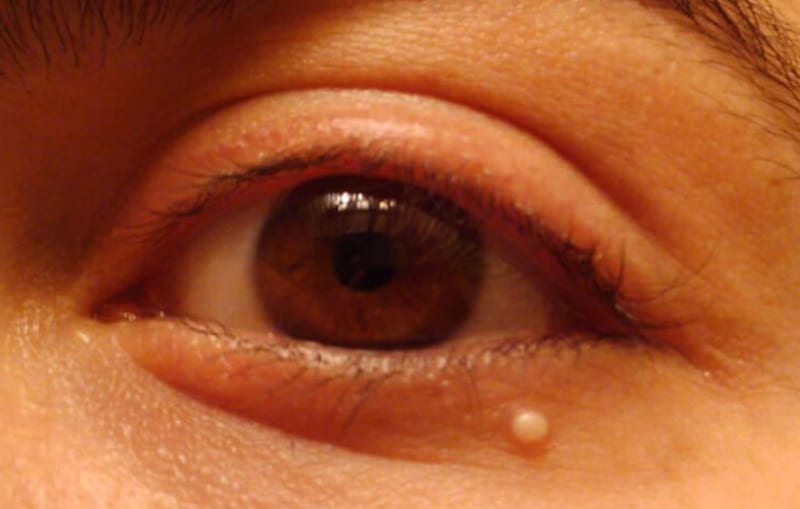
1. Milia: One of the Most Common Causes
When people notice small, firm, white bumps around the eyes, milia are often one of the first possibilities.
Milia are tiny cysts filled with keratin, a protein naturally found in the skin. They commonly appear on the cheeks, nose, forehead, and especially around the delicate skin of the eyelids and under-eye area.
They usually look like:
-
Tiny white or pearly bumps
-
Firm, rather than soft
-
Smooth and rounded
-
Usually painless
-
Not surrounded by significant redness or swelling
Unlike acne, milia generally do not have the same type of pore blockage or inflammation, so trying to squeeze them usually does not work.
Milia can occur in people of any age. In adults, they may develop spontaneously or after certain types of skin irritation or injury.
2. Xanthelasma and Cholesterol Deposits
Another possibility is xanthelasma, which looks somewhat different from typical milia.
Xanthelasma consists of yellowish deposits containing lipids that usually develop around the eyelids, particularly near the inner corners.
They may appear as:
-
Yellow or yellow-white patches
-
Slightly raised areas
-
Soft or somewhat flat deposits
-
Lesions that gradually become more noticeable
Xanthelasma can sometimes be associated with abnormal blood lipid levels, including elevated cholesterol. However, having xanthelasma does not automatically mean that a person has high cholesterol, and people with normal lipid levels can also develop it.
If you notice persistent yellowish deposits around your eyelids, discussing them with a healthcare professional may be worthwhile. A clinician may recommend a cholesterol or lipid panel depending on your medical history and risk factors.
3. A Stye May Start as a Small Bump
A stye, medically known as a hordeolum, is an inflamed blockage involving an eyelid gland.
Unlike milia, a stye is often associated with inflammation.
You may notice:
-
Redness
-
Tenderness or pain
-
Swelling
-
A bump along the eyelid margin
-
Sometimes a small white or yellow point
Styes can be uncomfortable but often improve on their own.
A warm, clean compress applied gently to the closed eyelid for several minutes at a time can help encourage drainage and relieve discomfort.
However, do not squeeze or pop a stye. Doing so can worsen inflammation or potentially spread infection.
4. Chalazion: A Firm Eyelid Lump
A chalazion can resemble a stye but is caused by a different process.
It occurs when an oil-producing gland in the eyelid becomes blocked. A chalazion often develops as a firm, rounded lump within the eyelid.
Unlike a stye, it may not be particularly painful.
Some people notice:
-
A firm eyelid lump
-
Mild swelling
-
Little or no redness
-
A sensation of pressure around the eye
-
Occasionally blurred vision if the lump becomes large enough to press against the eye
Warm compresses and gentle eyelid hygiene are often recommended initially, but persistent or large chalazia may require evaluation by an eye-care professional.
5. Syringomas Can Look Like Tiny White or Skin-Colored Bumps
Syringomas are benign growths involving sweat glands. They commonly appear around the lower eyelids and can be mistaken for milia.
They tend to be:
-
Very small
-
Flesh-colored, yellowish, or slightly whitish
-
Firm
-
Usually painless
-
Present in groups or clusters
Syringomas are generally harmless. However, because several eyelid conditions can look similar, a dermatologist or ophthalmologist may need to examine persistent bumps to determine exactly what they are.
6. Blocked or Enlarged Oil Glands
The skin around the eyes contains numerous tiny glands that help maintain the tear film and protect the skin.
When these glands become blocked or enlarged, small bumps can sometimes appear.
They may not look perfectly white. Instead, they can appear yellowish, skin-colored, or slightly raised.
People with chronic eyelid irritation or conditions affecting the oil glands may be more prone to these changes.
Maintaining gentle eyelid hygiene can help, but aggressive scrubbing is not recommended because the skin around the eyes is extremely delicate.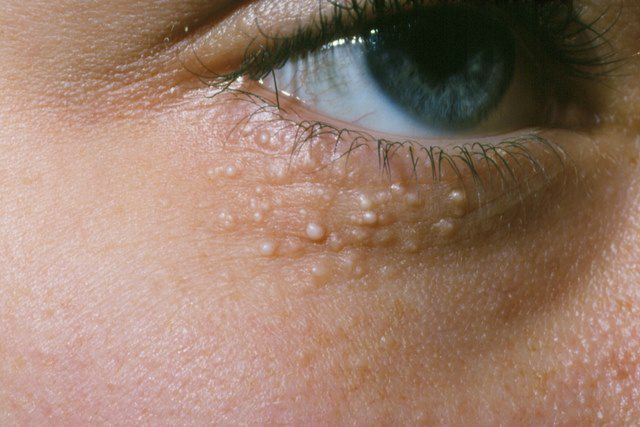
7. Sebaceous Hyperplasia
Sebaceous hyperplasia occurs when oil-producing sebaceous glands become enlarged.
It is more commonly seen elsewhere on the face, but similar small bumps can occasionally occur around the eye area.
They may appear as:
-
Small yellowish or skin-colored bumps
-
Smooth, rounded lesions
-
Painless growths
-
A tiny central depression in some cases
They are generally benign, but any new or changing growth around the eye should be assessed if its appearance is unusual or concerning.
8. Not Every White Bump Is a Skin Condition
Sometimes what appears to be a small white bump is actually something different.
For example, a person may mistake:
-
A tiny cyst for a whitehead
-
A blocked gland for milia
-
A yellowish cholesterol deposit for a skin-colored bump
-
An eyelid lesion for a spot on the surface of the eye
The exact location matters.
A white spot on the eyeball itself is different from a bump located on the eyelid or surrounding skin and may require prompt ophthalmic evaluation, particularly if it is associated with pain, redness, light sensitivity, or changes in vision.
Why You Shouldn't Try to Pop Them
One of the biggest mistakes people make with bumps around the eyes is trying to remove them at home.
The skin in this area is thin and delicate, and the eye itself is vulnerable to injury.
Squeezing or puncturing a bump can cause:
-
Skin damage
-
Bleeding
-
Infection
-
Inflammation
-
Scarring
-
Swelling around the eye
Even if the bump looks exactly like a pimple, it may not actually be one.
This is particularly important with milia, which often require professional extraction if removal is desired. A trained professional can use appropriate sterile techniques rather than forcing the cyst through the skin.
Can Skincare Products Cause These Bumps?
Sometimes, the products applied around the eyes may contribute to irritation or clogged pores.
Heavy creams, occlusive products, makeup, sunscreen, or other cosmetics may not be the direct cause of every eyelid bump, but they can sometimes contribute to irritation or changes in the skin.
If you frequently develop bumps around your eyes, consider keeping your routine simple:
Use gentle cleansers, avoid aggressive exfoliation around the eyes, remove makeup thoroughly, and avoid applying irritating products too close to the eyelid margin.
That does not mean you need to stop moisturizing altogether. The goal is to use products appropriate for the sensitive eye area rather than repeatedly experimenting with harsh treatments.
When Should You See a Doctor?
Most tiny, stable, painless bumps are not emergencies. Nevertheless, professional evaluation is appropriate if you are uncertain about what you are seeing.
Consider seeing a dermatologist or eye-care professional if a bump:
-
Continues to grow
-
Keeps returning
-
Becomes painful
-
Becomes significantly red or swollen
-
Bleeds or develops an ulcer
-
Changes in appearance
-
Causes persistent irritation
-
Affects your vision
-
Is associated with loss of eyelashes
-
Does not improve as expected
A clinician can examine the lesion and determine whether it is something simple, such as milia, or whether further testing or treatment is appropriate.
Seek Urgent Care for Serious Eye Symptoms
Some symptoms around the eyes should not simply be watched at home.
Seek urgent medical attention if you develop sudden vision loss, severe eye pain, rapidly worsening swelling, significant redness with fever, double vision, or pain when moving the eye.
These symptoms can indicate problems that are different from an ordinary skin bump and may require prompt treatment.
What Can You Do at Home?
If the bumps are tiny, painless, and stable, gentle care is usually the safest approach.
Try to:
Keep the area clean. Wash your face gently without scrubbing the eyelids.
Remove makeup before bed. Leaving cosmetics on overnight may contribute to irritation and clogged pores.
Avoid squeezing. Even small bumps can become infected or irritated when manipulated.
Use warm compresses when appropriate. A warm compress can be helpful for certain blocked eyelid glands, particularly when a stye or chalazion is suspected.
Avoid harsh acids or strong acne treatments near the eyes. Products containing powerful exfoliating ingredients can irritate the delicate eyelid area if used incorrectly.
Don't scrape or puncture the bump yourself. Professional removal is safer when treatment is actually needed.
The Appearance Can Offer Important Clues
Although many conditions can look similar, some general differences can be helpful.
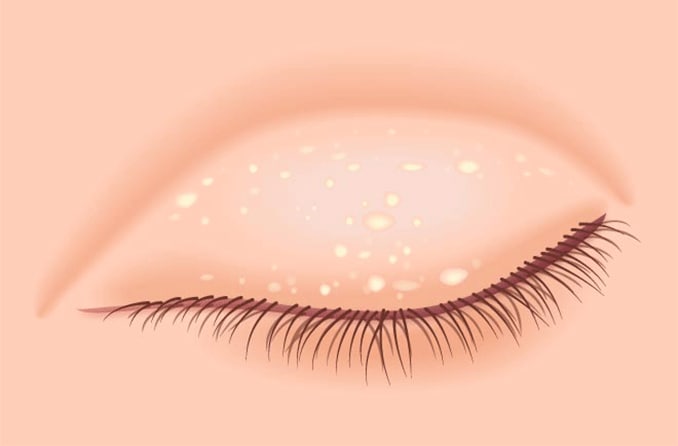
Tiny, hard, pearly-white bumps are often consistent with milia.
Yellowish, flatter deposits near the inner eyelids may be xanthelasma.
A red, painful bump along the eyelid margin may be a stye.
A firm lump within the eyelid with little pain may be a chalazion.
Multiple tiny, flesh-colored bumps around the eyelids can occur with conditions such as syringomas.
These descriptions are only clues, not a diagnosis. A healthcare professional should make the diagnosis when the appearance is uncertain.
The Bottom Line
Small white bumps around your eyes can be surprisingly noticeable, but they are often caused by harmless conditions such as milia or blocked eyelid glands. Other possibilities include xanthelasma, syringomas, styes, chalazia, and other benign skin changes.
The most important thing is not to assume every bump is acne and try to pop it. The skin surrounding your eyes is particularly delicate, and unnecessary manipulation can create a problem that was not there before.
Pay attention to changes in size, color, pain, redness, bleeding, or vision. If a bump persists, changes, or causes symptoms, having it examined by a dermatologist or eye-care professional is the safest way to find out what it really is.
Sometimes, a tiny white bump is simply a harmless skin cyst. But when something around your eyes looks new or unusual, knowing when to leave it alone and when to have it checked is far more important than trying to remove it yourself.