
A Stroke Can Happen at Any Age - 5 Warning Signs Young People Should Know
Str0ke Can Strike Young People Too - 5 Warning Signs That Demand Attention
⏱️ 1 min read 18/08/2026 16:15
Falling asleep sounds simple until you're lying in bed at midnight with a racing mind, tense muscles, and a clock that seems to get louder every minute.
You close your eyes and tell yourself, "I need to sleep now."
Instead, your brain becomes even more active.
You start thinking about tomorrow's schedule, replaying conversations from the day, worrying about work, or calculating how many hours of sleep you have left.
This is where the so-called military sleep method has gained attention.
The technique is often described online as a method developed to help soldiers relax and fall asleep quickly, sometimes with claims that it can help a person fall asleep in as little as two minutes.
However, it's important to keep expectations realistic. There is limited scientific evidence that this exact "military method" reliably puts everyone to sleep within two minutes. The individual relaxation techniques involved—such as controlled breathing, progressive muscle relaxation, and mental imagery—are much more consistent with established approaches for reducing physical and mental arousal.
So, rather than thinking of it as a guaranteed two-minute sleep trick, it may be more useful to view it as a structured relaxation routine.
Here's how it works.
The military sleep method is a sequence designed to help your body and mind transition from an alert state into a relaxed state.
The commonly described routine involves:
Relaxing the face
Dropping and relaxing the shoulders
Relaxing the arms and hands
Slowly relaxing the legs
Breathing calmly
Clearing or calming the mind
Using a peaceful mental image
The basic idea is simple:
Instead of trying harder to fall asleep, you deliberately remove sources of physical and mental tension.
This is important because sleep isn't something you can force through willpower.
The harder you tell yourself that you must fall asleep immediately, the more alert you may become.
Start by getting into your normal sleeping position.
You don't need a special mattress, pillow, or posture.
The goal is simply to become comfortable enough that you don't need to keep adjusting your body.
Once you're settled, allow yourself to stop worrying about getting the technique "perfect."
This isn't a competition.
If your body naturally prefers sleeping on its side, don't force yourself to lie flat on your back just because a particular version of the technique describes it that way.
Comfort matters.
Begin with your face.
Close your eyes naturally and consciously release tension from your forehead.
Let your eyebrows soften.
Relax the muscles around your eyes.
Unclench your jaw.
Let your tongue rest comfortably rather than pressing it against the roof of your mouth.
Relax your lips.
Many people don't realize how much tension they carry in their face during the day.
You may even notice that you're unconsciously clenching your jaw.
Don't force your face into a particular position.
Simply allow the muscles to become loose.
Take a slow, comfortable breath.
Then let it out gently.
Next, focus on your shoulders.
Stress often causes people to unconsciously raise or tense their shoulders.
Imagine your shoulders becoming heavy and sinking into the mattress.
You don't need to push them downward.
Just stop holding them up.
Allow the muscles around your neck and shoulders to soften.
If you notice tension, don't become frustrated.
Simply acknowledge it and relax again.
This is one of the central principles of relaxation techniques:
You don't need to fight tension. You simply notice it and release it.
Move your attention down your arms.
Start with your upper arms.
Then your elbows.
Then your forearms.
Finally, focus on your hands and fingers.
Let your hands become completely relaxed.
If your fingers are curled tightly, allow them to loosen naturally.
You can imagine your arms becoming heavy against the mattress.
At this point, you may already notice that your breathing has slowed slightly.
That's a good sign.
But don't worry if you don't feel dramatically different.
Relaxation can happen gradually.
Now move your attention toward your lower body.
Relax your thighs.
Then your knees.
Your calves.
Your ankles.
And finally your feet and toes.
Imagine your legs becoming heavy and supported by the bed.
Don't actively tense and release every muscle unless that feels helpful.
The goal is simply to become aware of each part of your body and let unnecessary tension go.
This technique resembles progressive muscle relaxation, a well-established relaxation strategy used to reduce physical tension.
Once your body is relaxed, bring your attention to your breathing.
Take slow, comfortable breaths.
There is no need to take extremely deep breaths or hold your breath for long periods.
A simple pattern is:
Breathe in gently.
Breathe out slowly.
Then repeat.
Try to make the exhalation comfortable and unforced.
Some people find that focusing on a slightly longer exhalation helps them feel calmer.
But the most important thing is comfort.
If you feel dizzy or uncomfortable, return to your normal breathing.
This is often the hardest part.
Your body may be relaxed while your brain is still thinking about everything.
You might suddenly remember an email you forgot to send.
Then you think about tomorrow's meeting.
Then you remember something embarrassing from five years ago.
Then you start calculating how little sleep you're going to get.
This is completely normal.
The goal isn't to force your mind to become completely empty.
Instead, gently redirect your attention away from stimulating thoughts.
One commonly described version of the military technique uses a simple mental image.
For example, imagine yourself lying comfortably in a peaceful environment.
You could picture:
A quiet beach
A calm forest
A dark, comfortable bedroom
Floating gently on calm water
Lying beneath a clear night sky
Choose something that feels peaceful rather than exciting.
The more detailed and emotionally engaging the image becomes, the more likely it is to turn into another active thought.
Keep it simple.
Don't get frustrated.
This is one of the biggest mistakes people make when trying relaxation techniques.
They think:
"I'm doing this wrong because I'm still thinking."
But thinking is what the brain does.
Instead of fighting thoughts, notice them and gently return your attention to your breathing or mental image.
You may have to do this dozens of times.
That's okay.
Each time you return your attention, you're practicing the skill.
The military sleep method isn't magic.
Its potential benefit comes from combining several principles used in relaxation and sleep research.
Physical tension can make it harder to settle into sleep.
Relaxing the face, shoulders, arms, and legs may reduce that tension.
Focusing attention on breathing or a simple mental image can reduce the tendency to continuously analyze the day's problems.
Repeating the same sequence every night can create a consistent signal that it's time to wind down.
Perhaps most importantly, the technique encourages you to relax rather than force sleep.
That distinction can matter.
You may have seen headlines claiming that the military method can make anyone fall asleep in less than two minutes.
That claim should be treated cautiously.
There isn't strong scientific evidence demonstrating that this specific routine reliably puts the average person to sleep within exactly two minutes.
Sleep onset varies considerably between individuals.
Some people fall asleep quickly.
Others naturally need more time.
Stress, caffeine, pain, medications, sleep schedules, medical conditions, and the sleep environment can all influence how quickly someone falls asleep.
So don't lie in bed watching the clock and thinking:
"It's been two minutes. Why am I still awake?"
That defeats the purpose.
The goal is relaxation, not a stopwatch.
Clock-watching can increase sleep anxiety.
You look at 11:45 p.m.
Then 12:10 a.m.
Then 12:35 a.m.
Now you're calculating how many hours remain before your alarm.
That mental calculation can make you even more alert.
If possible, keep the clock out of your direct line of sight.
Let your body follow its normal sleep process rather than constantly evaluating your progress.
Relaxation techniques work better when you aren't simultaneously stimulating your nervous system.
Caffeine can remain active in the body for several hours.
Coffee isn't the only source.
Caffeine can also be found in:
Tea
Energy drinks
Cola
Chocolate
Pre-workout products
Some medications
If you struggle with falling asleep, consider reducing caffeine later in the day.
Individual sensitivity varies, so some people may need to stop caffeine earlier than others.
One of the biggest obstacles to falling asleep is the smartphone sitting next to your pillow.
Scrolling through social media can keep your brain engaged.
Notifications can trigger curiosity.
Emotionally intense videos or conversations can increase alertness.
Bright light from screens can also interfere with the body's normal preparation for sleep.
You don't necessarily need to eliminate screens completely.
But creating a period of lower stimulation before bedtime can make it easier to transition into sleep.
Your environment matters.
A bedroom that is too hot, noisy, bright, or uncomfortable can interfere with sleep.
Consider keeping the room:
Cool enough to be comfortable
Dark
Quiet
Comfortable
Free from unnecessary distractions
If outside noise is unavoidable, white noise or another consistent background sound may help some people.
Eating a huge meal immediately before bed can make some people uncomfortable.
It may also worsen reflux in susceptible individuals.
That doesn't mean you need to go to bed hungry.
A light snack may be perfectly reasonable if you're genuinely hungry.
The goal is simply to avoid a pattern that consistently leaves you uncomfortable when you lie down.
The same relaxation principles can be useful if you wake up at 2 or 3 a.m.
Try not to immediately reach for your phone.
Don't start checking emails.
Don't calculate how many hours of sleep remain.
Instead, return to slow breathing and gradually relax different parts of your body.
If you remain awake for a prolonged period and become frustrated, sleep experts often recommend getting out of bed and doing something quiet in dim light until you feel sleepy again.
Then return to bed.
This can help prevent your brain from associating the bed with frustration and wakefulness.
Occasional difficulty falling asleep is normal.
Persistent insomnia is different.
Talk with a healthcare professional if you regularly:
Take a long time to fall asleep
Wake frequently during the night
Wake much earlier than intended
Feel exhausted during the day
Struggle to concentrate
Depend heavily on sleeping medication
Have significant daytime sleepiness
Sleep problems can be caused by stress, anxiety, depression, medications, chronic pain, reflux, sleep apnea, restless legs syndrome, and other conditions.
Treating the underlying problem is often more effective than relying on a relaxation trick alone.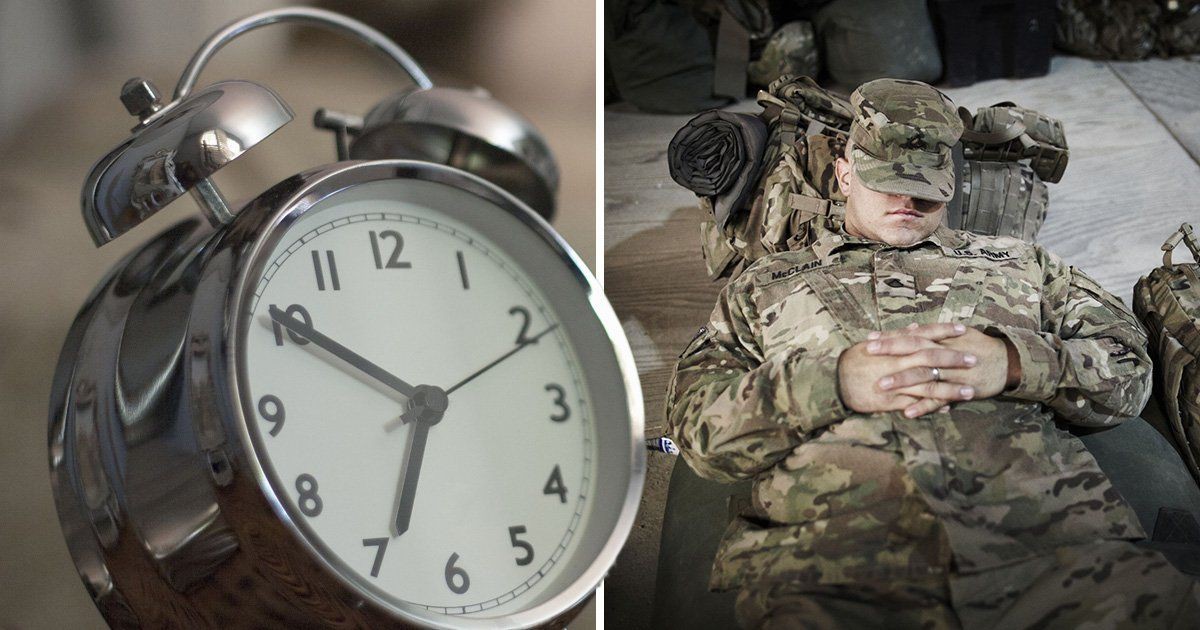
If you snore loudly, gasp during sleep, wake up choking, or experience severe daytime sleepiness, don't assume you simply need a better bedtime routine.
These can be signs of obstructive sleep apnea.
In that situation, the problem isn't simply difficulty relaxing.
Your breathing may be repeatedly disrupted during sleep.
A healthcare professional can determine whether a sleep evaluation is appropriate.
If you want to try the technique, you can turn it into a simple routine:
Step 1: Get comfortable.
Step 2: Relax your forehead, eyes, jaw, and tongue.
Step 3: Let your shoulders become heavy.
Step 4: Relax your arms and hands.
Step 5: Relax your legs and feet.
Step 6: Breathe slowly and comfortably.
Step 7: Imagine a peaceful, simple scene.
Step 8: When thoughts appear, gently return your attention to your breathing.
Do not worry about completing every step perfectly.
Consistency matters more than perfection.
The so-called military sleep method has become popular because it promises something almost everyone wants: the ability to fall asleep quickly, even when the mind refuses to slow down.
But the strongest takeaway isn't the "two-minute" promise.
It's the underlying strategy.
Relax your body. Slow your breathing. Reduce mental stimulation. Stop fighting sleep.
These are sensible principles that can be incorporated into a healthy bedtime routine.
If the technique works for you, great.
If it takes ten, twenty, or thirty minutes rather than two, that doesn't mean you've failed.
And if you consistently struggle to sleep despite practicing good sleep habits, don't simply keep searching for another sleep hack.
Persistent insomnia may be a symptom of an underlying condition that deserves proper evaluation.
Sometimes the best way to sleep faster isn't to force your brain to shut down.
It's to give your body the conditions it needs to naturally let go.
Str0ke Can Strike Young People Too - 5 Warning Signs That Demand Attention
This Cheap Market Staple May Be More Powerful for Your Health Than You Think
Why Sweet Potatoes Deserve a Place on Your Plate?
Why Do You Drool While Sleeping? The Possible Reasons May Surprise You
5 Situations When Taking a Bath May Be Riskier Than You Think
Think These 3 Foods Are Harmless Together? Here’s What Experts Say
Don’t Ignore Excessive Yawning: It Could Have Several Causes
Stomach Can.cer: 7 Warning Signs You Shouldn’t Ignore
Many people frequently dismiss nighttime leg cramps as a sign of overexertion or dehydration. While occasional muscle cramps are usually harmless, frequent or severe episodes can point to underlying health issues. Understanding why these cramps occur is t
These Subtle Signs May Mean Your Bl00d Sugar Is Out of Control
After Can.cer Treatment: 7 Simple Habits Worth Making Part of Your Routine

These 6 Beloved Foods Could Be Affecting Your Kidneys Without You Realizing It

10 Natural Ways to Help Relieve Chest and Throat Mucus

Don’t Ignore These 8 Symptoms That Keep Appearing After You Eat


Want Better Heart Health? Add More of This Vegetable to Your Meals

Sleep on Your Left Side? Here’s How It May Affect Your Health

Eat These 7 Foods in the Morning for Better Digestion and Gut Health

Don’t Overlook These 10 Foods That May Support Your Body’s Natural Can.cer Defenses
When his 13-year-old daughter Mia is kidnapped, an intimidating motorcycle mechanic risks everything to save her.
A stoic stranger with a dark past sacrifices everything to save a young girl’s mother, only to uncover a miraculous connection to his own lost sister.
Str0ke Can Strike Young People Too - 5 Warning Signs That Demand Attention
NEVER JUDGE SOMEONE BY THEIR JOB, AGE, OR APPEARANCE.
This Cheap Market Staple May Be More Powerful for Your Health Than You Think
Why Sweet Potatoes Deserve a Place on Your Plate?
Why Do You Drool While Sleeping? The Possible Reasons May Surprise You
5 Situations When Taking a Bath May Be Riskier Than You Think
Think These 3 Foods Are Harmless Together? Here’s What Experts Say
Don’t Ignore Excessive Yawning: It Could Have Several Causes
NEVER JUDGE STRENGTH BY AGE
NEVER JUDGE A VETERAN BY HIS AGE
Feared by many, Ryder Cole is secretly a lone biker who rescues a fleeing bride on a rainy night.
Stomach Can.cer: 7 Warning Signs You Shouldn’t Ignore
Many people frequently dismiss nighttime leg cramps as a sign of overexertion or dehydration. While occasional muscle cramps are usually harmless, frequent or severe episodes can point to underlying health issues. Understanding why these cramps occur is t
Never lose hope. Your darkest moment does not have to be the end of your story