That mixture of familiar imagery and impossible science has long been a useful tool in horror.
A laboratory can look clean and orderly while the activity inside it is morally horrifying. A doctor can speak calmly while describing something cruel. A scientific objective can sound impressive even when the methods used to pursue it are unacceptable.
The movie's underlying warning is that technical knowledge does not automatically make someone ethical.
Scientific progress requires responsibility, consent, and respect for human life. Without those principles, the language of research can be used to disguise exploitation.
The Zombie Element: What Happens to the Victims?
Evil Town is often described as a zombie horror film, but its zombie-like figures are connected to the scientist's experiments rather than a conventional supernatural outbreak.
The distinction is important.
In many zombie films, the central fear is that the dead return to life or that an infection spreads through a population. The threat expands as more people become infected, and survivors must find a way to escape or stop the outbreak.
In Evil Town, the altered victims are part of the medical scheme itself.
The experiment is designed to obtain material for the scientist's search for youth. The process leaves the donors in a condition that makes them appear mindless and physically transformed.
This gives the film a disturbing reversal.
The residents want to avoid becoming weak or helpless, yet their method creates helpless victims. The people who are supposed to benefit from the research are protected by a system that destroys the people used to supply it.
The zombie imagery therefore reinforces the movie's larger theme: the pursuit of personal survival can become monstrous when it depends on stripping others of their humanity.
It also gives the story a visual horror element that differs from the more psychological tension of the town's friendly residents.
The audience sees what the experiment has done. The victims are no longer simply missing people whose fate remains unknown. Their altered condition reveals the physical consequences of the doctor's ambition.
This creates an unsettling question about the meaning of survival.
If a person remains alive but loses their ability to think, communicate, and live independently, has the experiment really preserved what makes life valuable?
The movie does not need to answer that question in a philosophical speech. The images of its victims make the point in a much more direct way.
The Characters at the Center of the Mystery
One of the important figures in the film is Christopher Fuller, played by James Keach.
Christopher is associated with medicine, which gives him a particular position within the story. Unlike visitors who have no connection to medical knowledge, he is better placed to recognize that something is wrong with the town's practices.
His presence also creates a natural conflict with Dr. Schaeffer.
The two characters represent opposing uses of medical knowledge. One is connected to the pursuit of a scientific breakthrough at any cost, while the other becomes part of the resistance to the doctor's scheme.
The conflict is not simply between two individuals with different personalities. It reflects a larger disagreement about what medicine is supposed to accomplish.
A doctor should not treat patients as disposable material. Medical knowledge should be used to reduce suffering, not create it.
Dean Jagger's performance as Dr. Schaeffer gives the film an experienced screen presence at the center of its unusual premise.
Jagger had a long career in film and television, and his appearance in Evil Town became his final film role. His presence connects the movie to an earlier generation of Hollywood performers.
That detail adds a melancholy dimension to the film's history. A production that spent years being reworked ultimately became the last screen appearance of a veteran actor.
The supporting cast includes Robert Walker Jr., Doria Cook-Nelson, Michele Marsh, Lynda Wiesmeier, Christie Houser, Dabbs Greer, Regis Toomey, Lurene Tuttle, Hope Summers, and Richard Hale.
The large ensemble reflects the film's complicated construction. Several groups of characters and storylines are brought together, with the travelers, townspeople, medical figures, and victims all contributing to the atmosphere.
For viewers who enjoy obscure horror cinema, part of the interest lies in recognizing familiar faces from older American film and television productions.
Some performers had careers that extended well beyond this one movie, while others are more closely associated with exploitation and genre cinema.
The film is therefore not only a strange story about a town's search for eternal youth. It is also a snapshot of performers and filmmakers whose careers intersected in an unusually complicated production.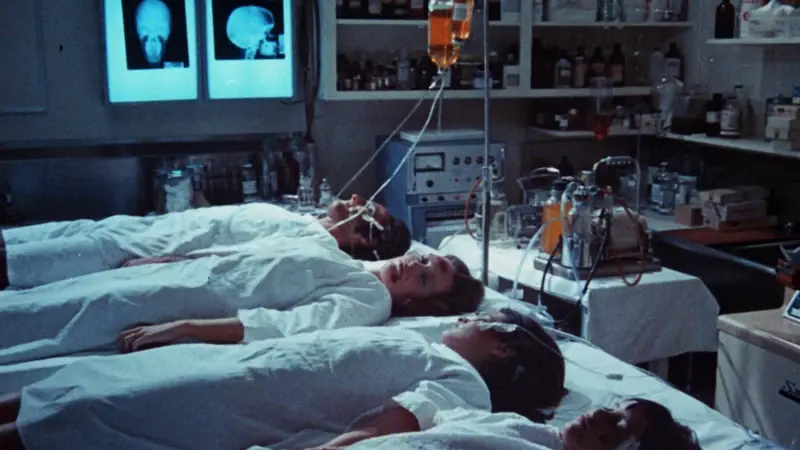
The Extraordinary Production History Behind the Forgotten Film
The story behind Evil Town is almost as unusual as the story on screen.
Although audiences generally associate the film with 1987, its origins go back much further. The project began in the early 1970s, when it was developed under the working title And God Bless Grandma and Grandpa.
The early version was connected to filmmaker Curtis Hanson, who later became known for directing major productions such as L.A. Confidential and Wonder Boys. At the time, however, he was a much younger filmmaker working on a very different kind of project.
The production did not proceed smoothly.
Over the years, the project went through changes in personnel, story, footage, and direction. The title changed, new material was filmed, and the original concept was reshaped several times.
It was eventually associated with the title God Bless Dr. Shagetz, with Dean Jagger appearing as the scientist at the center of the story.
But even that version did not immediately become a finished, widely distributed film.
The project became entangled in production difficulties and legal disputes involving its financing. What might have been a relatively straightforward low-budget horror production turned into a long-running problem that left the film unfinished or unavailable in the form originally intended.
This troubled history is one reason Evil Town stands out among obscure horror releases from the era.
Most films are remembered for their story, performances, or visual style. Evil Town also attracts attention because its production history became an important part of its identity.
A Film That Changed Hands and Changed Shape
By the early 1980s, producer Mardi Rustam had obtained rights to the material.
Rustam decided to reshape the existing production and add new footage. The result was not simply a restoration of the original film. It was a reworked version that combined older material with additional sequences.
The film was edited and restructured under the title Evil Town. Dr. Shagetz became Dr. Schaeffer, and new scenes were added to help create a more complete feature.
This process helps explain why the movie has several directors associated with it.
Curtis Hanson, Larry Spiegel, Peter S. Traynor, and Mardi Rustam are all connected to the film's development or completed version, although their involvement took place at different stages.
It is unusual for a feature film to have so many credited directors, but the production history makes the situation easier to understand. Rather than being created as one continuous project under a single director, Evil Town developed through several stages and creative changes.
The result is a film that feels different from a carefully planned production in which every scene is designed around one consistent vision.
Some parts reflect the earlier material, while others belong to the later additions. The finished movie is therefore a patchwork of different creative periods.
That unusual construction is not necessarily a strength from a conventional filmmaking perspective. It can create uneven pacing and transitions that feel abrupt.
Yet it is also one of the reasons collectors and fans of obscure horror continue to discuss the film.
A production with such a long and complicated journey has a story of its own.
Why the 1987 Release Date Can Be Confusing
There is some variation in how the film's year is listed.
Many widely used movie databases identify Evil Town as a 1987 release, with a limited theatrical opening on June 2 of that year. Some specialist film references discuss the 1985 copyright date or describe the finished version as a 1985 production.
These dates refer to different stages of the film's development.
The earlier material began in the 1970s. Rustam's reworked version was copyrighted in 1985. The movie subsequently received its 1987 release.
That distinction is worth understanding because the film is often presented as a typical product of the 1980s horror boom.
In reality, its visual and creative identity reaches back into the previous decade. It combines material produced at different times, reflecting changing tastes in low-budget horror and the home-video market.