You step outside after a rainy evening and notice something unusual moving slowly across your garden path.
At first glance, it looks like an ordinary earthworm.
But then you look closer.
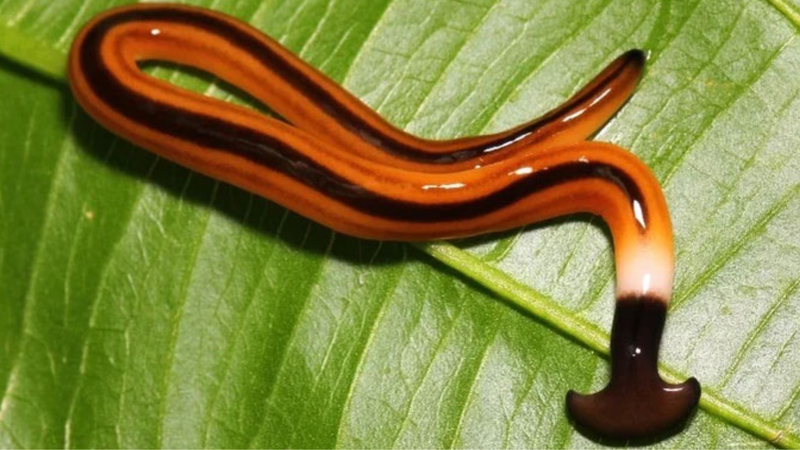
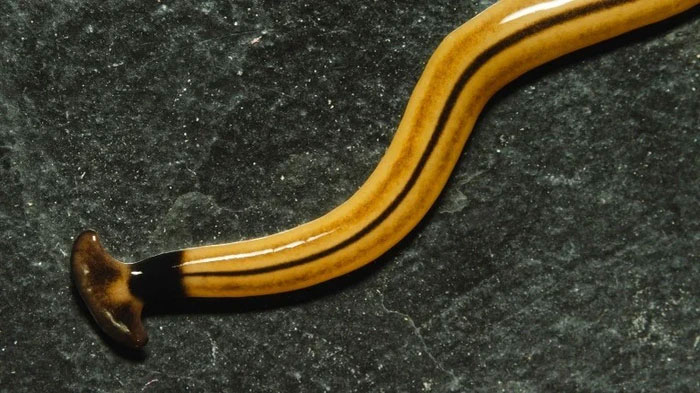
Its body is unusually long and flattened. Its head appears broad and strangely shaped—almost like a tiny hammer or shovel. Instead of wriggling through the soil like a familiar earthworm, it glides slowly across the surface.
If you've never seen one before, the creature can look surprisingly strange.
It may be a hammerhead worm, a group of unusual land planarians that have attracted attention in gardens and yards in many parts of the world.
Although hammerhead worms aren't dangerous to people in the way that venomous animals or biting insects can be, they are not simply another harmless garden worm. They are predators, and some species can affect populations of earthworms and other soil-dwelling organisms.
So what exactly is this strange creature?
Why does it have such an unusual head?
Should you be worried if you find one in your yard?
And what should you do if you encounter it?
Let's take a closer look.
What Is a Hammerhead Worm?
The name hammerhead worm is commonly used for several species of terrestrial flatworms belonging to groups such as Bipalium and related genera.
They are not true earthworms.
Earthworms belong to the phylum Annelida, while hammerhead worms are flatworms, belonging to the phylum Platyhelminthes.
That difference is important because the two animals have very different body structures, lifestyles, and feeding habits.
Earthworms are segmented animals that spend much of their lives moving through soil and feeding on organic matter.
Hammerhead worms are predators.
They actively search for other small organisms, including earthworms and other soft-bodied invertebrates.
This predatory lifestyle is one reason their presence in gardens can be significant.
Why Does It Have a Hammer-Shaped Head?
The most obvious feature of these worms is their unusual head.
Depending on the species, the head can appear:
-
Broad and flattened
-
Crescent-shaped
-
Shovel-like
-
Hammer-shaped
-
Fan-shaped
This distinctive appearance is responsible for the common name hammerhead worm.
The head isn't simply a decorative feature.
The flattened body and broad head are part of the animal's specialized anatomy and help it interact with its environment as it moves across surfaces.
Unlike mammals or insects, these worms don't have a conventional skeletal system.
Their bodies are soft, flexible, and adapted for gliding.
The result is an animal that looks quite different from the familiar earthworms most people recognize.
Hammerhead Worms Are Not Earthworms
One of the easiest mistakes to make is assuming that every worm found in a garden is an earthworm.
A typical earthworm is:
-
Cylindrical
-
Segmented
-
Relatively round in cross-section
-
Usually brown, reddish, or gray
-
Adapted to burrowing through soil
Hammerhead worms are generally:
-
Flattened
-
Unsegmented
-
Smooth
-
Often patterned or brightly colored
-
Equipped with a distinctive broadened head
Their movement can also look different.
An earthworm often contracts and extends its segmented body to move through soil.
A hammerhead worm can glide across surfaces using a thin layer of mucus and microscopic structures on the underside of its body.
Once you know what to look for, the difference can be surprisingly obvious.
Where Are Hammerhead Worms Found?
Hammerhead worms are associated with moist environments.
They may be encountered in:
-
Gardens
-
Flower beds
-
Lawns
-
Under rocks
-
Beneath logs
-
Around plant pots
-
Under leaves
-
Mulched areas
-
Greenhouses
-
Damp soil
They are especially noticeable after rain or during periods of high humidity.
Why?
Because moisture helps these soft-bodied animals move across surfaces and reduces the risk of drying out.
During hot, dry conditions, they may remain hidden in protected places.
This means that seeing one after rainfall doesn't necessarily mean a population suddenly appeared overnight.
They may simply have become easier to spot.
Why Do They Appear in Yards?
Hammerhead worms aren't necessarily attracted to your house itself.
Instead, your yard may provide several things they need:
Moisture
Water and humidity help them survive.
Shelter
Leaves, mulch, stones, logs, and other garden debris provide hiding places.
Food
A healthy garden ecosystem contains many small invertebrates.
If earthworms and other soft-bodied organisms are present, predators may also find suitable food.
Stable temperatures
Protected garden environments can provide more favorable conditions than exposed areas.
This is one reason people may encounter unusual worms in gardens, greenhouses, and landscaped areas.
Are Hammerhead Worms Dangerous to Humans?
This is one of the biggest questions people have when they first encounter one.
In general, hammerhead worms are not considered a direct danger to people simply because they are present in a yard.
They don't behave like snakes or aggressive insects.
They aren't looking for humans to attack, and encountering one does not mean that your household is in immediate danger.
However, that doesn't mean you should casually handle unfamiliar worms with your bare hands.
Some hammerhead worms produce chemical substances that help them capture prey and deter predators.
Certain species have been reported to contain tetrodotoxin or other biologically active compounds, although the presence and significance of these substances varies among species.
Because identification can be difficult, it's sensible to avoid unnecessary direct contact.
If you need to move one, use a tool or wear gloves and wash your hands afterward.
Why Do Hammerhead Worms Matter to Gardeners?
The biggest concern isn't usually human safety.
It's their effect on other organisms in the garden ecosystem.
Hammerhead worms are predators.
And one of their best-known prey items is the earthworm.
That matters because earthworms perform valuable ecological functions.
They help:
-
Move organic material through soil
-
Create channels in the ground
-
Improve soil structure
-
Contribute to nutrient cycling
-
Help organic matter decompose
-
Support healthy soil ecosystems
Not every garden requires large populations of earthworms, and earthworm species differ in ecological importance depending on the environment.
But in many gardens, earthworms are considered beneficial members of the soil community.
A predator that feeds heavily on them can therefore influence the local ecosystem.
Do Hammerhead Worms Kill Earthworms?
Yes.
Hammerhead worms can prey on earthworms.
They may locate an earthworm, attach themselves to it, and use digestive enzymes to begin breaking down its tissues.
The feeding process is very different from what most people imagine when they think about a worm eating.
Hammerhead worms have a muscular pharynx that can be extended outside the body.
They use digestive secretions to break down prey, and the resulting material can then be absorbed.
It's an efficient predatory strategy for a soft-bodied animal.
This unusual feeding behavior is one reason hammerhead worms have attracted scientific attention.
Are They Bad for Every Garden?
Not necessarily.
It's important not to turn the presence of one unusual worm into a gardening emergency.
Finding a single hammerhead worm does not mean your garden ecosystem is collapsing.
Population size matters.
Species matter.
Local environmental conditions matter.
And the ecological effects of introduced species can vary significantly between locations.
Some hammerhead worms are considered invasive or potentially invasive outside their native ranges, but the ecological significance depends on the specific species and region.
That's why correct identification is important.
A strange-looking worm should not automatically be labeled an invasive species simply because it has a broad head.
How Did They Spread to New Areas?
Some hammerhead worms and other terrestrial flatworms have been transported beyond their original geographic ranges.
One major reason is the movement of plants and soil.
Imagine a nursery plant growing in moist soil.
A small flatworm or egg could potentially be transported with the plant to another location.
When that plant is planted in a new garden, the organism may find:
-
Moist soil
-
Shelter
-
Prey
-
A suitable climate
Over time, it may establish a population.
This is one reason gardeners and agricultural authorities pay attention to unusual soil organisms that appear in areas where they were not previously known.
The movement of plants and soil can unintentionally move many organisms around the world.
Why Are They Especially Noticeable After Rain?
If you've ever seen a strange worm-like creature on a sidewalk after rain, you may have wondered where it came from.
Moisture is a major part of the explanation.
Terrestrial flatworms generally need moisture to move effectively and avoid drying out.
After rain, the ground and surrounding surfaces become humid and wet.
That creates conditions that allow these animals to move across:
-
Pavement
-
Concrete
-
Leaves
-
Garden paths
-
Wooden surfaces
-
Soil
A creature that normally stays hidden beneath leaves or mulch suddenly becomes visible.
So the appearance of a hammerhead worm after rain isn't necessarily mysterious.
It may simply be taking advantage of favorable environmental conditions.
What Do Hammerhead Worms Eat?
Their diet varies by species, but many hammerhead worms are predators of other invertebrates.
Potential prey can include:
-
Earthworms
-
Slugs
-
Snails
-
Other small soft-bodied organisms
-
Other worms and invertebrates
Some species are highly specialized, while others may have broader diets.
This is another reason you shouldn't assume every flatworm you find in the garden has exactly the same ecological impact.
Different species can behave differently.
Do Hammerhead Worms Have Eyes?
Some hammerhead worms have numerous tiny eyes, particularly around the head region.
These aren't eyes like human eyes.
They are simple light-sensitive structures that help the animal detect changes in light intensity and environmental conditions.
Their sensory systems are adapted to a slow-moving, surface-dwelling lifestyle.
They don't need complex vision to hunt the way a bird or mammal does.
Instead, they rely heavily on chemical and tactile cues to navigate and locate prey.
Can Hammerhead Worms Regenerate?
One of the strangest characteristics associated with some terrestrial flatworms is their remarkable ability to regenerate.
Flatworms have long fascinated scientists because certain species possess extensive regenerative capabilities.
Some species can regenerate body structures after injury, and certain flatworms can reproduce through fragmentation.
However, the popular claim that “cutting a hammerhead worm creates two complete worms” is an oversimplification and can lead to bad advice.
Regenerative abilities vary considerably between species and body regions.
More importantly, deliberately cutting or crushing an unfamiliar flatworm is not a responsible way to deal with it.
If you encounter one, identification and appropriate local guidance are better approaches.
Should You Kill a Hammerhead Worm?
This question doesn't have one universal answer.
If you discover one in your garden, don't immediately assume you need to destroy it.
First, consider:
What species is it?
Where are you located?
Is it native or introduced in your region?
Are local authorities recommending control?
These questions matter because management recommendations differ between regions.
In some places, hammerhead worms may be regarded as invasive organisms requiring attention.
In others, individual sightings may not warrant any action.
If you are unsure, photograph the animal rather than immediately handling or destroying it.
A clear photograph can sometimes help a local extension service, university, natural history organization, or invasive-species program identify it.
What Should You Do If You Find One?
A sensible approach is relatively simple.
1. Don't panic
Seeing one unusual worm doesn't mean your home is infested.
2. Avoid handling it directly
Use gloves or a tool if you need to move it.
3. Take a photograph
Capture the head shape, body pattern, and approximate size.
4. Note where you found it
Record whether it was:
-
In soil
-
Under mulch
-
Near a plant
-
On pavement
-
Beneath a rock
-
Inside a greenhouse
This information can help with identification.
5. Don't release unfamiliar organisms elsewhere
If you've collected an unusual worm for identification, don't transport or release it into another garden, park, or natural area.
6. Contact a local expert if necessary
University extension programs, agricultural agencies, or local invasive-species organizations may be able to provide guidance.
Don't Confuse Hammerhead Worms With Other Flatworms
Not every flatworm with an unusual appearance is a hammerhead worm.
There are numerous species of terrestrial flatworms.
Some are:
-
Native
-
Introduced
-
Predatory
-
Ecologically important
-
Rare
-
Difficult to identify without close examination
Color alone isn't enough.
Even head shape isn't always enough.
If you're trying to identify one accurately, characteristics such as body size, pattern, head shape, location, and behavior can all be useful.
For scientific identification, experts may need much more information.
Why Gardeners Should Care About Soil Biodiversity
The discovery of a strange worm can actually provide an opportunity to think about something bigger:
Your garden is an ecosystem.
Under your feet is a complex community of organisms.
There may be:
-
Earthworms
-
Springtails
-
Mites
-
Beetles
-
Fungi
-
Bacteria
-
Nematodes
-
Ants
-
Other insects
-
Plant roots
-
Predatory organisms
All of these organisms interact.
Some break down organic material.
Some feed on plants.
Some eat decomposers.
Others prey on those predators.
The garden isn't simply a collection of plants.
It's a living network.
Introducing a new predator into that network can sometimes have consequences that aren't immediately obvious.
How to Encourage a Healthy Garden Ecosystem
If your goal is healthy soil, focus on the entire ecosystem rather than eliminating every creature you don't recognize.
Helpful practices include:
Add organic matter
Compost and other appropriate organic materials can improve soil structure and support microbial activity.
Avoid unnecessary pesticide use
Broad-spectrum pesticides can affect beneficial organisms as well as pests.
Maintain appropriate moisture
Healthy soil needs water, but excessive moisture can create other problems.
Avoid unnecessary soil disturbance
Constantly digging and turning soil can disrupt organisms living below the surface.
Learn to identify common garden organisms
Knowing the difference between beneficial insects, pests, decomposers, and predators makes gardening decisions easier.

A Strange Worm Doesn't Automatically Mean a Bad Worm
One of the most important lessons is to resist the urge to label an unfamiliar creature as dangerous simply because it looks unusual.
Nature is full of organisms that look bizarre to humans.
The hammerhead worm is a perfect example.
Its flattened body and strange head can make it appear almost alien.
But its unusual appearance doesn't mean it is attacking humans or invading your home.
Its importance is ecological.
Because it is a predator, its presence can influence other organisms—particularly earthworms and other invertebrates.
That makes it interesting to scientists and gardeners, especially when it occurs outside its native range.
What About Pets?
For households with pets, another reason to avoid unnecessary contact is that animals may investigate unfamiliar creatures.
Dogs and cats sometimes sniff, paw at, or attempt to eat worms and other small animals they discover outdoors.
If you find an unusual flatworm in an area where pets frequently play, it's sensible to keep pets away from it until you know what species you're dealing with.
If a pet has eaten an unfamiliar organism and subsequently develops unusual symptoms, contact a veterinarian for advice rather than relying on internet identification.
When Should You Be Concerned?
One isolated sighting usually isn't a reason for alarm.
However, you may want to pay closer attention if you begin seeing large numbers of unusual flatworms repeatedly, especially if:
-
They appear throughout your garden.
-
Earthworm numbers seem to be declining.
-
You live in an area where a particular hammerhead worm is considered invasive.
-
You repeatedly find them around imported plants or soil.
-
Local agricultural or environmental authorities have issued warnings.
In these circumstances, documenting sightings and contacting a local expert can be useful.
The Bottom Line
Finding a strange worm in your yard can be surprising, especially when it has a distinctive hammer-shaped head.
It may be a hammerhead worm, a type of terrestrial flatworm that differs dramatically from ordinary earthworms.
These creatures are predators rather than decomposers. Some species feed on earthworms and other soft-bodied invertebrates, which means they can play a different—and sometimes important—role in garden ecosystems.
They generally aren't something that humans need to fear simply because they are present outdoors. However, because some species produce defensive or prey-capture chemicals and because identification can be difficult, it's best to avoid unnecessary direct contact.
Most importantly, don't panic and don't automatically assume that every unusual worm is an invasive pest.
Take a photograph, note where you found it, and seek local identification if you're concerned.
Your backyard may look ordinary from above, but beneath the leaves, mulch, and soil is a surprisingly complex ecosystem. Every strange creature you encounter is part of that larger story—and sometimes, a bizarre-looking worm can teach us more about the hidden world beneath our feet than we ever expected.