The Weight of Honor
⏱️ 1 min read 08/08/2026 19:18
The warm scent of freshly baked pastries and roasted coffee filled the small neighborhood bakery.
It was early evening, the busiest time of the day.
Customers stood in line near the counter, children pressed their faces against the glass display filled with chocolate croissants and cinnamon rolls, and the soft ringing of the front door bell echoed every few seconds as people came and went.
Behind the counter stood Margaret Hayes, the owner of the bakery.
She was a woman in her late fifties, always impeccably dressed, with neatly combed silver-blond hair and a calm, commanding presence. Everyone in the neighborhood knew Margaret.
She had owned the bakery for more than twenty years.
To most people, it was simply a successful family business.
But to Margaret, it was something much more.
It was the last thing her husband had left behind.
Her husband, Daniel, had built the bakery from nothing. Twenty-five years earlier, he had started with a tiny oven, a borrowed storefront, and a dream of creating a place where no one in the neighborhood would ever have to go hungry.
Daniel had passed away two years earlier.
Since then, Margaret had kept the bakery open—not merely for profit, but because she believed she was protecting the promise they had made together.
That evening, however, something happened that would force her to remember the deepest part of that promise.
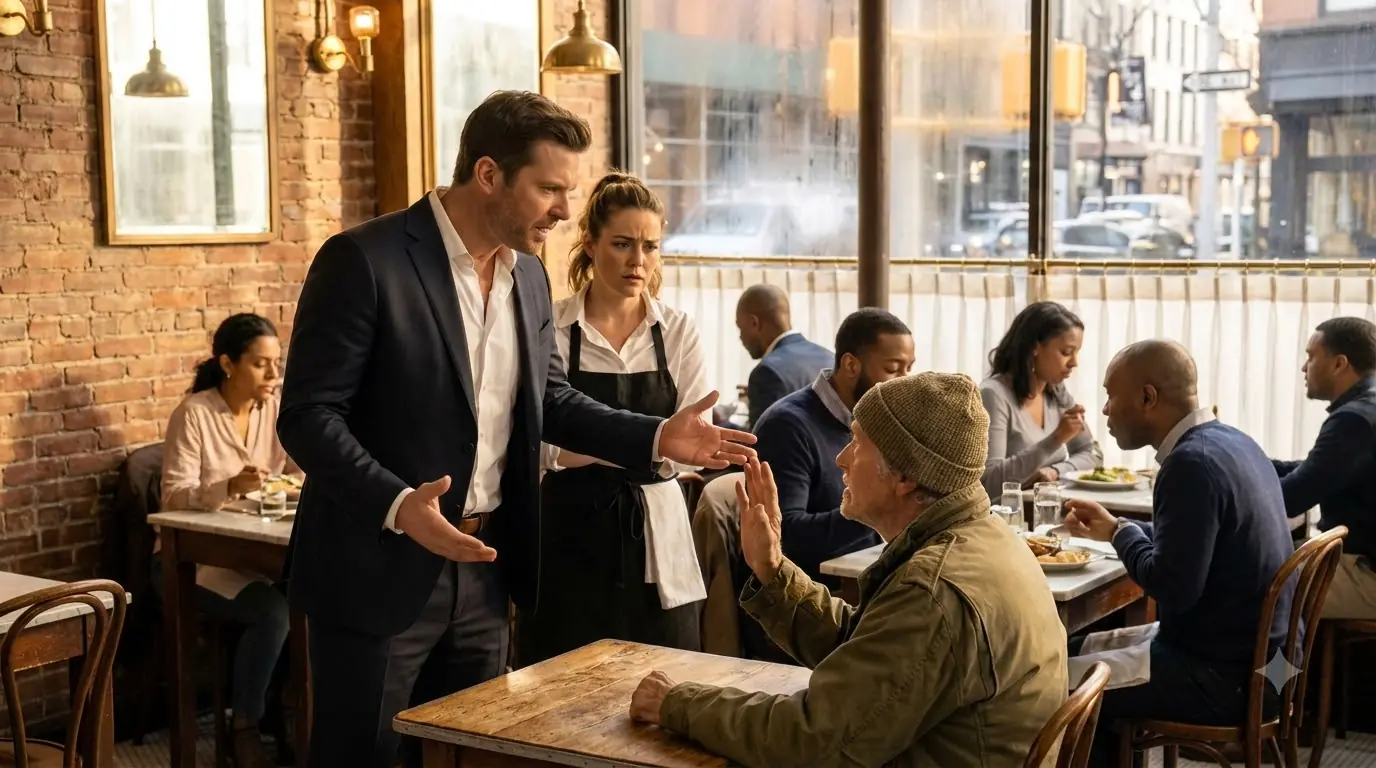
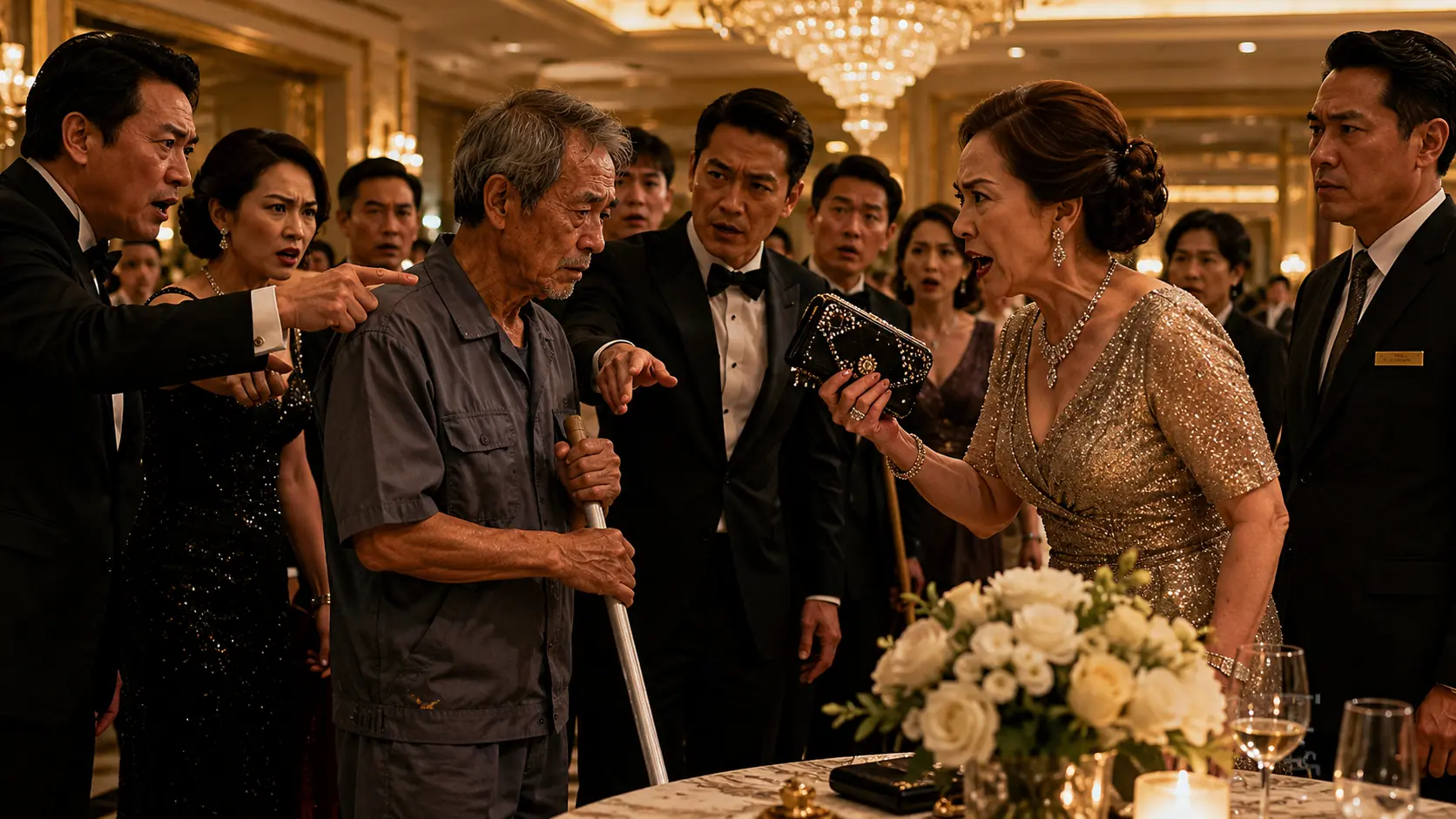
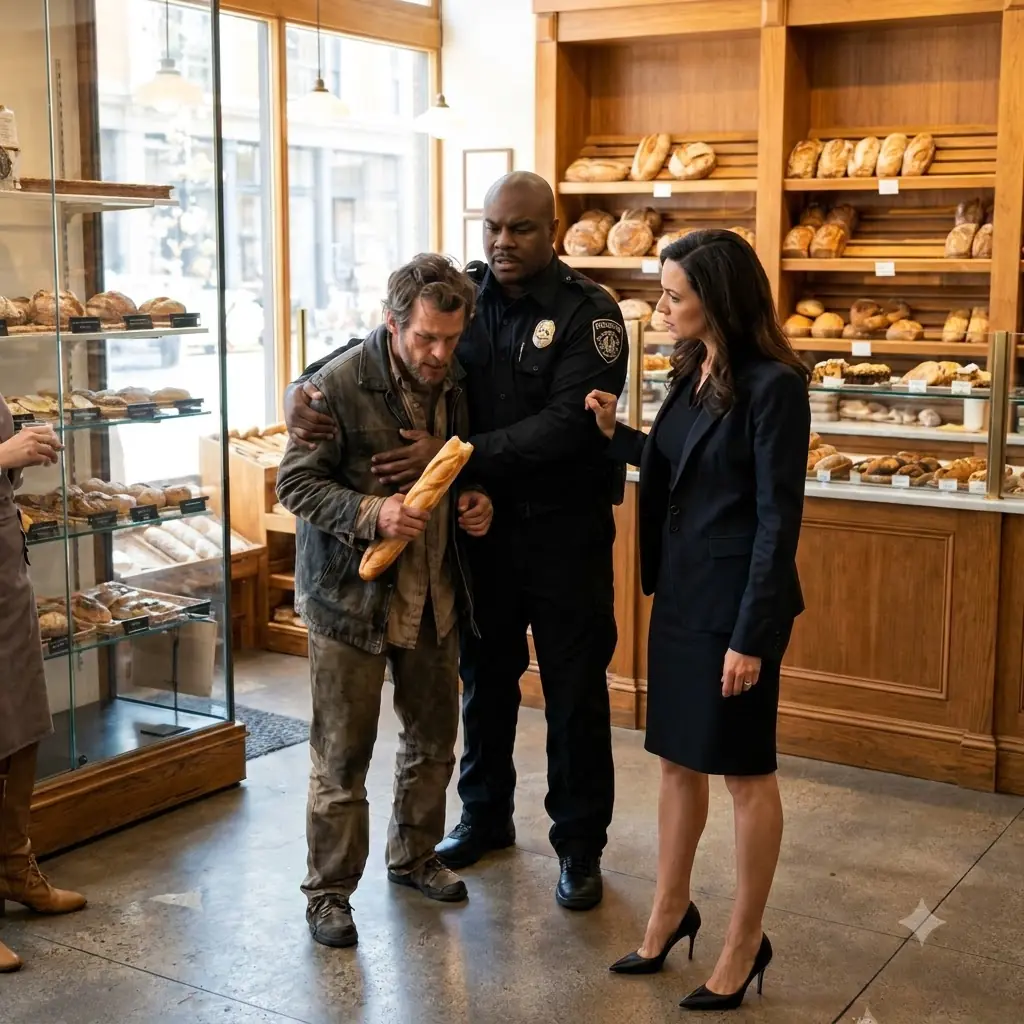
Near the entrance, a police officer stood beside a disheveled man.
The man's clothes were old and worn. His shoes were covered in dust, and his face looked exhausted, as though he had not slept properly in weeks.
The officer had one hand firmly resting on the man's shoulder.
In the man's trembling hands was a single baguette.
One loaf of bread.
The officer approached the counter.
"Ma'am," he said, addressing Margaret, "I caught the thief."
The bakery suddenly became quiet.
Several customers turned to look.
The man lowered his head.
He didn't struggle.
He didn't argue.
He didn't try to escape.
He simply stood there, holding the baguette against his chest.
Margaret looked at him carefully.
"What happened?" she asked.
The officer sighed.
"I saw him leave through the side door without paying. He tried to hide the bread underneath his coat. I stopped him before he got very far."
Margaret's eyes moved toward the baguette.
Then back to the man.
"What is your name?"
The man swallowed hard.
"Thomas."
"Thomas what?"
"Thomas Reed."
His voice was barely audible.
Margaret noticed something strange.
The man wasn't looking at her.
He wasn't looking at the officer either.
He was staring at the floor.
And his hands were shaking.
"Thomas," Margaret said quietly, "why did you steal the bread?"
For several seconds, there was no answer.
Then the man's lips trembled.
"I'm sorry."
His voice cracked.
"I swear I'm sorry."
The officer tightened his grip slightly.
But Thomas continued.
"I wasn't going to sell it. I wasn't going to hurt anyone. I just..."
He stopped.
His eyes became wet.
"My kids haven't eaten since yesterday."
The bakery fell completely silent.
A woman near the counter slowly lowered the coffee cup in her hand.
Someone whispered, "Oh my God."
Thomas wiped his eyes with the back of his hand.
"I tried to find work," he continued. "I asked everywhere. Construction sites, restaurants, warehouses... anywhere that would hire me."
He looked at the baguette.
"I had twelve dollars this morning. I used it to buy medicine for my youngest daughter."
His voice became quieter.
"By tonight, there was nothing left."
Margaret watched him carefully.
Thomas continued.
"I told my children I'd bring something home."
He took a shaky breath.
"I couldn't go back empty-handed."
The officer looked uncomfortable.
"Sir, I understand your situation," he said, "but stealing is still stealing."
Thomas nodded immediately.
"I know."
He didn't make excuses.
"I know I did something wrong."
Then he looked directly at Margaret for the first time.
"I'll accept whatever punishment you want."
His eyes filled with tears.
"But please..."
He clasped his hands together.
"Please don't involve my children."
His voice broke.
"They didn't do anything."
Thomas lowered his head.
"If someone has to pay for what I did, let it be me."
He took a breath that seemed to come from somewhere deep inside him.
"Just leave my kids alone."
Margaret stared at him.
Something about those words struck her.
Not because they were dramatic.
But because she had heard something similar many years ago.
She remembered Daniel.
When they were young and struggling to keep their bakery alive, there had been nights when they barely had enough money to pay the electricity bill.
Daniel had always said the same thing:
"A hungry person doesn't need judgment first. They need a chance."
Margaret looked at Thomas again.
"How many children do you have?"
Thomas hesitated.
"Three."
"How old?"
"Eleven, seven, and four."
Margaret's expression changed.
The sternness in her eyes softened.
"Where are they?"
"At home."
"Waiting for you?"
Thomas nodded.
"Probably."
Margaret glanced toward the bakery shelves.
There were dozens of loaves of bread.
Hundreds of pastries.
Food worth thousands of dollars.
And yet this man was standing in front of her trembling because he had stolen one baguette.
Margaret slowly walked around the counter.
She stopped directly in front of him.
Thomas looked terrified.
He expected anger.
Perhaps an accusation.
Maybe a fine.
Maybe jail.
Instead, Margaret said something he never expected to hear.
"Then go get them."
Thomas blinked.
"What?"
"Go get your children."
He stared at her in confusion.
The police officer looked equally stunned.
"Ma'am," the officer said, "are you saying you're letting him go?"
Margaret looked at him.
"No."
The officer frowned.
"Then what exactly are you doing?"
Margaret turned toward Thomas.
"I'm not letting him go."
She paused.
"I'm giving him a reason to come back."
Thomas didn't understand.
"I don't..."
Margaret pointed toward the bakery's kitchen.
"Bring your children here."
The officer looked confused.
"You're going to feed a thief?"
Margaret's expression became serious.
"No."
She looked directly at the officer.
"I'm going to feed three hungry children."
The room went silent again.
Thomas stared at her.
His lips moved, but no words came out.
Margaret continued.
"There's a difference."
The officer slowly released Thomas's shoulder.
But Margaret wasn't finished.
She walked back behind the counter and picked up the baguette from his trembling hands.
Then she placed it on the counter.
"That bread is no longer stolen."
Thomas looked at her.
"It is?"
"It is now paid for."
She opened the cash register, took out some money, and placed it beside the baguette.
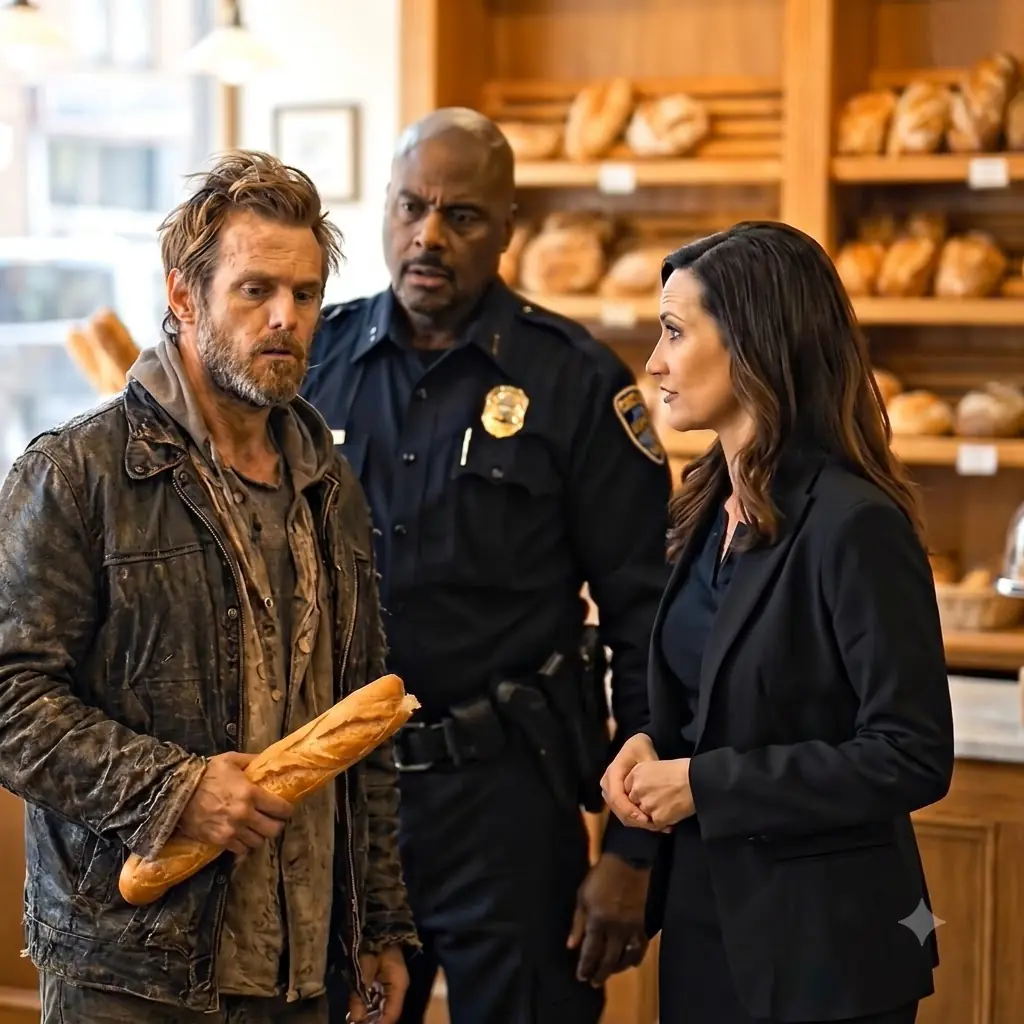
Then she looked at Thomas.
"Take your children."
Thomas's eyes filled with tears again.
"I don't understand."
Margaret took a slow breath.
"Years ago, my husband and I wrote our wills."
She glanced around the bakery.
"This place was everything to him."
She smiled faintly.
"He built it from nothing."
The officer listened carefully.
Margaret continued.
"When he became sick, we started talking about what would happen after he was gone."
Her voice became softer.
"He told me something I never forgot."
She reached beneath the counter and pulled out a small, worn envelope.
"I should give this to the person who proved they understood what the bakery was really built for."
Thomas stared at the envelope.
"What does that have to do with me?"
Margaret looked at him.
"Everything."
She opened the envelope.
Inside was a handwritten letter.
Margaret unfolded it carefully.
"My husband left one final condition in his will."
She looked at Thomas.
"He said that if I ever found someone who was willing to sacrifice their own dignity, reputation, or comfort simply to make sure their children could eat..."
She paused.
"...I was supposed to give that person an opportunity."
Thomas shook his head.
"No."
Margaret nodded.
"Yes."
"You don't know me."
"I know enough."
"You can't just..."
Thomas struggled to finish the sentence.
Margaret continued.
"My husband believed that a person's worst moment shouldn't always define the rest of their life."
She looked at the stolen baguette.
"Tonight, you could have stolen something expensive."
"You didn't."
"You could have taken money."
"You didn't."
"You could have taken enough food to feed your family for weeks."
"You didn't."
She looked into his eyes.
"You took one loaf of bread."
"Because you were trying to feed your children."
Thomas covered his face with both hands.
His shoulders began to shake.
He cried silently.
The police officer looked down.
Even he seemed affected by the moment.
Margaret stepped closer.
"Thomas."
The man slowly looked up.
"My husband didn't want this bakery to belong to someone who only cared about money."
She placed the letter in his hands.
"He wanted it to belong to someone who understood why it existed."
Thomas stared at the letter.
"What are you saying?"
Margaret smiled through tears of her own.
"I'm saying that if you're willing to work..."
She paused.
"...I'll give you a job."
Thomas nodded immediately.
"Anything."
"But that's not all."
Thomas looked confused.
Margaret continued.
"After you prove yourself, I want you to become my partner."
The officer's eyes widened.
"Partner?"
Margaret nodded.
"And eventually..."
She looked around the bakery.
"...the bakery will be yours."
Thomas froze.
He thought he had misunderstood her.
"Mine?"
Margaret nodded.
"My husband left instructions for me to transfer ownership to someone who demonstrated that they valued feeding people more than feeding their own pride."
Thomas stared at her as if she had just spoken another language.
"But I stole from you."
Margaret smiled sadly.
"Yes."
"You should hate me."
"I don't."
"You should call the police."
"I did."
Thomas glanced at the officer.
The officer gave a small, almost embarrassed smile.
"Technically, she did."
Margaret continued.
"But sometimes justice isn't only about punishment."
She looked toward the bakery's front window.
"Sometimes justice means giving someone the chance to become better than the mistake they made."
Thomas couldn't hold back his tears anymore.
He dropped to his knees.
Margaret immediately reached down and helped him stand.
"Don't kneel," she said.
"Go get your children."
Thomas nodded.
Then he stopped.
"Why me?"
Margaret looked at him for a long moment.
"Because when you were hungry, you thought about your children first."
She smiled.
"And my husband believed that told him everything he needed to know."
Thomas left the bakery.
For the first time in months, he wasn't walking home with his head lowered in shame.
He was running.
Minutes later, the bakery door opened again.
Thomas returned with three children.
They were tired.
Confused.
And clearly hungry.
The youngest held tightly onto her father's hand.
Margaret immediately placed fresh bread, soup, fruit, and pastries on a table.
The children stared at the food.
"Can we really eat this?" the seven-year-old asked.
Margaret smiled.
"Yes."
The little girl looked at her father.
Thomas nodded.
"Go ahead."
The children began eating.
Thomas stood nearby, watching them.
For the first time in a very long time, he smiled.
Margaret watched from behind the counter.
She could almost imagine Daniel standing beside her.
She imagined him looking at the family and saying the words he had repeated throughout their marriage:
"This is why we built it."
Years later, the bakery would become one of the most respected small businesses in the city.
But Thomas never forgot the night he walked through that door carrying a stolen baguette.
He worked harder than anyone.
He learned the business.
He rebuilt his life.
And eventually, he became the owner Margaret had promised he could become.
But he changed one thing.
Every evening, just before closing, Thomas placed a basket of fresh bread outside the bakery.
Above it was a simple handwritten sign:
"If you're hungry, take one. No questions asked."
Some people criticized him.
Some said it would attract thieves.
Others said he was too generous.
Thomas never argued.
He simply remembered the night when he had been the hungry man standing outside someone else's bakery.
And he remembered the woman who had looked beyond his mistake and seen the father underneath it.
Because sometimes, one loaf of bread is more than food.
Sometimes, it is a second chance.
Sometimes, compassion can change the direction of an entire family.
And sometimes, the person who appears to have the least to offer is the one who reveals the greatest lesson of all:
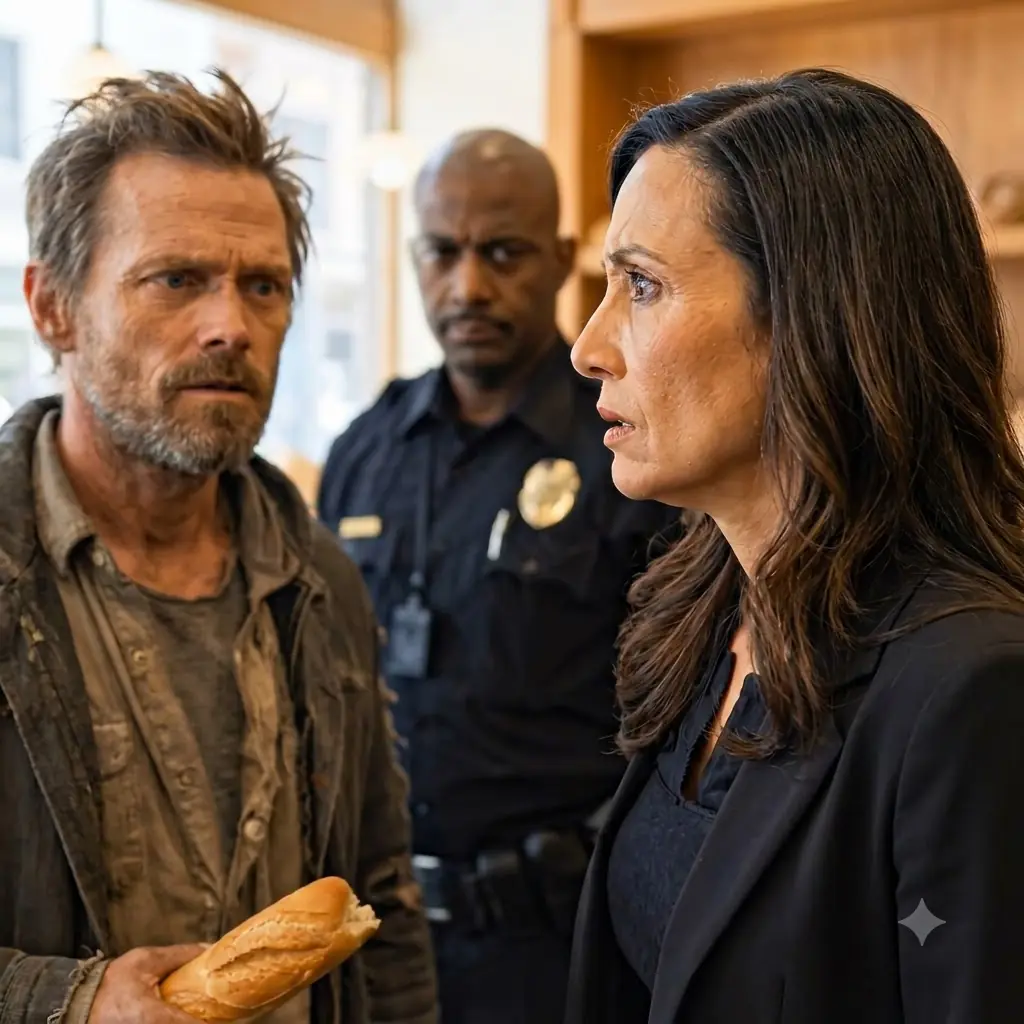
A person's worst moment does not have to become their final chapter.
That night, Thomas thought he had stolen a loaf of bread.
He didn't know that the loaf would lead him to something far more valuable—
a future he had stopped believing was possible.
Twelve years earlier, Veronica Limia had sat in a courtroom in handcuffs.
A Necklace Revealed the Truth
“The music was still playing when the king realized the princess had disappeared from the royal ball.”
“At the king’s grand ball, a priceless diamond disappeared and everyone blamed the poorest servant in the room.”
“She thought she was protecting her love… until the man she loved said, ‘I can’t breathe anymore.’
The Truth That Destroyed Their Wedding
“A wallet full of diamonds disappeared and the poorest man in the room became the first suspect.”
The Bride Who Walked Away
The Millionaire With a Basket of Flowers
The Chairman Recognized His Son by a Scar
THEY JUDGED THE WRONG MAN
Twelve years earlier, Veronica Limia had sat in a courtroom in handcuffs.
🔎 Could Your Feet Be Showing Signs of Liver Trouble? Here’s What to Know
🔍 5 Subtle Signs of Cervical Can.cer You Should Never Brush Off
😱 If Your Mouth Is Always Dry When You Wake Up, These 8 Causes May Surprise You
🔥 Stop and Think Before Eating These 6 Foods — Your Thyroid May Thank You!
👀 Your Body Could Be Crying Out for Magnesium — 32 Signs You Should Know
🤯 These Tiny Buttons Can Do WAY More Than You Think — 6 Phone Tricks Revealed!
Belly Fat vs. Liver-Related Abdominal Swelling: What’s the Difference?
Skip the Expensive Salmon: This Affordable Fish Offers Plenty of Protein for Less
A Necklace Revealed the Truth
“The music was still playing when the king realized the princess had disappeared from the royal ball.”
One Half Lemon, Several Clever Household Uses You May Not Know