THE STRANGER WHO WALKED INTO TOWN
The midday sun beat down mercilessly on the dusty frontier town.
Heat shimmered above the wooden sidewalks, and every gust of wind sent clouds of pale dust rolling through the narrow streets. The town had once been a place of hope—a place where farmers, merchants, ranchers, and travelers came looking for a fresh start.
But time had made it hard.
The people had learned to distrust strangers.
They had learned that a clean coat did not always mean an honest man, and that a friendly smile could sometimes hide a loaded gun.
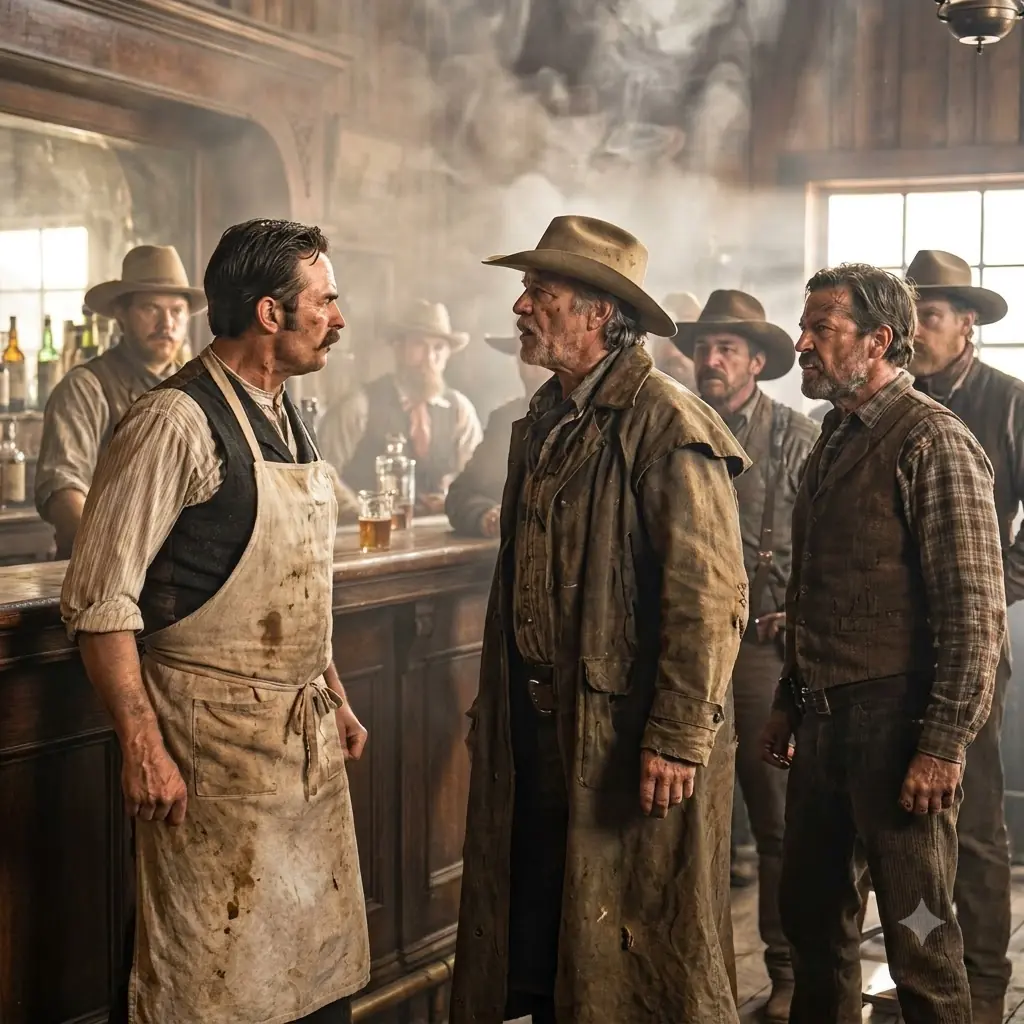
In the center of town stood a weathered saloon called The Rusty Spur.
Inside, the air was thick with cigar smoke, cheap whiskey, sweat, and the constant murmur of men who had spent too many years watching the world become crueler.
The swinging doors suddenly creaked open.
Everyone looked up.
A stranger had just walked inside.
He was an older man, perhaps somewhere in his late sixties. His face was weathered like cracked leather, carved by decades of sun, wind, and hardship. A battered black hat sat low over his forehead, and a long, dust-covered duster coat hung from his shoulders.
His boots were worn.
His clothes were plain.
There was no silver belt buckle, no expensive watch, no polished horse waiting outside.
He looked like a man who had traveled too far and slept too little.
A man who had nothing left to prove.
He slowly stepped toward the bar.
For a moment, nobody said anything.
The stranger rested one hand against the wooden counter.
"Coffee," he said quietly. "Black."
The bartender stared at him.
He was a broad-shouldered man in his forties, with a thick beard, scarred knuckles, and a stained canvas apron stretched across his chest.
His name was Hank Mercer.
He had owned the Rusty Spur for nearly fifteen years, and during that time, he had developed a simple rule.
Respect belonged to those who could afford it.
Hank looked the stranger up and down.
Then he laughed.
Not a friendly laugh.
A cruel one.
"Coffee?"
The stranger nodded.
"And maybe a corner where I can sit for a while."
The bartender's smile disappeared.
He grabbed a dirty rag and slammed it onto the counter.
"Get out of here."
The room immediately became quiet.
The stranger looked at him.
"I'll pay."
Hank leaned forward.
"We don't serve people like you."
The stranger's expression barely changed.
"What kind of person is that?"
A few men at the tables chuckled.
Hank folded his arms.
"People who look like they haven't washed in a month. Drifters. Beggars. Trouble."
The stranger glanced down at his dusty coat.
Then back at Hank.
"I've been traveling a long way."
"Then keep traveling."
The stranger sighed.
He seemed too tired to argue.
He turned slightly, looking for an empty corner.
That was when Hank nodded toward two large men sitting near the bar.
"Show him the door."
The two men stood.
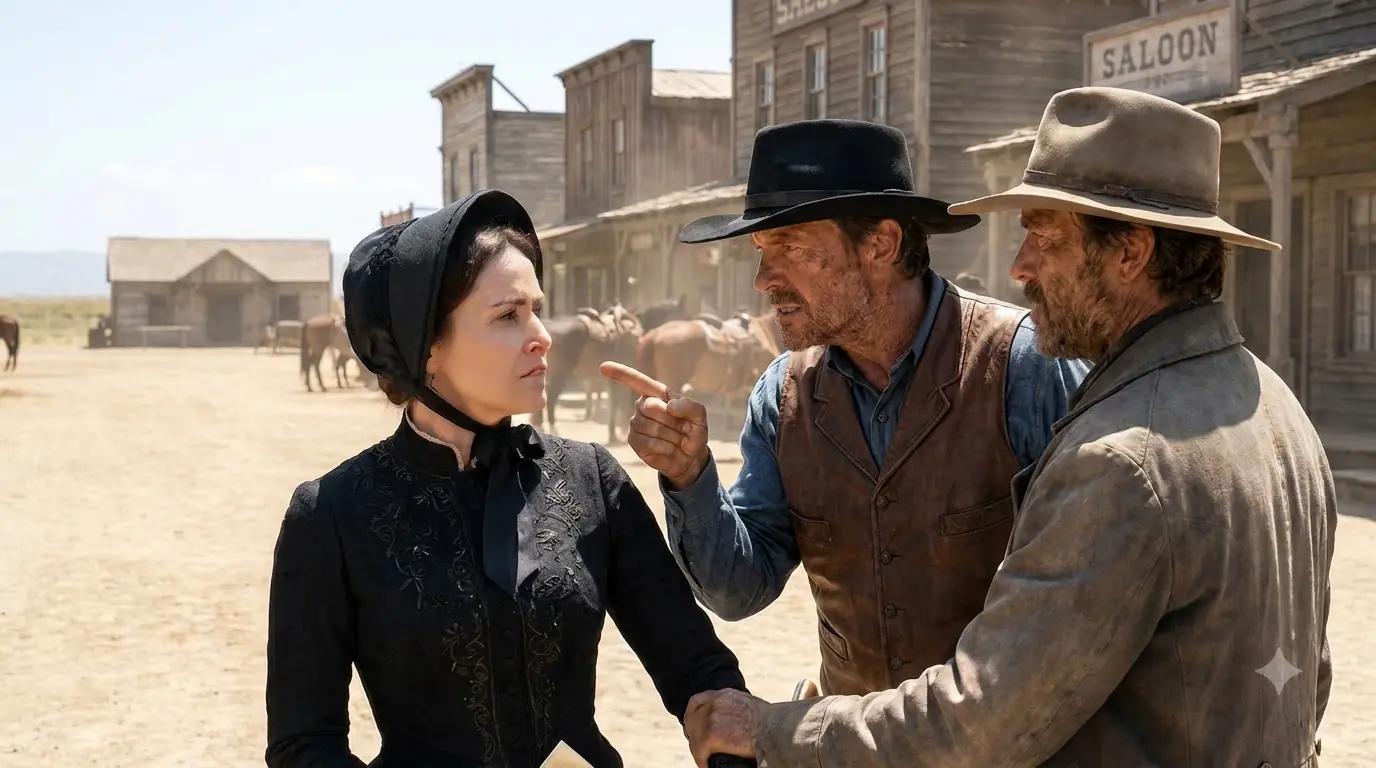
They were both heavily built, with thick arms and rough hands. They approached the stranger from either side.
One grabbed his shoulder.
The other took hold of his arm.
"Come on, old man."
The stranger didn't resist.
For a second, it looked as if he would simply allow himself to be pushed outside.
Then he calmly shrugged.
Both men's hands slipped away.
Neither of them understood how it happened.
The stranger hadn't struck them.
He hadn't even raised his voice.
He had simply moved with the efficiency of someone who had done this many times before.
The two men exchanged confused looks.
The stranger adjusted his coat.
"I don't want trouble," he said.
Hank sneered.
"Then leave."
The old man looked at him for a long moment.
"I just wanted a coffee."
Nobody answered.
He turned toward the door.
And then—
BANG!
The saloon doors violently crashed open.
A young woman stumbled inside.
She was breathing heavily, her hair disheveled, her face pale with terror.
She nearly fell before catching herself against the doorframe.
Everyone turned toward her.
"What happened?" someone shouted.
The woman looked around the room.
Her eyes were wide.
"The Black Brothers."
The name alone changed everything.
The laughter disappeared.
The men stopped drinking.
A chair scraped across the floor.
"What about them?" Hank demanded.
"They're coming."
The woman swallowed hard.
"There are at least a dozen riders. Maybe more. They're coming straight toward town."
A murmur spread through the saloon.
Someone whispered, "No..."
Another man immediately reached for his revolver.
The woman continued.
"They hit Miller's Crossing this morning. Burned the supply store. Took everything they wanted."
She struggled to breathe.
"Then they rode toward us."
The room erupted into panic.
The Black Brothers were not ordinary outlaws.
They had become a nightmare whispered about around campfires and behind locked doors.
They had robbed stagecoaches, attacked isolated ranches, and terrorized settlements across the frontier.
Wherever they went, people learned the same lesson.
Resistance only made things worse.
"They'll be here in minutes!" someone shouted.
Men rushed toward the windows.
Others checked their weapons.
A few began arguing about whether to hide or fight.
The bartender's confidence vanished.
"How many?" he asked.
"Twelve," the woman replied.
Then she hesitated.
"Maybe thirteen."
Silence.
Everyone in the saloon understood what that meant.
They were outnumbered.
The town had only a handful of men who could shoot.
Most had families.
Most had something to lose.
And suddenly, every person in the room was thinking about the same thing.
Survival.
A young man named Caleb pushed through the crowd.
He was barely twenty-five, strong, proud, and inexperienced.
He had spent years imagining himself as the kind of man who would stand against danger.
Now he finally had his chance.
Or at least, he thought he did.
"We can't just sit here!" Caleb shouted.
He moved toward the door.
"Someone has to stop them."
As he rushed forward, he encountered the old stranger standing quietly near the entrance.
Caleb shoved him aside.
"Get out of the way, old man!"
The stranger stumbled half a step.
Then stopped.
Something changed.
It was subtle.
Almost invisible.
The tiredness in his shoulders disappeared.
His eyes, which moments earlier had seemed distant and exhausted, suddenly became sharp.
Cold.
Focused.
The saloon became strangely quiet.
The stranger slowly turned toward Caleb.
"It's been twenty years," he said.
His voice was low.
Calm.
But there was something in it that made Caleb's confidence disappear.
"Twenty years since anyone called me that."
Caleb stared at him.
"What?"
The stranger reached slowly toward the brim of his hat.
He removed it.
For the first time, everyone saw his entire face.
There were several old scars along his jaw and one thin line running from his left eyebrow toward his temple.
But it wasn't the scars that frightened them.
It was his eyes.
They were the eyes of a man who had survived things nobody in that room could imagine.
Eyes that had seen war.
Death.
Betrayal.
And the kind of violence that left a person permanently changed.
Hank the bartender stared at him.
His face suddenly lost all its color.
His lips parted.
"No..."
The stranger looked at him.
Hank took one slow step backward.
"You..."
His voice trembled.
"I know those eyes."
Nobody understood.
Hank did.
Years ago, long before he owned the saloon, Hank had been a young ranch hand working near the southern border.
He remembered stories.
Stories about a lawman who had disappeared twenty years earlier.
A man who had faced entire gangs alone.
A man who had rescued towns that had already given up.
A man whose name had become a legend.
People said he had died.
Others said he had simply walked away.
But Hank remembered the name.
His voice came out barely above a whisper.
"You're..."
The stranger waited.
Hank swallowed.
"You're Elias Blackwood."
The room went completely silent.
Even the woman who had brought the warning stopped breathing.
The name meant something.
Everyone had heard it.
The Gunslinger Who Never Missed.
The Marshal Who Rode Into Red Valley Alone.
The Man Who Ended the Blackwater Gang.
For twenty years, Elias Blackwood had been nothing more than a story.
A ghost from another era.
A legend people talked about without believing he could still be alive.
Caleb stared at the old man.
"You can't be him."
Elias looked at him.
"I was."
Caleb shook his head.
"But they said you were dead."
Elias gave a faint smile.
"People say many things about men they don't understand."
Outside, distant hoofbeats began to echo through the streets.
Slow.
Heavy.
Getting closer.
Everyone turned toward the windows.
The Black Brothers had arrived.
Hank looked toward Elias.
"What are we supposed to do?"
Elias put his hat back on.
"Stay inside."
Hank blinked.
"What?"
"You heard me."
"But there are thirteen of them."
Elias slowly walked toward the swinging doors.
"And?"
Hank stared at him.
"You can't face them alone."
Elias stopped.
For the first time, he looked back at the people inside the saloon.
His voice was quiet.
"Twenty years ago, I believed a man proved his strength by how many people he could defeat."
He looked at his scarred hands.
"I was wrong."
The hoofbeats grew louder.
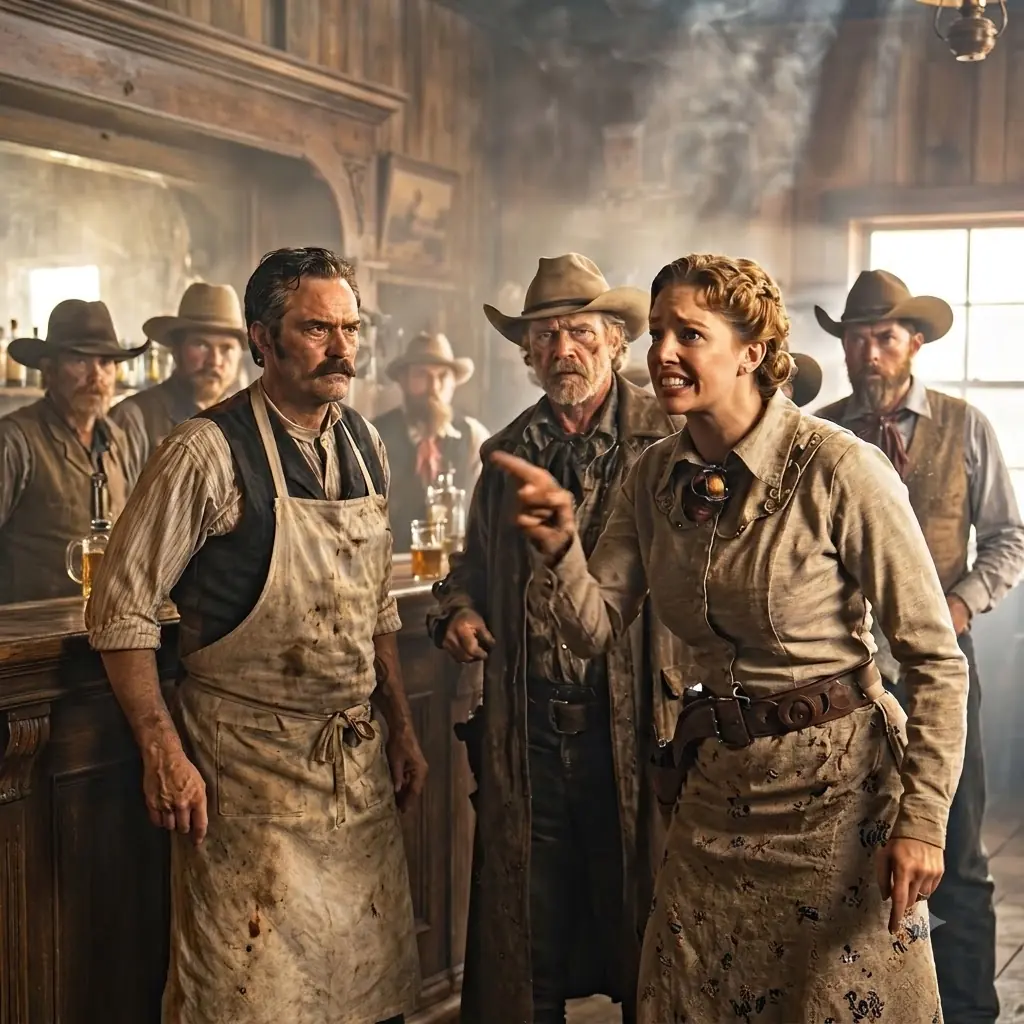
"I spent half my life chasing men like these."
He looked around the room.
"And somewhere along the way, I forgot what I was actually fighting for."
The room remained silent.
Elias continued.
"Not revenge."
"Not glory."
"Not a name."
He looked toward the frightened young woman.
"People."
Then he turned toward the doors.
"I fight so ordinary people can wake up tomorrow and believe they're safe."
He stepped outside.
The blazing sunlight swallowed his silhouette.
Across the street, thirteen riders slowly entered the town.
Their horses kicked up clouds of dust.
At the center rode a tall man wearing a black coat.
He pulled his horse to a stop.
His eyes narrowed when he saw the old stranger standing alone in the middle of the street.
He laughed.
"Who the hell are you?"
Elias didn't answer immediately.
He simply stood there.
The wind moved his long coat.
His hand rested calmly near his side.
The gang leader smiled.
"You're either very brave..."
He leaned forward in his saddle.
"...or very stupid."
Elias finally looked directly at him.
"I've been called both."
The gang leader reached toward his weapon.
But Elias spoke again.
"You have one chance."
The riders laughed.
Thirteen men against one.
It seemed ridiculous.
Until the leader noticed something.
Elias wasn't afraid.
Not even slightly.
The old man's posture wasn't that of someone preparing to die.
It was the posture of someone who had already survived everything death could offer.
The leader's smile slowly disappeared.
"You know who we are?"
Elias nodded.
"I know exactly who you are."
"And you still want to stand there?"
Elias looked past them toward the town.
At the frightened faces behind windows.
At the saloon.
At the people who had judged him by his coat.
At Hank, who had refused him a simple cup of coffee.
Then he looked back at the riders.
"Yes."
The leader drew his weapon.
Elias moved.
What happened next was over before most people inside the saloon understood what they had seen.
A sharp crack split the air.
Then another.
Then another.
Not wild gunfire.
Precise.
Controlled.
One by one, the gang's weapons were knocked from their hands.
Some riders fell from their horses in surprise.
Others froze.
Within moments, the entire street had gone silent.
Elias stood exactly where he had started.
The gang leader stared at him.
His confidence was gone.
He finally understood.
The legend had never died.
He had simply grown old.
And perhaps that was even more dangerous.
Elias slowly lowered his hand.
"You should leave."
The leader hesitated.
"Why?"
Elias looked him directly in the eyes.
"Because unlike twenty years ago..."
He paused.
"...I don't need to prove anything anymore."
The Black Brothers turned their horses.
One by one, they rode away.
The town remained silent until the last hoofbeat disappeared into the distance.
Then someone inside the saloon began to clap.
Another person joined.
Soon, the entire room erupted.
But Elias didn't smile.
He simply walked back inside.
Hank stood behind the bar, ashamed.
He looked at the old man's dusty coat.
Then at his battered boots.
Then at the coffee pot.
Without saying a word, Hank poured a cup.
He placed it carefully on the counter.
"I'm sorry," he said.
Elias looked at him.
"For what?"
Hank lowered his eyes.
"For judging you before I knew you."
Elias picked up the coffee.
He took a slow sip.
Then smiled faintly.
"That's a mistake most people make."
Hank nodded.
Elias walked toward the corner and sat down.
For the first time that day, the old man looked peaceful.
Caleb approached him slowly.
He seemed embarrassed.
"I called you an old man."
Elias looked up.
"You did."
"I'm sorry."
Elias studied him for a moment.
Then gestured toward the empty chair.
"Sit."
Caleb sat down.
"How did you become... all of that?"
Elias looked into his coffee.
"Time."
Caleb waited.
Elias continued.
"Time teaches a man that strength isn't about how hard you can hit."
He looked around the saloon.
"It's about knowing when someone else needs you to stand."
Caleb nodded slowly.
Outside, the dust began to settle.
The town was still standing.
The people were still safe.
And the stranger everyone had dismissed as a tired old drifter had reminded them of something they had forgotten.
You cannot measure a person's worth by their clothes.
You cannot judge a life by the years written on a face.
And sometimes, the person you are quickest to disrespect is the very person who could save you when the world falls apart.
Elias finished his coffee.
He placed a few coins on the counter.
Then he stood.
Hank looked at the money.
"Coffee's on the house."
Elias smiled.
"Next time."
He put his hat back on.
"Maybe I'll stay long enough for another cup."
The saloon doors swung open.
Elias stepped into the evening sunlight.
Behind him, the people of the town watched in silence.
No one laughed.
No one called him a drifter.
No one looked at his dusty coat and saw a worthless old man.
They saw something different now.
They saw a survivor.
A protector.
A legend.
But Elias Blackwood didn't seem interested in being remembered.
He simply mounted his old horse and looked toward the distant horizon.
Then he rode away.
Because legends, he had learned long ago, were never created by the people who wanted to become famous.
They were created by people who kept doing the right thing long after nobody was watching.
And sometimes...
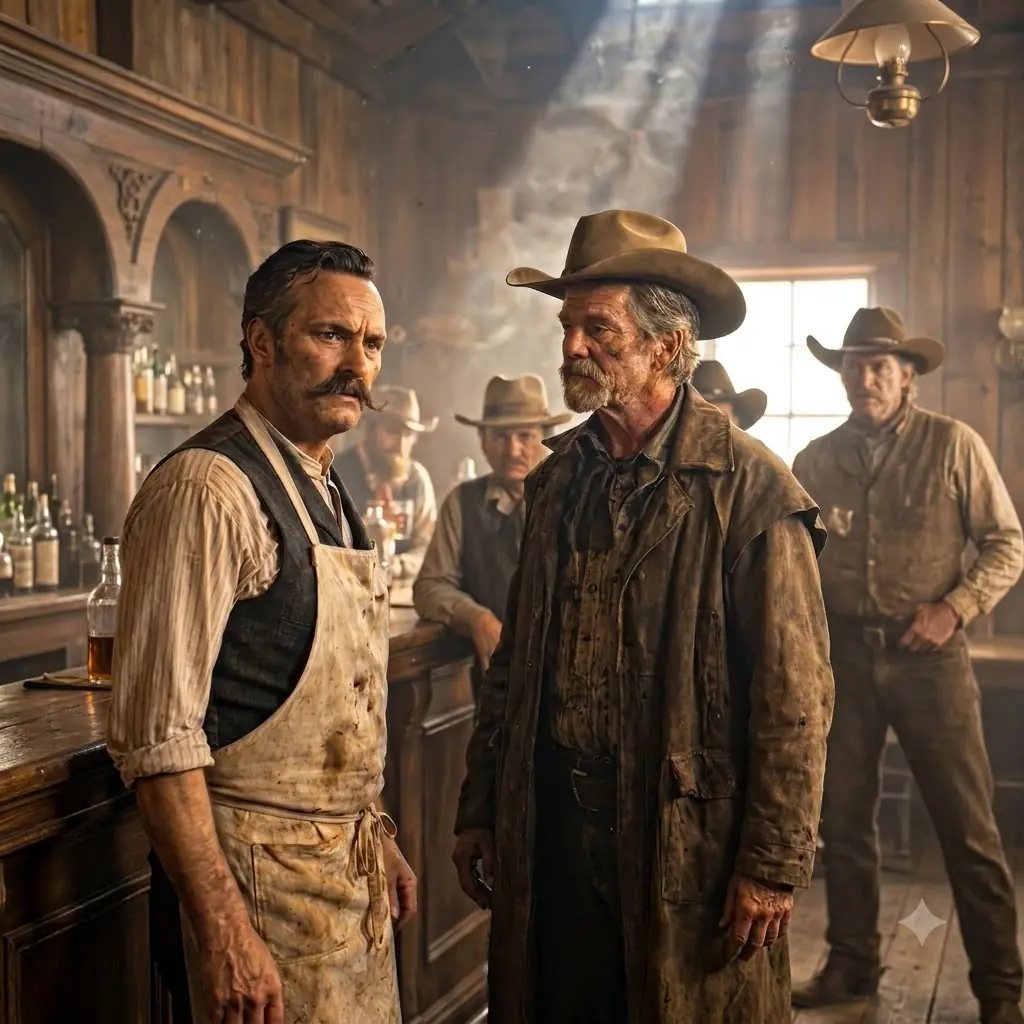
the greatest heroes are the ones who walk into town looking like they have nothing left to give—
only to prove they had been carrying the strength to save everyone all along.