The word “Gyan” comes from the Sanskrit word Jnana, meaning knowledge or wisdom, while Mudra can be translated as a gesture, seal, or symbolic hand position. Together, Gyan Mudra is often described as the “Mudra of Knowledge” or “Gesture of Wisdom.”
One of the reasons Gyan Mudra remains popular today is its simplicity. You do not need special equipment, advanced yoga skills, or a complicated routine. All you need is a comfortable place to sit and a few quiet minutes for yourself.
But what makes this simple hand position so meaningful? Let’s explore the traditional meaning of Gyan Mudra, its potential benefits, and how you can practice it correctly.
What Is Gyan Mudra?
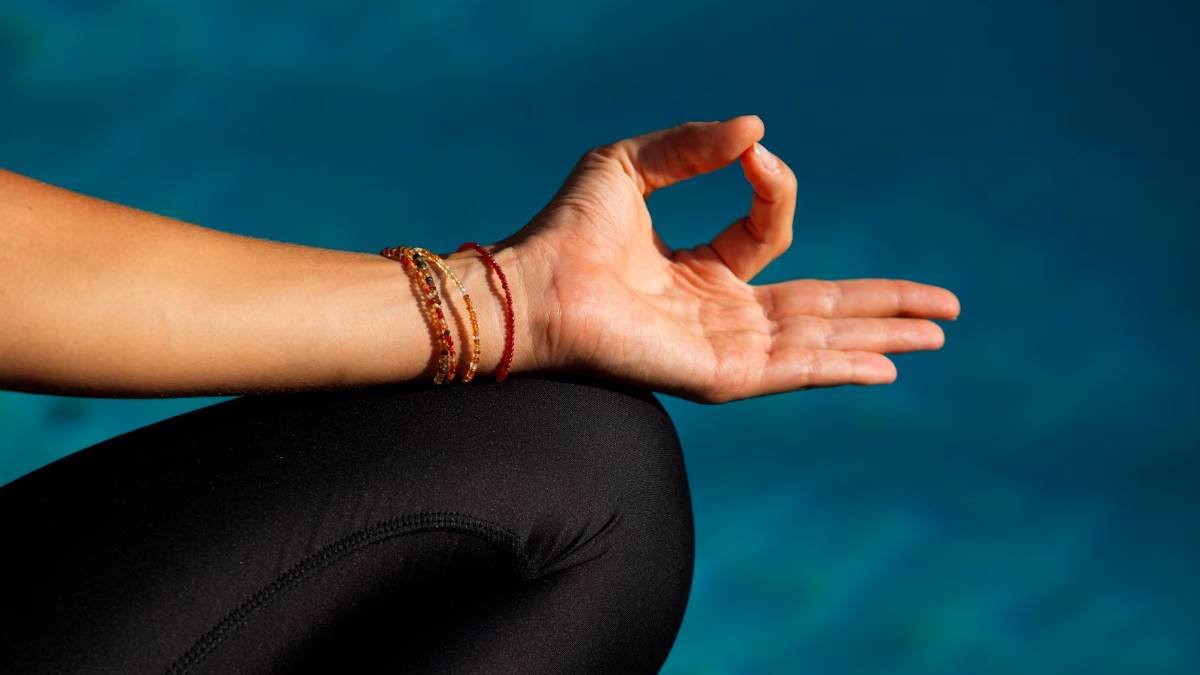
Gyan Mudra is performed by gently bringing the tip of the thumb and the tip of the index finger together, creating a small circle. The other three fingers remain naturally extended or relaxed.
The gesture is commonly practiced while sitting during meditation or yoga. You may see it in traditional depictions of yogis, monks, and meditation practitioners.
In traditional yogic philosophy, the fingers are sometimes associated with different elements or aspects of human experience. The thumb is often connected with universal consciousness or higher awareness, while the index finger is associated with the individual self.
When the two fingertips meet, the gesture is traditionally understood as representing the connection between individual awareness and universal consciousness.
Whether or not you follow these philosophical interpretations, the physical gesture can serve as a useful reminder to slow down, focus your attention, and become more present.
The Meaning Behind Gyan Mudra
Gyan Mudra carries a deeper symbolic meaning beyond its physical appearance.
The index finger is traditionally associated with the individual self, while the thumb represents higher consciousness. Bringing them together symbolizes the meeting of the individual and the universal.
The remaining three fingers are often interpreted as representing different qualities or states that can distract the mind, such as the three gunas in yogic philosophy: sattva, rajas, and tamas.
From this perspective, Gyan Mudra represents a movement toward greater awareness, wisdom, and inner balance.
For many practitioners, the gesture is less about achieving a specific physical result and more about creating a mental and spiritual intention.
Simply forming the mudra can become a cue that tells your mind:
“It’s time to pause, breathe, and focus.”
Potential Benefits of Gyan Mudra
Gyan Mudra is traditionally associated with several mental, emotional, and spiritual benefits. While scientific research specifically on Gyan Mudra is limited, practices that incorporate meditation, slow breathing, and mindfulness have been studied for their potential effects on well-being.
Here are some commonly associated benefits.
1. May Support Concentration
One of the most popular reasons people practice Gyan Mudra is to encourage concentration.
When you sit quietly with your hands in the mudra, you have a simple physical point of focus. This can make it easier to establish a meditation routine and reduce the tendency to become distracted.
Students, professionals, and anyone who spends long periods working or studying may find the gesture useful as part of a mindfulness break.
Rather than trying to force your mind to concentrate, the mudra can become a gentle reminder to return your attention to the present moment.
2. May Encourage Calm and Relaxation
Gyan Mudra is frequently practiced alongside slow, controlled breathing and meditation.
The mudra itself should not be viewed as a guaranteed treatment for stress or anxiety. However, taking a few minutes to sit quietly, breathe slowly, and reduce external stimulation can promote a greater sense of calm.
The combination of a steady posture, relaxed hands, and mindful breathing can create a simple ritual for transitioning from a busy state of mind to a more peaceful one.
3. Supports Meditation Practice
Gyan Mudra is closely associated with meditation.
For beginners, having a specific hand position can make meditation feel more structured. Instead of wondering what to do with your hands, you can simply place them comfortably on your knees and bring your attention to your breathing.
Over time, this position can become a familiar signal that marks the beginning of your meditation practice.
4. Encourages Mindfulness
Mindfulness is the practice of paying attention to the present moment with greater awareness.
Gyan Mudra can act as a physical anchor during mindfulness exercises. Whenever you notice that your thoughts have wandered, you can gently return your attention to your breath, posture, and the sensation of your fingertips touching.
This simple action can help create a stronger connection between body and mind.
5. May Help Create a Sense of Inner Balance
Traditional yoga philosophy often connects mudras with the flow and balance of energy within the body.
From this traditional perspective, Gyan Mudra is associated with knowledge, awareness, and mental balance.
Modern practitioners may interpret this more simply: taking regular moments to pause and reflect can help create a healthier balance between constant activity and periods of rest.
6. Can Be Easily Added to a Daily Routine
Another advantage of Gyan Mudra is that it requires very little time.
You can practice it during meditation, yoga, breathing exercises, or quiet reflection. Because there is no special equipment involved, it can easily become part of a morning or evening routine.
Even a few minutes of intentional stillness can provide an opportunity to step away from distractions and reconnect with yourself.
How to Practice Gyan Mudra
Practicing Gyan Mudra is simple.
Step 1: Find a Comfortable Position
Sit in a comfortable position. You can sit cross-legged on the floor, on a meditation cushion, or simply sit upright in a chair.
The most important thing is to choose a position that allows you to remain comfortable without unnecessary tension.
Keep your spine naturally upright and relax your shoulders.
Step 2: Relax Your Hands
Place your hands gently on your knees or thighs, with your palms facing upward or in another comfortable position.
Avoid gripping or creating unnecessary tension in your fingers.
Step 3: Form the Mudra
Gently bring the tip of your index finger to the tip of your thumb.
Allow the other three fingers to extend naturally.
The connection between the thumb and index finger should be light and comfortable. There is no need to press the fingertips together firmly.
Step 4: Close Your Eyes
If comfortable, gently close your eyes.
Take a few slow, natural breaths.
Notice the sensation of your breathing without trying to control it too much.
Step 5: Focus Your Attention
Bring your attention to your breath.
As you inhale, notice the sensation of the air moving through your nose or chest.
As you exhale, allow your body to relax.
If thoughts appear, simply notice them and gently return your attention to your breathing.
Step 6: Continue for a Few Minutes
Beginners can start with 3–5 minutes and gradually increase the duration if they find it comfortable.
There is no need to force yourself to meditate for a long time. Consistency is often more useful than duration.
When Is the Best Time to Practice Gyan Mudra?
There is no single “perfect” time to practice.
Many people prefer practicing in the morning because it creates a calm beginning to the day. Others enjoy using Gyan Mudra in the evening as a way to slow down before bedtime.
You can also practice it during a short mindfulness break during the day.
For example:
Morning: Practice for a few minutes after waking up.
Before studying: Use it as a short concentration ritual.
During a work break: Sit quietly and take several slow breaths.
Before meditation: Use the mudra to establish a focused state of mind.
Evening: Practice as part of a relaxing wind-down routine.
The best time is ultimately the time when you can practice consistently and comfortably.
How Long Should You Hold Gyan Mudra?
There is no universally required duration.
If you are new to meditation or mudras, start with just a few minutes. As you become more comfortable, you can gradually extend your practice to 10, 15, or even 20 minutes.
Some traditional practices may use mudras for longer periods, but beginners do not need to force themselves to sit for extended sessions.
Listen to your body and keep your hands, wrists, shoulders, and posture relaxed.
Common Mistakes to Avoid
Although Gyan Mudra is simple, a few common mistakes can make the practice less comfortable.
Pressing the Fingers Too Hard
The thumb and index finger only need gentle contact. Pressing them together strongly may create unnecessary tension.
Forcing the Other Fingers
Let your remaining fingers relax naturally. They do not need to be perfectly straight.
Creating Tension in the Shoulders
Your shoulders should remain relaxed. If you notice tension, take a slow breath and allow your upper body to soften.
Expecting Instant Results
Meditation and mindfulness practices generally work best when approached with patience.
Gyan Mudra should not be viewed as a magic gesture that instantly changes your physical or mental state. Instead, think of it as a simple tool that can support a broader practice of awareness and relaxation.
Gyan Mudra and Modern Life
Modern life can make it difficult to slow down.
We constantly receive notifications, messages, emails, advertisements, and other forms of information. Our attention is often divided between multiple tasks at once.
Gyan Mudra offers a remarkably simple way to create a small moment of intentional stillness.
You do not need a special room or expensive equipment. You can sit quietly almost anywhere, place your thumb and index finger together, close your eyes, and take a few mindful breaths.
The physical gesture itself may be small, but the habit it represents can be meaningful.
It reminds us that sometimes the most valuable moments are the ones in which we stop doing and simply become aware.
Gyan Mudra as a Symbol of Knowledge
The traditional symbolism of Gyan Mudra makes it particularly meaningful for people who are interested in personal growth and learning.
Knowledge is not simply about collecting information. In many philosophical traditions, wisdom also involves understanding yourself, recognizing your thoughts, and becoming more aware of how you respond to the world.
Practicing Gyan Mudra during meditation can therefore be seen as a symbolic reminder to cultivate curiosity, awareness, and self-reflection.
It can be especially meaningful when combined with journaling, reading, meditation, or other personal-development practices.
A Simple 5-Minute Gyan Mudra Practice
If you want to try it yourself, here is a simple routine:
Minute 1: Sit comfortably and relax your body.
Minute 2: Form Gyan Mudra by gently touching your thumb and index fingertip together.
Minute 3: Close your eyes and focus on slow, natural breathing.
Minute 4: Notice your thoughts without judging them. Whenever your attention wanders, gently return to your breath.
Minute 5: Take a few final breaths and slowly open your eyes.
You can repeat this simple practice every day.
The goal is not perfection. The goal is to create a small, consistent moment of awareness.
Final Thoughts
Gyan Mudra is a simple yet powerful symbol within the traditions of yoga and meditation. Its traditional meaning is connected with knowledge, wisdom, awareness, and the relationship between individual and universal consciousness.
Although scientific evidence specifically supporting Gyan Mudra is limited, incorporating the gesture into meditation, mindful breathing, and relaxation practices may provide a simple structure for developing greater focus and presence.
The beauty of Gyan Mudra is its accessibility. Anyone can try it, almost anywhere, without special equipment.
So the next time you need a moment to pause, sit comfortably, gently touch your thumb and index finger together, take a slow breath, and allow yourself a few minutes of quiet awareness.
Sometimes, a small gesture can become a powerful reminder to reconnect with your mind, your breath, and the present moment.